Department of Space
Union Minister Dr. Jitendra Singh Calls Upon Industry to Scale Up Investments in India's Space Sector
India's Private Space Ecosystem Expands to Over 400 Start-ups Following Space Sector Reforms: Dr. Jitendra Singh
Venture Capital and Technology Adoption Funds to Accelerate India’s Space Economy: Dr. Jitendra Singh
Minister Advocates Greater Philanthropy in R&D, Says Investment in Science is Service to Humanity
प्रविष्टि तिथि:
11 JUN 2026 5:43PM by PIB Delhi
Union Minister of State (Independent Charge) for Science & Technology and Earth Sciences; Minister of State in the Prime Minister's Office, Department of Atomic Energy, Department of Space, Personnel, Public Grievances and Pensions, Dr. Jitendra Singh today called upon industry leaders to significantly scale up investments and participation in India's space sector to accelerate the development of globally competitive indigenous technologies and reduce dependence on external sources.
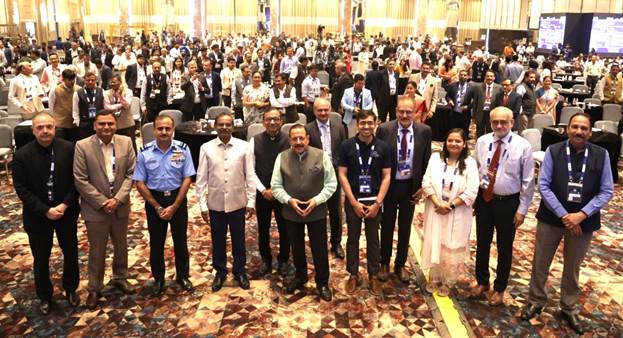
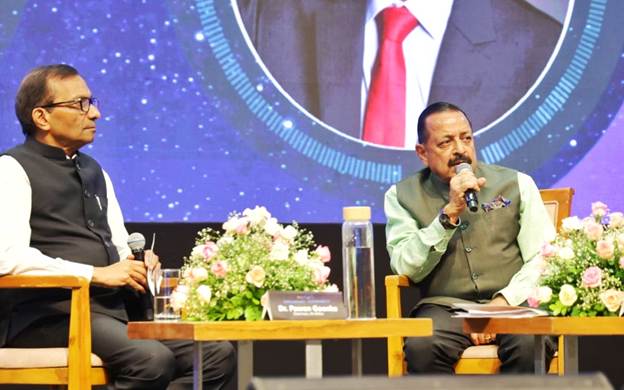
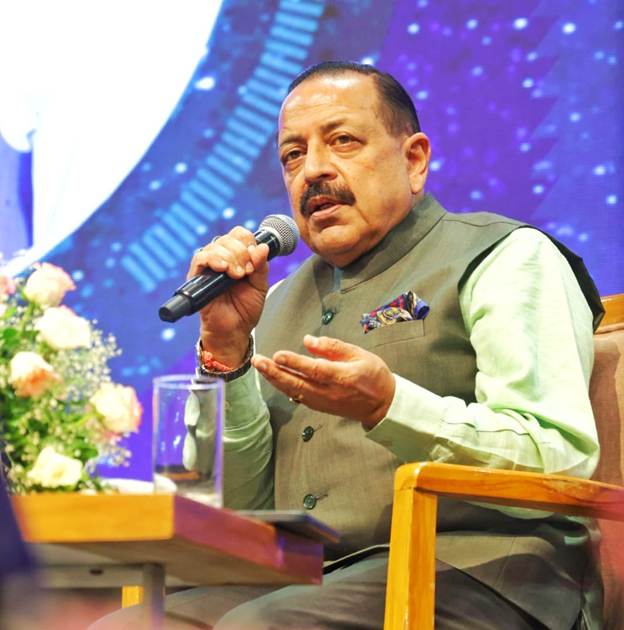
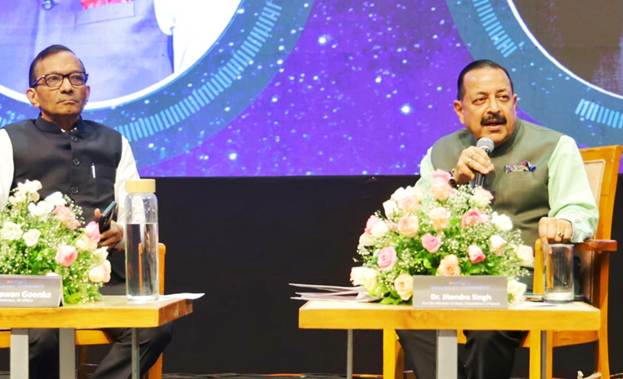
Addressing the 10th IN-SPACe Industry Connect, Dr. Jitendra Singh emphasised that while India's start-up ecosystem has demonstrated remarkable innovation and technological capability, achieving leadership in the global space economy would require stronger participation from established industries through enhanced funding, manufacturing strength and market access.
Dr. Jitendra Singh stated that the opening up of the space sector to private participation under the leadership of Prime Minister Shri Narendra Modi marked a historic shift in India's approach to strategic sectors. He described the reforms as a courageous decision that unlocked India's latent entrepreneurial potential and transformed the country's space ecosystem within a short span of time.
Highlighting the policy initiatives undertaken to support the sector, Dr. Jitendra Singh said that the space sector reforms were followed by the Indian Space Policy 2023, which provided strategic direction and regulatory clarity to stakeholders. He further noted that the liberalisation of the Foreign Direct Investment (FDI) regime has helped attract investments and improve India's integration with global value chains. The Minister described the establishment of the Indian National Space Promotion and Authorization Centre (IN-SPACe) as a major institutional reform that has enabled, promoted, authorised and supervised non-governmental participation across the entire space value chain.
Dr. Jitendra Singh highlighted the Government's efforts to strengthen the innovation ecosystem through financial and institutional support mechanisms. He informed that a ₹1,000 crore Venture Capital Fund and a ₹500 crore Technology Adoption Fund have been introduced to facilitate innovation and commercialisation in the sector. He added that initiatives relating to seed funding, incubation support, skill development programmes and an AICTE-approved Space Technology curriculum are contributing towards building a future-ready talent pipeline for the country's expanding space economy.
Referring to the rapid growth of India's private space ecosystem, the Minister noted that what began with a handful of pioneering enterprises has now evolved into an ecosystem comprising over 400 start-ups and several hundred large and small companies. He stated that Indian enterprises are today developing launch vehicles, satellites, propulsion systems, Earth observation applications, space situational awareness capabilities and a range of downstream solutions. Companies such as Skyroot Aerospace, Agnikul Cosmos, Pixxel, Galaxeye, Digantara and Dhruva Space, he said, exemplify India's entrepreneurial capabilities and technological innovation.
Calling for the emergence of a stronger culture of philanthropy in scientific research, Dr. Jitendra Singh noted that while philanthropic contributions have traditionally been directed towards charitable causes, investment in research and innovation should also be recognised as an important service to society.
The Minister also appealed to industry stakeholders to candidly communicate the challenges and constraints they encounter while operating within the evolving space ecosystem. Assuring them of the Government's support, he stressed the importance of maintaining an open and constructive dialogue between policymakers and industry.
Dr. Jitendra Singh acknowledged the industry's concerns regarding the need for faster approvals, streamlined processes and an effective single-window mechanism. He emphasised that the objective of governance should be to incentivise innovation rather than create unintended barriers.
Dr. Jitendra Singh also emphasised the need for greater collaboration between government, industry, academia, investors and state governments to realise the vision of Atmanirbhar Antariksh. He observed that the agility of start-ups must be complemented by the scale, financial strength and execution capabilities of established industries.
He highlighted that India possesses abundant talent and entrepreneurial energy, and what had long been missing was an enabling policy environment. The reforms initiated under the leadership of Prime Minister Shri Narendra Modi, he said, had created that ecosystem and opened new avenues for innovation and enterprise.
Concluding his address, Dr. Jitendra Singh reiterated that India's aspirations in the space sector cannot be fulfilled through government efforts alone. He called upon all stakeholders to work together with ambition, confidence and commitment to establish India as a leading force in the global space economy.
***
NKR/NM
(रिलीज़ आईडी: 2271728)
आगंतुक पटल : 2337