Posted On:
27 NOV 2026 3:27PM by PIB Delhi
An innovative way to avoid colour blurring using Halide Perovskite Nanocrystals can enable stable, scalable, flexible, and cost-effective white-lighting technologies suitable for white light emitting diodes and smartphones.
The commercial white light-emitting diodes (WLEDs) used in our homes and smartphones are extremely energy-efficient, but they have a few drawbacks. They rely on expensive, rare-earth elements and complex, high-temperature manufacturing. Furthermore, once built, the tone of the white light is fixed and cannot be adjusted.
To find a simpler, tunable, and more cost-effective alternative, researchers are looking toward a new class of materials called all-inorganic halide perovskite nanocrystals (chemical formula CsPbX₃, where X can be chlorine, bromine, or iodine) which are bright, low cost and emit exceptionally bright and pure colors.
However, these Perovskite nanocrystals suffer from a critical drawback known as anion exchange. When nanocrystals of different halide compositions—such as green-emitting CsPbBr₃ and red-emitting CsPbI₃—come into close contact, their halide ions rapidly migrate and swap between crystals. As a result, the two intended colors blend into an unwanted intermediate orange color and with this color blurring can occur within minutes.
A team of researchers from the Centre for Nano and Soft Matter Sciences (CeNS), Bengaluru — an Autonomous Institute under the Department of Science and Technology (DST), Government of India — in collaboration with the Indian Institute of Technology (IIT) Delhi, has developed an innovative dual-protection strategy to lock the colors in place.
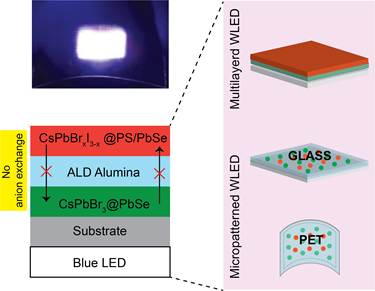
Fig. Demonstration of perovskite-based phosphor-converted WLEDs, their individual components, and a real-time photograph of the operational pc-WLED. The WLEDs were fabricated on both glass and flexible PET substrates. Green and red micropatterning was achieved through spray coating to fabricate the micropatterned WLED.
First, the team consisting of Gauri Sharma, Swati Khurana, Sameer Sapra, Pralay K. Santra reduced the halide vacancies on the crystal surface with a material called lead selenide. This removed the primary pathway for ion migration without degrading the material's brightness or color.
Second, they introduced atomic layer deposition (ALD) encapsulation by depositing an ultrathin, transparent protective coating of aluminum oxide (alumina, Al₂O₃) — only about 5 to 6 nanometers thick. This layer acts as a physical barrier that blocks ions from diffusing between adjacent color-emitting layers.
Using a simple and scalable spray-coating technique together with micropatterning, the researchers fabricated multi-layered white-LED devices on both rigid glass and flexible plastic (PET) substrates. The devices operated continuously for up to 24 hours in optimised versions — with stable white emission whose colour stayed close to that of ideal white light even when heated and cooled. They also established that tone of the white light can be converted to dim or warm tone just by changing the electrical current.
This work published in the journal Small represents an important step toward stable, scalable, flexible, and cost-effective white-lighting technologies but needs a bit of refinement to handle the toxicity of lead and find ways of making it eco-friendly before hitting the general market.
Publication link: DOI: https://doi.org/10.1002/smll.202512820
*****
SG/FT/AA