Posted On:
12 NOV 2026 6:11PM by PIB Delhi
The journey of the sanitation worker from Puducherry, Mr Muthuvel (name changed) highlights how NAMASTE Scheme has contributed to improved workplace safety, livelihood security and social recognition.
Through initiatives such as NAMASTE, the Government of India continues to reaffirm its commitment to protecting, respecting and empowering sanitation workers who play an indispensable role in maintaining public health and cleanliness across the country.
The National Action for Mechanised Sanitation Ecosystem (NAMASTE) Scheme of the Ministry of Social Justice and Empowerment, Government of India, continues to strengthen occupational safety, dignity and livelihood opportunities for sanitation workers across the country.
Demonstrating the positive impact of the Scheme, Mr Muthuvel, a 58-year-old sanitation worker from Oulgaret Municipality, Puducherry, has experienced significant improvements in his working conditions, health and financial stability following the provision of Personal Protective Equipment (PPE) and occupational safety orientation under the initiative.
Belonging to the Other Backward Classes (OBC) community, the beneficiary has been engaged in sewer line cleaning for more than ten years. Having studied up to Class 5, he relied on his occupation to support a family of four, earning approximately ₹9,000–10,000 per month.
Despite his dedication to providing essential sanitation services, the absence of adequate protective equipment exposed him to hazardous waste, harmful gases and other occupational health risks. Frequent health complications and associated medical expenses further affected his ability to maintain regular employment and financial stability.
The challenges extended beyond occupational hazards and economic difficulties. Social stigma associated with sanitation work also affected his professional recognition and sense of dignity. With limited access to essential safety resources, he aspired to secure healthier working conditions, reduce occupational risks and provide greater financial security for his family.
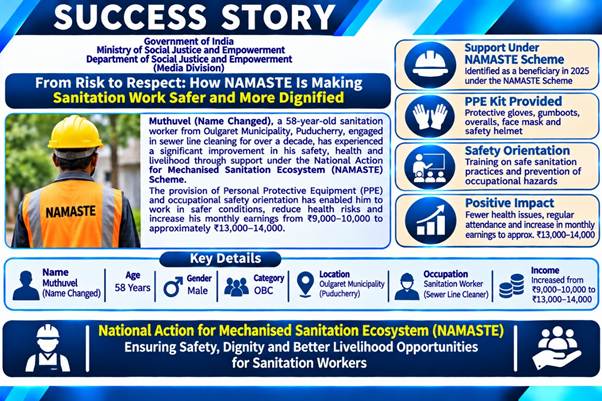
A significant turning point came in 2025 when he was identified as a beneficiary under the National Action for Mechanised Sanitation Ecosystem (NAMASTE) Scheme. Through the intervention, he received a comprehensive Personal Protective Equipment (PPE) kit comprising protective gloves, gumboots, overalls, a face mask and a safety helmet. He was also provided orientation on safe sanitation practices, appropriate use of protective equipment and measures to prevent occupational hazards.
The support brought a meaningful improvement in his everyday working conditions. With access to protective equipment and increased awareness of workplace safety, he became better equipped to perform his duties while reducing direct exposure to hazardous substances. The adoption of safer working practices contributed to fewer health complications, improved attendance and greater consistency in his professional responsibilities.
The positive impact of the intervention was also reflected in his financial circumstances. His monthly earnings, which previously ranged between ₹9,000 and ₹10,000, increased to approximately ₹13,000–14,000. Improved health and more regular attendance enabled him to maintain greater work continuity and contribute more consistently to his family's financial needs. The increase in earnings also helped strengthen household financial stability and reduce the burden associated with recurring medical expenses.
Beyond the improvements in occupational safety and income, the intervention contributed to strengthening his confidence and professional dignity. Access to protective equipment and institutional support reinforced the importance of recognising sanitation workers as essential contributors to public health and community well-being. The beneficiary also experienced greater recognition of his work within the community, reflecting a positive shift towards safer and more dignified sanitation practices.
For the beneficiary, the PPE kit represented more than protective equipment. It provided greater confidence in carrying out his responsibilities, strengthened his understanding of occupational safety and reinforced the assurance that his health, well-being and contribution to society are valued.
The NAMASTE Scheme seeks to promote the safety and dignity of sanitation workers through interventions aimed at reducing occupational hazards, encouraging mechanised sanitation practices and strengthening access to appropriate safety measures and institutional support. By facilitating protective equipment and safety orientation, the initiative contributes to healthier working environments and improved socio-economic opportunities for sanitation workers.
*****
SS-180-TAR/KV/GA/RK