Posted On:
06 NOV 2026 8:50PM by PIB Delhi
For Mr. Ramesh Kumar (name changed), the NAMASTE Scheme has provided more than a set of safety equipment. It has strengthened his ability to work with greater security and dignity. His experience reflects the importance of extending occupational protection, safety awareness and support to sanitation workers, whose services are essential to public health and cleanliness.
At the age of 60, Mr. Ramesh Kumar, a Scheduled Caste sanitation worker from Pondicherry, has experienced a positive change in his working conditions through the National Action for Mechanised Sanitation Ecosystem (NAMASTE) Scheme. His journey highlights the importance of occupational safety, protective equipment and awareness in ensuring the health and dignity of sanitation workers.
A sewer and septic tank cleaner with the Pondicherry Municipality for more than 15 years, Mr. Ramesh Kumar had spent years working in hazardous conditions without adequate personal protective equipment.
Prolonged exposure to hazardous waste resulted in recurring skin infections and respiratory discomfort, affecting his ability to work consistently and increasing his medical expenses. Having studied up to Class 5, he is the sole earning member of a family of four, and health-related interruptions and medical costs placed additional pressure on the household.
A significant change came in 2025, when he received support under the NAMASTE Scheme of the Ministry of Social Justice and Empowerment. He was provided with a complete Personal Protective Equipment (PPE) kit, including protective overalls, heavy-duty gloves, gumboots, a face mask and a safety helmet. He also received awareness training on safe sanitation practices and the prevention of occupational health risks.
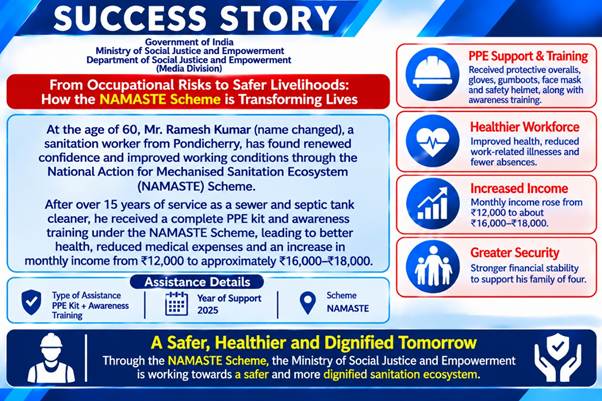
The assistance brought a positive change in his day-to-day work. With access to protective equipment and greater awareness of safety practices, he was able to perform his duties with improved protection and confidence. His health improved considerably, work-related absences reduced and medical expenses declined.
The improvement in his health and work consistency also contributed to better financial stability. His monthly income, which was approximately ₹12,000 before the intervention, increased to around ₹16,000–₹18,000 after receiving the support. This has helped him meet household expenses and continue supporting his family.
****
SS-170-TAR/KV/GA/RK