Posted On:
05 NOV 2026 5:38PM by PIB Delhi
UBC 63, a poorly populated group of stars, bound loosely by gravity (Galactic open cluster) about 4892 light years away from the Earth, which was previously identified as a single star cluster, has now been found to be composed of two distinct star clusters.
The chance discovery provided a rare opportunity to study the aftermath of a close flyby between two stellar systems and offers new insights into the dynamical evolution of star clusters in the Milky Way.
Star clusters are important building blocks of galaxies. They are groups of stars that form within the same large reservoirs of gas and dust and subsequently evolve under the influence of their own gravity as well as the broader Galactic environment. Among them, historically, UBC 63 has remained largely overlooked, with limited literature providing only preliminary parameter estimates that presumed it to be a single cluster.
A team led by Astronomers from India, including a Department of Science and Technology (DST) INSPIRE Senior Research Fellow (SRF) and researchers of the Gauhati University, and researchers of the Indian Institute of Astrophysics (IIA), a DST autonomous institution, who set out to investigate star formation dynamics within the UBC 63 cluster using data from the European Space Agency's (ESA) Gaia mission discovered to their surprise that UBC 63 actually consists of two clusters, UBC 63A and UBC 63B, that recently passed remarkably close to each other.
Encounters between star clusters are relatively uncommon. Detecting a system soon after such an encounter can therefore provide valuable clues about how gravitational interactions influence cluster structure, motion and long-term evolution.
Gaia which provides exceptionally precise measurements of the positions and motions of stars across the Milky Way, showed that the two clusters belong to starkly different ages.
The researchers studied the brightness and colours of the member stars of UBC 63 and found that the stars formed two distinct sequences in the colour magnitude diagram, a key astronomical tool used to investigate the evolutionary stages of star clusters. This indicated that UBC 63 might actually consist of two separate stellar systems.
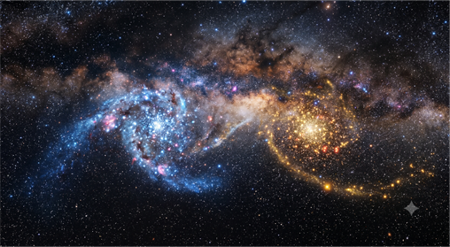
Fig: Artist’s impression of two star undergoing a close encounter. (Credit: Gemini)
A detailed analysis of the stellar motions and other properties, using robust machine learning techniques and advanced dynamical simulations powered by high-performance computing, confirmed the presence of two distinct populations, now designated UBC 63A and UBC 63B. The two clusters have markedly different ages. UBC 63A is a young cluster, approximately 21 million years old, whereas UBC 63B is much older, with an estimated age of about 562 million years. This substantial age difference demonstrates that the two systems did not originate as a single cluster.
The researchers then investigated how two clusters with such different histories came to be located so close to each other. By simulating their motions through the Milky Way, the study found that, at the time when the younger cluster formed, the two systems were separated at about 60 parsecs (approx. 196 light years). The two clusters came remarkably close to one another about 6 million years ago, up to a separation of only about 7 parsecs (approx. 23 light years).
Today, the two clusters are approximately 26 parsecs (approx. 85 light years) apart. Their motion shows that they are not gravitationally bound to each other. Instead, they are moving apart after a close encounter.
The study demonstrates the power of modern astronomical surveys such as Gaia to uncover hidden structures that can remain unnoticed when stars are viewed only in projection on the sky.
The research published in Astronomical Journal was carried out by Samrat Biswas, an INSPIRE Senior Research Fellow (SRF) at Gauhati University; Biman J Medhi from Gauhati University; Sergio Messina (INAF – Catania Astrophysical Observatory); Zhanpeng Zhu (Shanghai Normal University); Songmei Qin (Shanghai Astronomical Observatory); Sukanta Deb (Cotton University); A. H. Sheikh (also an INSPIRE SRF at Gauhati University); H. S. Das (Assam University); Motohide Tamura (The University of Tokyo); Maheswar Gopinathan (Indian Institute of Astrophysics) and Ram Sagar (Indian Institute of Astrophysics).
Publication Link:https://iopscience.iop.org/article/10.3847/1538-3881/ae8c38
***
NKR/FT/AA