Posted On:
23 OCT 2026 6:59PM by PIB Delhi
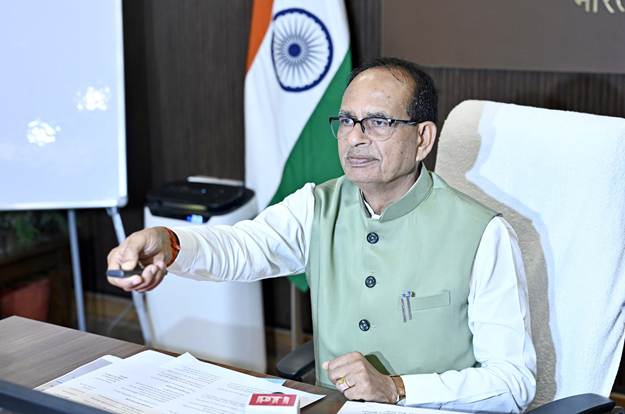
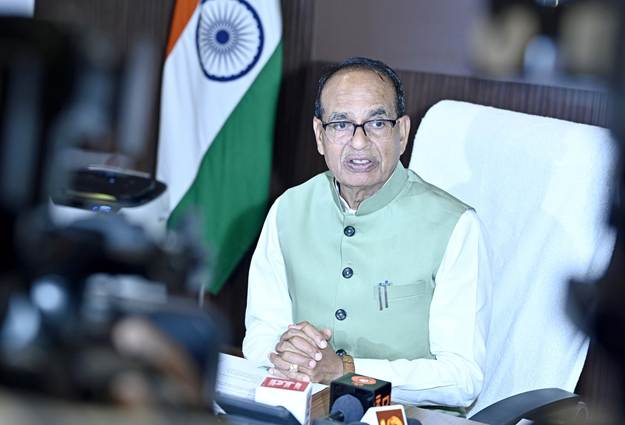
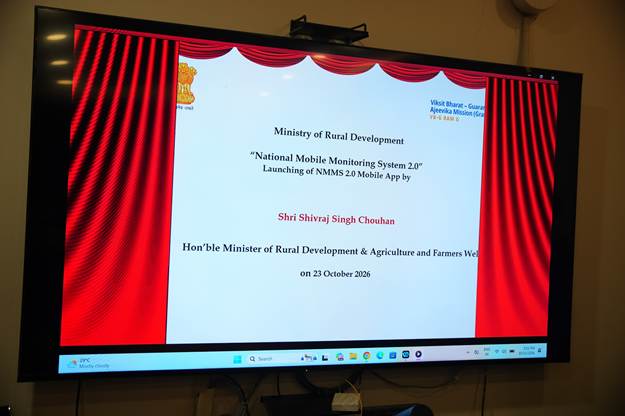
Union Minister for Agriculture and Farmers’ Welfare and Rural Development, Shri Shivraj Singh Chouhan today launched an enhanced, security-focused version of the National Mobile Monitoring System (NMMS) app for recording workers’ attendance under the VB-G RAM G. Developed with technical support from the Indian Institute of Technology Madras and relevant technical agencies, the upgraded version introduces stronger device-level security, AI-based verification and safeguards against app tampering and fraudulent attendance. It also provides for offline attendance recording in areas without network connectivity and an exception mechanism for genuine workers facing authentication difficulties. Addressing a press conference in New Delhi, Shri Chouhan said the government’s priority was to ensure employment for rural workers, protect their wages and ensure that public funds were used transparently and for their intended purpose. He emphasised that technology must strengthen accountability without allowing genuine workers to be denied their entitlements because of connectivity or technical problems. Rural Development Secretary Rohit Kansal, Joint Secretary Rohini R. Bhajibhakre and other officials were present at the event.
VB-G RAM G generates nearly 46 crore person-days
Shri Chouhan said the vision of Viksit Bharat is being advanced alongside efforts to build developed villages across the country. The VB-G RAM G scheme, implemented across all rural areas from July 1, 2026, has provided employment support to rural households, he said. Sharing the scheme’s progress, the Minister said work had been undertaken at 31.23 lakh worksites across more than 2.41 lakh Gram Panchayats. In response to demand, employment had been provided to more than 3.65 crore workers belonging to 2.89 crore rural households. Nearly 46 crore person-days have been generated so far, of which approximately 40 crore have been recorded through face authentication, he said. The Centre has allocated ₹95,692 crore for the scheme in the financial year 2026-27. Including the states’ share, the total provision exceeds ₹1.51 lakh crore. A mother sanction of ₹26,126 crore has already been issued to states and Union Territories as the first instalment.
Enhanced face authentication to curb fraudulent attendance
The Union Minister said complaints of fake attendance and wages being claimed in the names of other individuals had necessitated stronger verification measures. Face authentication was introduced in the NMMS app in March 2026 to address these concerns. Andhra Pradesh, Karnataka, Kerala, Odisha, Tamil Nadu, Telangana, Chhattisgarh, Rajasthan and Uttarakhand have achieved 100% attendance recording through face authentication at worksites, he said. The system has helped substantially reduce the scope for impersonation and fraudulent entries. The latest version builds on a security update released in the last week of September 2026. Shri Chouhan said cybersecurity required continuous improvement to keep pace with evolving attempts at technological breaches. The upgraded app integrates Google Play Integrity and incorporates device-level security checks, secure data transmission, safeguards against cloning and tampering, and liveness detection. These features are designed to verify that the person appearing before the camera is a real, live worker rather than a dummy image or an old photograph. AI-based face verification has also been refined to account for differences across states and geographical regions.
Offline attendance and exception mechanism to protect genuine workers
Emphasising that technological safeguards must not come at the expense of workers’ rights, Shri Chouhan said no genuine worker should lose employment or wages because of poor network connectivity or technical difficulties. Where network connectivity is unavailable at a worksite, attendance can be recorded offline under the prescribed procedure and uploaded once the device reaches an area with network access, after the muster roll is closed. An authorised exception mechanism is also available when face authentication fails for elderly workers or persons with disabilities, or when a mobile device encounters technical problems. In such cases, the mate or field worker can submit a request under the prescribed process.
Multi-layered checks before wage payments
Shri Chouhan explained that recording attendance through the app alone does not automatically determine wage payments. A multi-layered verification system is in place to ensure that payments correspond to genuine work. The system includes an AI-based photo de-duplication module that identifies suspicious or repeated photographs. Where such entries are detected, the wage list and Fund Transfer Order (FTO) are automatically withheld until the necessary checks are completed. The electronic Measurement Book (e-MB) records the actual work carried out at the site, as physically measured by technical engineers. Wage amounts are determined on the basis of this measurement, following which payments are transferred directly to workers’ bank accounts through the prescribed Direct Benefit Transfer (DBT) process. This ensures traceability of transactions. The Minister said random spot inspection teams had been deployed in districts to verify the authenticity of work on the ground. Social audits and public disclosure mechanisms have also been implemented. States have been directed to closely monitor the use of suspicious or unauthorised applications. Where such misuse is detected, they have been instructed to collect digital evidence promptly and initiate criminal proceedings under the applicable laws. Chouhan reiterated that employment would be provided to those who need it, but corruption and irregularities would not be tolerated.
Farmer ID drive nears 11-crore milestone ahead of deadline
Sharing an update on another major initiative aimed at improving agricultural service delivery, Shri Chouhan said the nationwide Farmer ID drive was progressing rapidly to expand the use of technology in agriculture and make government schemes more accessible to farmers. Under the target set by Prime Minister Shri Narendra Modi, 11 crore Farmer IDs are to be created by December 2027. India has already generated 10 crore 99 lakh 70 thousand Farmer IDs, bringing the country within 30,000 IDs of the 11-crore milestone more than a year ahead of the deadline. Shri Chouhan said the achievement marked significant progress towards technology-enabled agricultural services and easier access to government schemes for farmers.
***
PU