Ministry of Personnel, Public Grievances & Pensions
Posted On:
23 OCT 2026 5:25PM by PIB Delhi
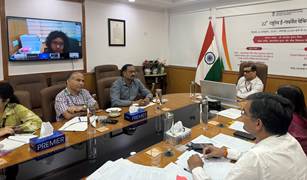
The Department of Administrative Reforms and Public Grievances (DARPG) organised the 22nd National e-Governance Webinar (NeGW) on 23 October 2026. The webinar was chaired by Shri Avanish Kumar Mishra, Joint Secretary, DARPG, and brought together officials from Central Ministries, State Governments, districts, local bodies, and temple and shrine management bodies to share approaches for technology-enabled governance.
The webinar showcased two Gold Award-winning initiatives recognised under the National Awards for e-Governance 2026: TRINETRA – AI-Based Video Surveillance System for the Mahakal Rudrasagar Integrated Development Area (MRIDA), including Mahakaleshwar Temple, Ujjain, Madhya Pradesh; and the Panchayat Advancement Index (PAI) – Data-Driven Governance for Viksit Bharat, led by the Ministry of Panchayati Raj. The initiatives demonstrated how AI-enabled surveillance and data analytics can support public safety, performance monitoring and evidence-based planning.
The National e-Governance Webinar Series provides a platform to disseminate award-winning e-Governance initiatives and support their adoption and replication, particularly at the State, district and local body levels.
TRINETRA – AI-Based Video Surveillance System
Shri Pratham Kaushik, (IAS) Administrator, Shri Mahakaleshwar Temple, Ujjain, presented TRINETRA, implemented for MRIDA in partnership with Ujjain Smart City Limited and the Shri Mahakaleshwar Temple Management Committee. The initiative adapts and scales the surveillance model of the Shri Mata Vaishno Devi Shrine Board to address the substantial increase in pilgrim footfall at Mahakaleshwar Temple and the surrounding area.
TRINETRA deploys more than 450 AI-enabled cameras, video analytics, facial recognition and predictive crowd monitoring through an Integrated Command & Control Centre. The system supports real-time surveillance, crowd-flow management and emergency response coordination. The project brief reports that emergency response time has reduced from 15–20 minutes to under five minutes. It also records 552 missing-person cases resolved, 53 lost items recovered, 10 theft incidents intercepted and video evidence provided in seven police cases.
The initiative provides a technology-enabled model for improving pilgrim safety and managing high-footfall religious and public congregation sites, while supporting future replication and scaling.
Panchayat Advancement Index – Data-Driven Governance for Viksit Bharat
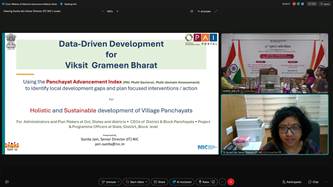
Smt. Sunita Jain, Senior Director (IT), NIC, presented the Panchayat Advancement Index (PAI), a data-driven framework of the Ministry of Panchayati Raj to assess Gram Panchayat performance across nine Localized Sustainable Development Goal (LSDG) themes. PAI uses standardised indicators, integrated data, validation workflows, analytical dashboards and Panchayat scorecards to assess development outcomes and identify priority areas for intervention.
|
|
|
The presentation on the Panchayat Advancement Index (PAI) highlighted its role in data-driven rural governance across nine development themes, using 150 indicators and 230 data points to identify gaps and guide targeted action. It enables officials at the village, block, district, State and Central levels to determine priorities, assign responsibilities and monitor progress. Designed as a development report card rather than merely a ranking exercise, the PAI portal covers around 2.6 lakh Gram Panchayats, supporting evidence-based planning and more targeted and sustainable rural development.
The webinar highlighted how the two initiatives apply technology and data to different governance contexts, strengthening safety and crowd management at a major pilgrimage destination and supporting transparent, measurable and evidence-based development at the grassroots. More than 360 officials participated in the session.
The session concluded by acknowledging the valuable contributions of the speakers and the active participation of officials and stakeholders. Participants were encouraged to consider the approaches presented for adoption and replication in their respective jurisdictions.
**********
NKR/Anand