Posted On:
23 OCT 2026 4:54PM by PIB Delhi
Scientists have uncovered a pivotal mechanism explaining why the matter around rapidly spinning black holes, also called accretion disk may emit highly oscillating X-rays.
The study which zeroes in on a single physical mechanism to produce these flickering of X-rays across a broad range of frequencies reduces randomness in theoretical modeling of these exotic astronomical objects.
Black hole, the most compact object in the Universe, with massive gravity that prevents even light from escaping, can spin about its axis. Matter pulled toward a black hole by its strong gravity is called an accretion flow and it falls inward at high speed, producing non-thermal radiation.
This radiation often shows nearly regular variations in brightness, called QPOs. In black hole X-ray binaries, these oscillations can have frequencies ranging from less than one cycle per second to several hundred cycles per second.
Previous studies could either explain the low frequency oscillations, or had to invoke other exotic process to explain high frequency oscillations.
In order to fill the gap, Scientists from the Aryabhatta Research Institute of Observational Sciences (ARIES), an autonomous institute of Department of Science and Technology (DST), Government of India took up the task of explaining how the oscillations of accretion shocks around a spinning black hole produce this wide range of frequencies.
They used a computer simulation developed by the Numerical and Theoretical Astrophysics Group at ARIES to model the behaviour of viscous accretion flows around black holes. Scientists from Nicolaus Copernicus Astronomical Center, Poland and MJP Rohilkhand University, Bareily were also involved in this work led by Mr. Sanit Debnath and Dr. Indranil Chattopadhyay from ARIES.
The simulation follows the movement of matter while ensuring that important physical quantities such as energy, mass, and momentum are conserved. This helped the researchers understand how these rapidly moving flows behave and how their oscillations can produce the observed variations in radiation from black holes.
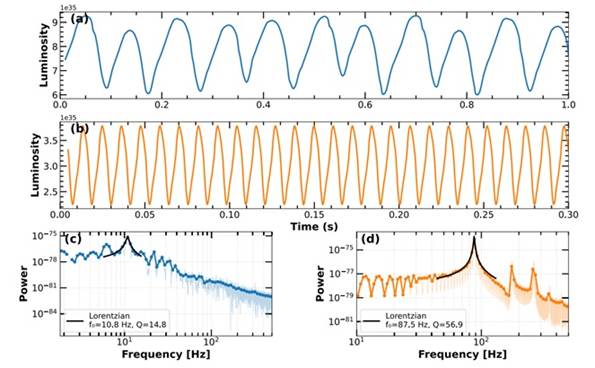
Fig :Time series of luminosity for two different 𝛼=0.01, 0.035, and their corresponding power density spectrum (PDS) is shown for the model A91.2. We assume black hole mass is 10M⊙.
Their findings were recently published in the Journal of High Energy Astrophysics (JHEAP). The researchers found that when the viscosity of the accretion flow becomes higher than a certain critical value, the normally stable shock in the disc becomes unstable and starts to oscillate. These oscillations in the accretion disc can produce the regular variations in emitted radiation, observed as nearly periodic flickering of light know as quasi-periodic oscillations (QPOs).
The study also revealed that the spin of a black hole has a strong influence on the movement of the shock and the frequency of QPOs. In slowly spinning black holes, viscosity pushes the average position of the oscillating shock farther away from the black hole, resulting mainly in low-frequency QPOs.
In contrast, rapidly spinning black holes pull the shock closer to the black hole, producing QPOs over a much wider range of frequencies. For black holes with very high spin the predicted QPO frequencies can exceed 100 Hz for a black hole about ten times the mass of the Sun, similar to the high-frequency variations observed in black hole X-ray binary systems.
The simulations also show that as the black hole spins faster, the shock moves closer to the black hole and its oscillations become more pronounced. Interestingly, the study found a clear relationship between the QPO frequency and the gradient of photon flux with the frequency or in other words the photons index, providing another useful clue for understanding the energetic environment around spinning black holes.
These findings provide a clear physical explanation for why rapidly spinning black holes in X-ray binary systems can produce high-frequency QPOs. According to the researchers, this is the first numerical study to simulate an accretion flow in presence of internal friction or viscosity and where the thermodynamic relations of a relativistic fluid has been implemented. This simulation demonstrates how the black hole’s spin can influence the frequency of QPOs, in the most realistic scenario.
The results can help scientists better understand the origin of the rapid variations in X-ray emission observed from these systems.
Publication link:
https://www.sciencedirect.com/science/article/pii/S2214404826001059
****
NKR/FT/AA