Ministry of Fisheries, Animal Husbandry & Dairying
Posted On:
23 OCT 2026 3:17PM by PIB Delhi
The Department of Fisheries, Government of Madhya Pradesh, in association with the Department of Fisheries, Ministry of Fisheries, Animal Husbandry & Dairying (MoFAHD), Government of India (GoI) & NFDB, organised the Fisheries Investors & Exporters Conclave 2026 in Bhopal on 23 October 2026 to strengthen investment, processing, value addition and export opportunities in inland fisheries.
The Conclave was graced by Dr. Mohan Yadav, Hon’ble Chief Minister of Madhya Pradesh; Shri Rajiv Ranjan Singh, Hon’ble Union Minister of Fisheries, Animal Husbandry and Dairying and Panchayati Raj; Prof. S. P. Singh Baghel, Hon’ble Minister of State for Fisheries, Animal Husbandry and Dairying and Panchayati Raj; and Shri Narayan Singh Pawar, Hon’ble Minister, Department of Fishermen Welfare and Fisheries Development, Government of Madhya Pradesh, Dr Abhilaksh Likhi, Secretary, Department of Fisheries, Government of India, Chief Secretary, Government of Madhya Pradesh, Shri Ashok Barnwal. Investors, exporters, fish farmers, entrepreneurs from India and abroad along with senior officials of the Central and State Governments and other stakeholders across the fisheries value chain, were also present.
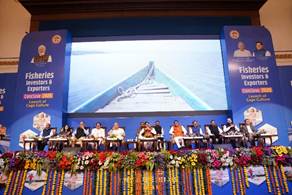
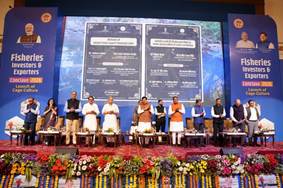
The Conclave brought together investors, exporters, fishers, more than 1,000 fish farmers from across Madhya Pradesh, fisheries cooperatives, Fish Farmer Producer Organisations (FFPOs), entrepreneurs, start-ups, processors, financial institutions, research organisations and other stakeholders across the fisheries value chain.
India's fish production reached 197.75 lakh MT in 2024–25, of which inland fisheries contributed 151.60 lakh tonnes, accounting for nearly three-fourths of the country's total fish production. India's seafood exports were valued at ₹73,890 crore in 2025–26. The Conclave focused on connecting this production base with processing, cold-chain infrastructure, quality assurance, market access and exports.
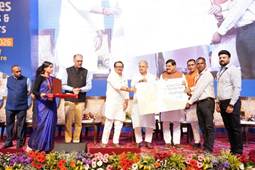
Shri Rajiv Ranjan Singh, Hon’ble Union Minister of Fisheries, Animal Husbandry and Dairying and Panchayati Raj, Government of India, and Dr. Mohan Yadav, Hon’ble Chief Minister of Madhya Pradesh, released the Madhya Pradesh Fisheries Investment and Export Guidelines, 2026, and the Standard Operating Procedures (SOPs) of Inland State Export Potential. These aim to facilitate investment across hatcheries, fish seed and feed, reservoir and cage fisheries, aquatic animal health, processing, cold-chain infrastructure, logistics, value addition and market development. Madhya Pradesh has been notified by the Central Government as a Reservoir Fisheries Cluster.
The programme also featured the virtual inauguration of integrated cage culture units and the handover of administrative approval for the Integrated Development of Reservoirs and Amrit Sarovars in Madhya Pradesh.
Under the Pradhan Mantri Matsya Sampada Yojana (PMMSY), Hon’ble Union Minister of Fisheries, Animal Husbandry and Dairying and Panchayati Raj, Shri Rajiv Ranjan Singh handed over the Administrative Approval for the Integrated Development of Reservoirs in Madhya Pradesh, under the Union Budget Announcement 2026–27, to the Hon’ble Chief Minister of Madhya Pradesh. The initiative envisages the development of 49 reservoirs in the State at an approved project cost of ₹8755.60 Lakh, and 5 Amrit Sarovar at an approved project cost of ₹69 Lakhs.
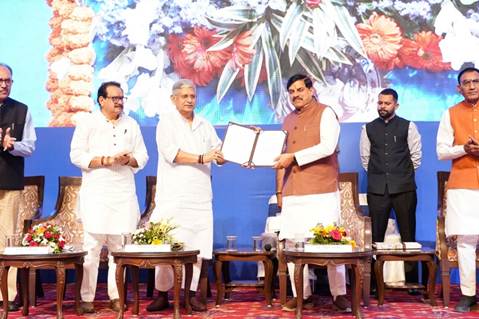
The initiative aims to harness the fisheries potential of reservoirs, enhance fish production and productivity, strengthen infrastructure, generate livelihood and employment opportunities, and improve the socio-economic well-being of fishers and fish farmers in the state.
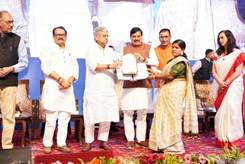
Shri Rajiv Ranjan Singh, Hon’ble Union Minister of Fisheries, Animal Husbandry and Dairying and Panchayati Raj, Government of India, and Dr. Mohan Yadav, Hon’ble Chief Minister of Madhya Pradesh, distributed certificates to beneficiaries under various fisheries-related initiatives, including the Kisan Credit Card (KCC) for fisheries, fisheries cooperatives, fisheries start-ups and the Performance Grant under the Pradhan Mantri Matsya Kisan Samridhi Sah-Yojana (PM-MKSSY).
Dr. Mohan Yadav, Hon’ble Chief Minister of Madhya Pradesh, highlighted the fisheries sector’s growing potential as a driver of investment, entrepreneurship, industrial development and exports, noting the increasing participation of investors, exporters, entrepreneurs and start-ups. Emphasising water resource management, he stated that the State’s irrigation potential had increased to 60 lakh hectares over the past two and a half years, with a target of 100 lakh hectares by the end of the State Government’s tenure. He highlighted the Ken–Betwa and Parvati–Kalisindh–Chambal river-linking projects, alongside efforts to develop reservoirs and conserve traditional water bodies, to strengthen water availability and create opportunities for fisheries.
Announcing three key initiatives, he outlined the integration of fisheries with the food processing industry to promote processing, value addition, packaging, cold-chain infrastructure and distribution; support and incentives for fisheries enterprises under the MSME framework, including land and other facilities; and the launch of the Madhya Pradesh Fisheries Policy 2026, providing for land allocation and facilities for fisheries enterprises. These measures aim to attract investment, generate employment and unlock the State’s fisheries and aquaculture potential.
Shri Rajiv Ranjan Singh, Hon’ble Union Minister of Fisheries, Animal Husbandry and Dairying and Panchayati Raj, Government of India, noted that India exports fish to 130 countries, but inland states contribute only 2% of total fisheries exports, despite a 147% increase in fish production in these states. He emphasised the need to develop reservoirs and large ponds through scientific cage and pen culture, improve productivity and connect fish farmers with investors, processors and exporters. Welcoming the Madhya Pradesh Fisheries Investment and Export Promotion Policy 2026, he stressed that fisheries must be recognised and developed as an industry to attract investment, generate employment and enhance incomes.
He underscored the importance of quality fish production, efficient logistics, value addition, ready-to-cook products and reliable supply chains to meet international market demand. Highlighting traceability as essential for export competitiveness, he referred to the National Framework for Aquaculture Traceability 2025 and the National Fisheries Digital Platform, which support digital documentation across the aquaculture value chain. He also noted that MPEDA would support inland-state exporters with market intelligence.
Outlining five priorities for export promotion, the Union Minister called for identifying export-suitable freshwater fish species and target markets; developing fish collection centres and large-scale processing hubs; strengthening partnerships among farmers, cooperatives, investors and exporters; ensuring quality certification and traceability from the outset; and maintaining continuous engagement with international buyers and clear export targets.
He further urged stakeholders to follow the SOP released at the conclave, which provides guidance across the value chain, from fish seed stocking and production to export requirements. He called upon the State Government and industry stakeholders to work in a coordinated manner to position Madhya Pradesh as a leading contributor to India’s inland fisheries exports.
Prof. S. P. Singh Baghel, Hon’ble Minister of State, Ministry of Fisheries, Animal Husbandry and Dairying and Panchayati Raj, GoI emphasising Madhya Pradesh’s vast inland fisheries potential, noted that the State’s extensive river network, reservoirs and favourable water quality provide significant opportunities for fisheries development. He highlighted the potential of Indira Sagar Reservoir for large-scale cage culture, noting that the development of one lakh cages could set a unique example for the country.
The Minister observed that the creation of an independent Department of Fisheries in 2019 had accelerated the sector’s growth and strengthened its development vision. He emphasised that inland fisheries, which account for approximately 75% of India’s fish production, offer substantial opportunities for investment, exports and livelihood generation. He underlined the important role of inland states, particularly Madhya Pradesh, Uttar Pradesh, Rajasthan, Bihar and Chhattisgarh, in driving the next phase of fisheries sector growth.
Shri Narayan Singh Panwar, Hon’ble Minister of State (Independent Charge), Department of Fishermen Welfare and Fisheries Development, Government of Madhya Pradesh, highlighted the State Government’s efforts to transform fisheries from a livelihood activity into a growth-oriented sector driven by modern technology, investment, entrepreneurship, employment and higher incomes. In this direction, the Integrated Fisheries Industry Policy 2026 has been launched to enhance fish production through better utilisation of water resources and large-scale promotion of modern cage culture in suitable districts.
Emphasising the importance of translating investment and technology into local benefits, he noted that increased production would enhance incomes and create employment opportunities for fisher families. With the support of the Government of India, the Sardar Sarovar, Indira Sagar and Vindhyavasini clusters are being developed, with efforts to replicate successful models across other districts and establish an integrated system from production to market.
He further stated that the Department would act as a facilitator and partner, connecting investors, fish farmers and fishing communities to enable viable investments at the grassroots level. Inviting investors and entrepreneurs to participate in Madhya Pradesh’s inland blue economy, the speaker reaffirmed the State’s commitment to increasing production, attracting investment, generating employment and ensuring the prosperity of fisher families.
Dr. Abhilaksh Likhi, Secretary, Department of Fisheries, Government of India, highlighted the untapped export potential of inland fisheries. He noted that freshwater species such as Pangasius and Tilapia currently account for only 2% of seafood exports, with a target to increase their share to 10% over the next five years. States such as Madhya Pradesh can play a key role by utilising reservoirs, ponds, lakes and rivers, alongside investments in infrastructure, cold chains, certification and export market access.
Dr Likhi further highlighted the Standard Operating Procedure (SOP) for cargo handling, prepared by the Government of India with MPEDA’s support, to facilitate inland fish exports. The Madhya Pradesh Fisheries Investment and Business Promotion Policy 2026 was also noted as an important initiative. Over the next five years, a cluster-based approach under the Pradhan Mantri Matsya Sampada Yojana (PMMSY), in collaboration with State Governments, will support training, value addition, packaging, branding and export logistics for inland fish and seafood, he added.
Shri Ashok Barnwal, Chief Secretary, Government of Madhya Pradesh, highlighted the State’s ambitious plan to increase fish production from 4.5 lakh tonnes to 10–11 lakh tonnes over the next two to three years through the adoption of modern fisheries technologies under the Blue Revolution.
He stated that the proposed expansion could generate an estimated ₹5,000 crore in additional annual income for the fisheries sector, benefiting at least 50,000 people. Emphasising the sector’s transformation from a supplementary livelihood activity into a driver of investment and full-time employment, he invited investors and industry stakeholders to partner with Madhya Pradesh in developing fisheries exports, processing and backward linkages.
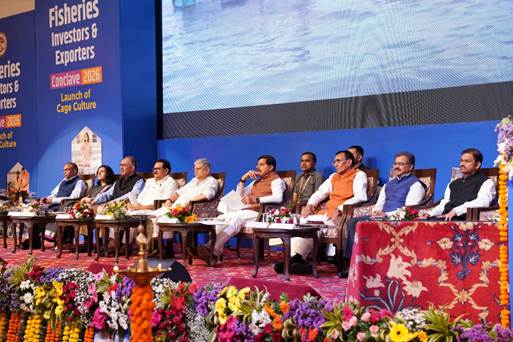
The Conclave highlighted the need to move beyond a production-oriented approach towards integrated fisheries value chains that connect production with processing, value addition, branding and markets. Stronger cold-chain connectivity, quality standards, certification and logistics can help inland fish products reach wider domestic and international markets.
The discussions and initiatives are expected to strengthen collaboration among Central and State Governments, investors, exporters, financial institutions, research organisations, fisheries cooperatives and entrepreneurs, translating Madhya Pradesh's inland fisheries potential into investment opportunities, stronger value chains and improved livelihood opportunities for fishers and fish farmers.
Background Note
- Madhya Pradesh has 4.50 lakh hectares of inland water area, including 3.75 lakh hectares of reservoirs, providing a substantial production base for inland fisheries and aquaculture. Major species produced in the State are Rohu, Catla, Mrigal, Tilapia, Pangasius, Common Carp and Grass Carp.
- Under Pradhan Mantri Matsya Sampada Yojana, the Department of Fisheries, Government of India has accorded approvals to Madhya Pradesh at a total project cost of ₹910.81 crore, with a Central share of ₹305.50 crore, and released ₹301.27 crore, equivalent to about 98.61per cent of the approved Central share. As a result, fish production in Madhya Pradesh increased from 2.00 lakh MT in 2019-20 to 4.45 lakh MT in 2024-25, registering an increase of about 123 per cent.
- The major production-related interventions approved under PMMSY include 78 hatcheries, 1,157 RAS and biofloc units, expansion of pond area by more than 5,700 hectares and one Integrated Aquapark.
- Under the Budget Announcement 2026-27, integrated development of 49 reservoirs and 5 Amrit Sarovars are approved to Madhya Pradesh with an investment of Rs. ₹88.25 crore. Madhya Pradesh has established 316 cages in Halali Reservoir notified as a Reservoir Fisheries cluster. The Integrated Cage Culture units being inaugurated during this programme will further support planned production and marketing of fish.
- Under FIDF, five projects have been approved in Madhya Pradesh:(i) fisheries training centre at a cost of ₹5.00 crore, (ii) cold storage at a cost of ₹1.21 crore, (iii) two innovative Projects at a cost of ₹0.44 crore and (iv) Establishment of Disease Diagnostic lab at a cost of ₹ 0.27crore. so far out of 5 projects 1 project related to fisheries training centre is ongoing while 4 yet to start.
*****
JP