Ministry of Social Justice & Empowerment
From Contractual Sanitation Worker to Entrepreneur: Sanjay Kumar’s Journey Towards Financial Independence Under NAMASTE
A Sanitation Worker from Ghaziabad, Uttar Pradesh, Builds an Independent Livelihood Through Mechanised Sanitation Services
Posted On:
16 OCT 2026 3:12PM by PIB Delhi
Mr. Sanjay Kumar’s journey highlights how access to institutional credit and capital subsidy can help sanitation workers transition towards mechanised sanitation, entrepreneurship and improved livelihood opportunities. By enabling him to own and operate a desludging vehicle, the support under SUY has helped him establish an independent source of income while contributing to the adoption of mechanised sanitation services.
Mr. Sanjay Kumar, a 42-year-old resident of Ghaziabad, Uttar Pradesh, faced financial challenges while supporting his family of six. Employed as a contractual sanitation worker, he earned approximately ₹12,000 per month.
Despite his hard work and dedication, his modest income made it difficult to meet household expenses, fulfil his family’s needs and build financial security for the future.
Having completed middle school, Mr. Kumar had limited employment opportunities and few prospects for increasing his earnings. As the sole earning member of his family, he aspired to improve his financial circumstances and provide a better standard of living for his loved ones. His ambition was to own a mechanised cleaning vehicle and establish an independent sanitation services business.
A significant opportunity emerged when Mr. Kumar attended an awareness camp organised at the Ghaziabad Municipal Corporation. During the camp, he learned about the Swachhta Udyami Yojana (SUY) under the National Action for Mechanised Sanitation Ecosystem (NAMASTE) Scheme, implemented by the Ministry of Social Justice and Empowerment, Government of India.
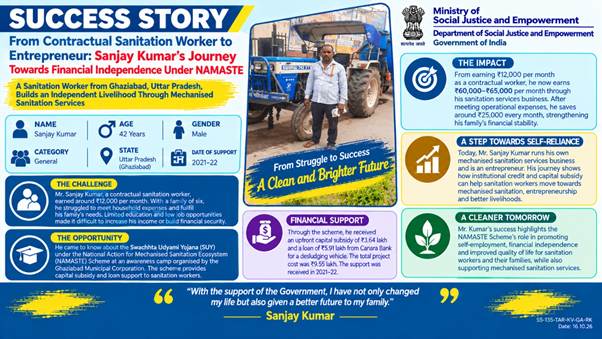
Through the scheme, he received an upfront capital subsidy from the Ministry and a loan from Canara Bank to procure a desludging vehicle. The total project cost was ₹9.55 lakh, comprising a loan of ₹5.91 lakh and a capital subsidy of ₹3.64 lakh. The financial assistance, received during 2021–22, enabled him to acquire the vehicle and transition from contractual employment to self-employment as a mechanised sanitation service provider.
The intervention marked a turning point in Mr. Kumar’s livelihood. From earning ₹12,000 per month as a contractual worker, he now earns approximately ₹60,000–₹65,000 per month through his sanitation services business. After meeting operational expenses, he is able to save around ₹25,000 every month. This improvement has strengthened his family’s financial stability and enabled him to plan better for future needs.
Today, Mr. Sanjay Kumar’s experience demonstrates how targeted financial assistance can create opportunities for economic empowerment. His journey from a contractual sanitation worker to an entrepreneur reflects the potential of the NAMASTE Scheme to promote self-employment, strengthen financial independence and improve the quality of life of sanitation workers and their families.
***
SS-135-TAR-KV-GA-RK
(Release ID: 2324322)
Visitor Counter : 92