PIB Backgrounder
BHAVYA: Creating Investment-Ready Manufacturing Ecosystems
Posted On:
14 OCT 2026 12:29PM by PIB Delhi
|
Bharat Audyogik Vikas Yojna (BHAVYA) is a ₹33,660 crore initiative to develop 100 plug-and-play industrial parks across India. The parks will provide modern industrial infrastructure, reliable services, and faster approvals, reducing the time needed to set up new industries. The scheme aims to attract investment, support MSMEs, strengthen supply chains, create jobs, and drive industrial growth across regions.
|
A New Phase in Manufacturing Policy
India's manufacturing sector is undergoing structural change. It now contributes about 16–17 percent of GDP and employs over 27 million workers. The National Manufacturing Mission aims to raise this share to 25 percent by 2035. The composition of industries is also changing, with medium- and high-technology industries accounting for 46.3% of manufacturing value addition. This reflects a shift towards higher-value and technology-intensive manufacturing.
As industries grow, they need reliable infrastructure, efficient logistics, and predictable approvals. Global supply chains are also diversifying, making well-connected industrial locations more important.
Plug-and-play parks bring these requirements together by providing essential infrastructure and common facilities before industries begin operations. This reduces the time and cost involved in setting up new manufacturing units. To expand this approach nationwide, the Bharat Audyogik Vikas Yojna (BHAVYA) was approved by the Cabinet in March 2026 and notified on 10 April 2026 with an outlay of ₹33,660 crore. BHAVYA is being implemented in partnership with States and private developers. The scheme emphasises increasing manufacturing capacity in the country and ease of doing business through streamlined approvals, effective single-window systems and investor-friendly reforms. The plug-and-play industrial ecosystems will reduce entry-level barriers and help industries move from investment to production quickly.
Policy Evolution: From Pre-2020 to Plug-and-Play Ecosystems
India's approach to manufacturing growth has evolved over time. Each phase has expanded the country's capacity to support industry and create new economic opportunities.
The first phase focused on industrial estates and Special Economic Zones (SEZs). These provided industrial land, common infrastructure, and regulatory incentives. As of February 2026, India had 370 notified SEZs. These zones attracted investments worth ₹7.82 lakh crore and generated employment for over 31.7 lakh people.
The approach then expanded from individual industrial zones to larger manufacturing hubs across the country. As of 14 October 2026, 4,164 industrial parks have been mapped on the India Industrial Land Bank (IILB). At the same time, the National Industrial Corridor Development Programme (NICDP) moved beyond providing industrial land. It combined manufacturing zones with utilities, logistics, and urban services, creating more integrated industrial locations.
Industrial nodes such as Dholera Special Investment Region (Gujarat), Shendra-Bidkin Industrial Area (Maharashtra), Vikram Udyogpuri (Madhya Pradesh), and Integrated Industrial Township Greater Noida (Uttar Pradesh) demonstrated the advantages of integrated planning.
|
Period
|
Policy Approach
|
What it Added
|
|
Pre-2020
|
Industrial estates and SEZs
|
Fiscal incentives; export-oriented regulatory perimeter
|
|
NICDP
|
Smart industrial cities with integrated infrastructure
|
Planned nodes, multimodal connectivity, plug-and-play pilots.
|
|
Budget 2026-27
|
Sector-specific plug-and-play parks (chemical parks, PM MITRA).
|
Cluster-based model in specific sectors.
|
|
BHAVYA (2026)
|
Nationwide rollout: 100 proposed plug-and-play parks nationwide.
|
Scale, coverage, and reform-linked delivery at national level
|
Inside the BHAVYA Framework
BHAVYA provides financial assistance of up to ₹1 crore per acre for developing industrial parks. The scheme covers essential components such as internal roads, power supply, water networks, drainage systems, common effluent treatment facilities, value-added infrastructure and Information & Communication Technology (ICT)-enabled administration. Underground utility corridors will enable a no-dig environment for efficient maintenance and uninterrupted industrial operations.
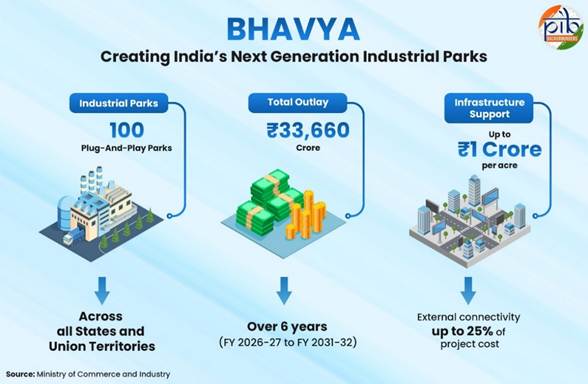
Parks will also feature ready-built factory sheds, built-to-suit units, testing and certification facilities, and warehousing. To improve worker welfare and productivity, provisions have been made for worker housing, healthcare facilities, skill development centres, and other social amenities. The scheme supports up to 25% of approved funding to be allocated for external infrastructure such as road, rail, and last-mile logistics connectivity, ensuring seamless integration with the wider transport network.
The scheme will be implemented over six years, from FY2026–27 to FY 2031–32. In the first phase, up to 50 industrial parks will be selected through a challenge mode across two selection rounds. The remaining parks will be selected in subsequent phases, taking the total number of parks supported under BHAVYA to 100. The selection will consider project readiness, land availability, and industrial potential. Each park will span 25 to 1,000 acres depending upon mandatory criteria of land sizes as per the Scheme guidelines. Projects will be implemented and managed through dedicated Special Purpose Vehicles (SPVs), which will oversee development, operations, investor facilitation, and long-term maintenance.
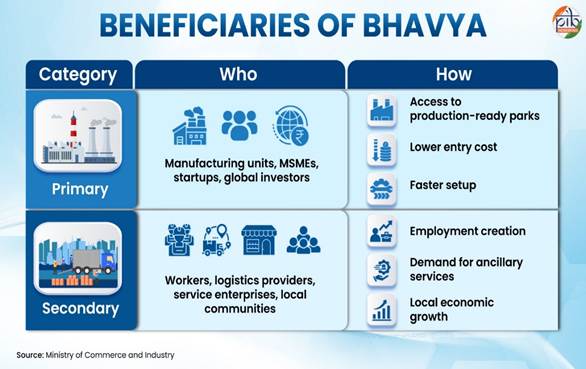
Manufacturing firms, Micro, Small, and Medium Enterprises (MSMEs), startups, and investors can access common facilities and streamlined approvals under BHAVYA.
In June 2026, the BHAVYA Portal was launched for the implementation and monitoring of the scheme. The portal supports project submission, appraisal and evaluation while enabling a transparent and competitive selection process.
Plug and Play Industrial Parks: Concept and Features
|
Trunk infrastructure is the higher-order infrastructure development with the primary purpose of serving ‘catchment’ areas to be shared between developments, commonly provided by local governments. It includes the development of the main line of infrastructure, such as water supply, drainage, sewerage/septage, roads, streetlights, electricity, etc.
|
Plug-and-play industrial parks are pre-developed industrial ecosystems where land, trunk infrastructure, utilities, and common facilities are made available beforehand. In many cases, approvals and basic clearances are streamlined through single-window systems. This allows enterprises to move faster from financial decisions to production, while reducing upfront costs and implementation delays.
Such models are becoming more relevant as supply chains diversify across locations and manufacturing becomes more time-sensitive. Investors increasingly seek locations where land availability, connectivity, utilities, and regulatory processes are predictable.
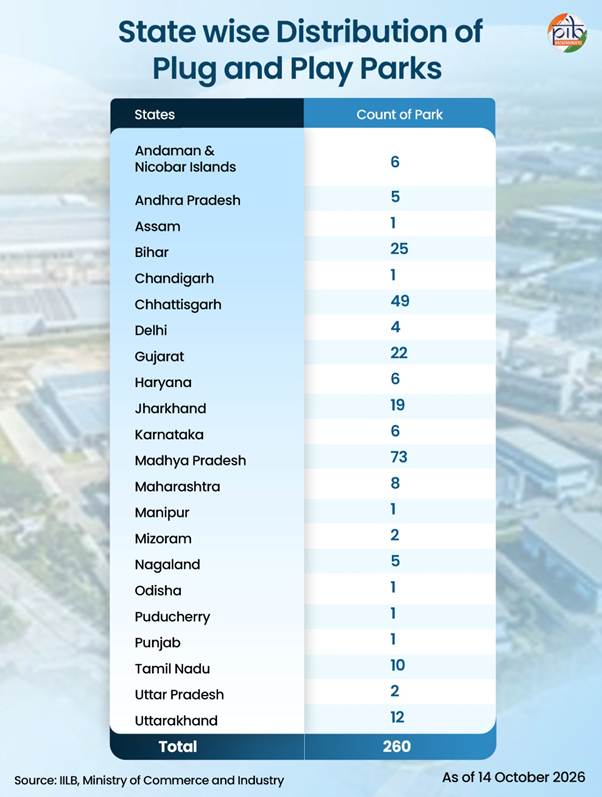
The plug-and-play model is already gaining traction in India. In the Union Budget 2025–26, ₹2,500 crore was allocated for the development of plug-and-play industrial parks. India currently has 260 plug-and-play industrial parks, reflecting the growing adoption of infrastructure-ready manufacturing ecosystems across sectors and states.
The plug-and-play model is also being extended to sector-specific industrial facilities. In July 2026, the Government approved the BHAVYA-Rasayan Scheme for three Chemical Parks. These parks will provide common facilities and environmental safeguards for chemical manufacturing.
|
Dholera SIR: An Integrated Industrial City
Dholera, Gujarat is emerging as a new-generation industrial city. Wide roads, reliable utilities, digital networks, and modern urban services were planned from the start. Power, water, gas, and drainage systems run through a common underground network, creating a plug-and-play environment for industries.
The region is developing as a hub for advanced manufacturing sectors. Semiconductors, aerospace and defence, solar manufacturing, green hydrogen, biotechnology, and heavy engineering are among the focused sectors. Strong links to ports, airports, expressways, and the Dedicated Freight Corridor connect Dholera to domestic and global markets. Outcomes include:
- 495 acres allotted across 11 plots
- Investment potential: ₹97,328 crore
- Employment potential: 6,000+ jobs
Land has been allotted for major projects, including Tata Electronics' semiconductor facility and Renew Power solar module manufacturing plant.
|
Towards a New Manufacturing Ecosystem
India’s manufacturing landscape is evolving with greater emphasis on integrated industrial development. The shift from industrial estates to planned manufacturing hubs reflects this changing approach. BHAVYA represents the next step in this transistion. Alongside other initiatives for industrial development, it forms part of India’s broader effort to strengthen its manufacturing base and enhance its role in global manufacturing.
References
Cabinet
https://www.pib.gov.in/PressReleasePage.aspx?PRID=2241785®=3&lang=1
https://www.pib.gov.in/PressReleasePage.aspx?PRID=2288863®=48&lang=1
Ministry of Commerce & Industry
https://www.pib.gov.in/PressReleasePage.aspx?PRID=2241814®=3&lang=1
https://www.pib.gov.in/PressReleasePage.aspx?PRID=2114840®=3&lang=2
https://www.dpiit.gov.in/static/uploads/2025/07/a7f8726a772d283c2c10a7d02ab5b190.pdf
https://www.pib.gov.in/PressReleasePage.aspx?PRID=2270334®=3&lang=1
https://www.pib.gov.in/PressReleasePage.aspx?PRID=2264533®=3&lang=1
Ministry of Finance
https://www.pib.gov.in/PressReleasePage.aspx?PRID=2219990®=3&lang=1
Ministry of Housing and Urban Affairs
https://pmay-urban.gov.in/uploads/guidelines/Operational-Guidelines-of-PMAY-U-2.pdf
Ministry of Textiles
https://www.pib.gov.in/PressReleasePage.aspx?PRID=2241103®=3&lang=2
NITI Aayog
https://www.niti.gov.in/sites/default/files/2025-04/India_Hand_Power_Tools_Sector_Report.pdf
https://niti.gov.in/sites/default/files/2025-10/Reimagining_Manufacturing_Indias_Roadmap_to_Global_Leadership_in_Advanced_Manufacturing.pdf
United Nations Industrial Development Organization
https://www.unido.org/sites/default/files/files/2019-11/International_Guidelines_for_Industrial_Parks.pdf
NICDC
https://nicdc.in/projects/4-projects-developed/dholera-special-investment-region-gujarat
https://dholera.gujarat.gov.in/advantage_dholera
https://dholera.gujarat.gov.in/business
IBEF
https://dev.ibef.org/industry/manufacturing-sector-india
Click here to see pdf
*****
PIB Research
(Release ID: 2323107)
Visitor Counter : 363