Ministry of Science & Technology
New metal-free porous material can help produce affordable clean energy
Posted On:
07 OCT 2026 3:39PM by PIB Delhi
A breakthrough metal-free catalyst developed by scientists could significantly reduce the cost of next-generation clean-energy technologies.
In energy storage devices such as zinc–air (Zn–air) batteries, oxygen from the air reacts with the electrode in a process known as the oxygen reduction reaction (ORR). The efficiency with which the battery operates is determined by this reaction. Zn–air batteries are a promising option for next-generation energy storage as they utilise the abundant, inexpensive and relatively safe element zinc while drawing oxygen directly from the air, thus eliminating the need to store an active cathode material. Compared with conventional lithium-ion (Li-ion) batteries, Zn–air batteries offer the potential for higher theoretical energy density, lower material cost, improved safety and greater sustainability. However, challenges related to rechargeability, cycle life and ORR kinetics remain.
Compared with hydrogen fuel cells, Zn–air batteries can provide a simpler, more compact energy storage solution that does not require high-pressure hydrogen storage or extensive hydrogen infrastructure. However, both Zn–air batteries and hydrogen fuel cells critically rely on efficient oxygen electrochemistry. Currently, many clean-energy technologies, particularly hydrogen fuel cells, depend on platinum, one of the world’s rarest and most expensive metals, as an efficient ORR catalyst. While platinum provides excellent catalytic performance, its high cost, scarcity and limited availability remain major barriers to large-scale deployment. Therefore, developing efficient, platinum-free ORR catalysts is crucial for realising the cost, sustainability and scalability advantages of Zn–air batteries, and for advancing affordable clean-energy technologies.
A team of researchers from S. N. Bose National Centre for Basic Sciences (SNBNCBS), Kolkata, and Institute of Nano Science and Technology (INST), Mohali, both institute of Department of Science and Technology (DST) as well as from SRM University, Amaravati, has now demonstrated that a specially designed metal-free organic porous material, prepared from 2,4,6-tris(4-aminophenyl)-1,3,5-triazine (TTT) and 4,8-dioxo-4,8-dihydrobenzo[1,2-b:4,5-b’]dithiophene-2,6-dicarbaldehyde (DHTD) linkers, named as TTT-DHTD. Interestingly, TTT-DHTD can perform almost as well as platinum without using any precious metals when used as the air-electrode catalyst in Zn–air batteries. This was published in the journal Science Advances.
Built entirely from abundant elements such as carbon, sulfur, nitrogen, and hydrogen, the material forms an ultra-porous, honeycomb-like network that efficiently converts oxygen into electricity—a key step in generating power in a fuel cell. Laboratory tests showed that the new catalyst achieved about 96% of the performance of commercial platinum catalysts, while remaining remarkably stable. Even after 120 hours of continuous operation, the material maintained its performance without the degradation or contamination that often affects conventional metal-based catalysts.
The researchers led by Dr. Pradip Pachfule from SNBNCBS, Prof. Ramendra Sundar Dey from INST, and Prof. Ranjit Thapa from SRM University, Amaravati, also used advanced computer simulations to understand why the material performs so well. They found that its carefully engineered molecular structure creates ideal sites where oxygen molecules can readily attach and react, enabling electricity to be generated quickly and efficiently.
Replacing platinum with inexpensive organic materials could dramatically reduce the cost of Zn-air cells, making clean transportation, portable power systems, and renewable energy storage more affordable and accessible. This development also highlights India's growing leadership in sustainable materials research.
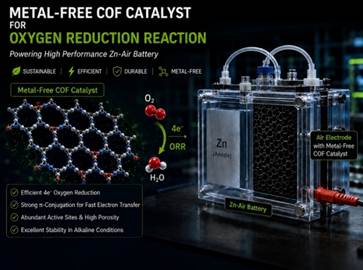
Fig 1. Metal-free covalent organic framework electrocatalyst for efficient oxygen reduction reaction and high-performance Zn–air batteries (Image credit: ChatGPT).
By combining innovative molecular design with advanced computational studies, the researchers have demonstrated that earth-abundant materials can rival the performance of precious metals in one of the most important reactions for clean-energy technologies.
As the world searches for cleaner and more economical energy solutions, breakthroughs like TTT-DHTD bring us one step closer to a future where efficient, durable, and affordable fuel cells become part of everyday life.
Publication link:
www.science.org/doi/epdf/10.1126/sciadv.aee3092
***
NKR/FT/AA
(Release ID: 2320120)
Visitor Counter : 339