Ministry of Science & Technology
Science Policy and Communication in an Era of Global Challenges: From Boundaries to Breakthroughs
Posted On:
17 SEP 2026 5:11PM by PIB Delhi
Council of Scientific and Industrial Research (CSIR) has been organizing annual sessions (virtual mode) during the Science Summit at United Nations General Assembly (UNGA) that are aimed at showcasing CSIR's contributions to Science and Technology and efforts towards Global Sustainable Development. The central theme of SSUNGA81 is "From Boundaries to Breakthroughs: Science for a Regenerative and Equitable Future". With this background, CSIR-NIScPR organised an online session on “Science Policy and Communication in an Era of Global Challenges: From Boundaries to Breakthroughs” on 16 September 2026, bringing together experts and practitioners to deliberate on strengthening the interface between science, policy and society in addressing complex global challenges.
Dr. Naresh Kumar, Chief Scientist, CSIR-NIScPR, in his welcome address emphasized the importance of moving scientific knowledge from research to real-world application and urged the need for stronger institutional mechanisms for connecting research, policy and deployment.
Outlining the overview of the scientific session, Dr. Kasturi Mandal, Senior Principal Scientist, CSIR-NIScPR and convener of the session mentioned the persistent global “science divide” in infrastructure, skills and participation and that the central premise of the session is that science policy and science communication are complementary pillars of sustainable & inclusive development.
Dr. (Mrs.) Geetha Vani Rayasam, Director, CSIR-National Institute of Science Communication and Policy Research (CSIR-NIScPR) chaired the scientific session. She also highlighted the significance of technology readiness, scientific entrepreneurship and foresight on emerging technologies, particularly in view of rapid developments in Artificial Intelligence. She stressed the need to anticipate emerging scenarios and strengthen evidence-informed policy approaches to ensure that scientific and technological advances translate into meaningful societal outcomes.
Shri Rohit Gupta, CTO of the Office of the Principal Scientific Adviser to the Government of India, presented TRL Compass, India's evidence-based national framework for assessing technology readiness, showing how a structured, sector-specific approach can de-risk deep tech investment and offer a template that emerging economies can adapt to their own priorities. He highlighted the collaboration between the Office of the Principal Scientific Adviser (PSA) and CSIR-NIScPR in development of sectoral specific TRL assessment frameworks for India which could be relevant to global south.
Dr. Joana Ball, Managing Director, Directory of Open Access Journals surged the involvement of governments, funders, researchers, universities, libraries, and publishers in strengthening open knowledge systems. She also highlighted the role of CSIR-NIScPR in connecting Indian research with researchers and wider society.
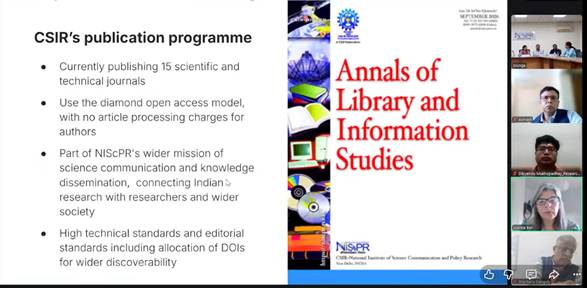
Dr. Avinash Kshitij, Scientist, CSIR-NIScPR highlighted aligning technological development with societal needs, investment, skills, and market readiness, highlighting technology foresight to anticipate emerging trends and policy priorities. Research shows startups and entrepreneurship can address societal issues through emerging technologies.
Dr. Vinayak, Scientist, CSIR-NIScPR highlighted a complexity-based approach that goes beyond citation counts to identify breakthrough research by exploiting the local structure of citation networks, map which countries are making breakthroughs in which disciplines, and reveal the scientific capabilities of nations.
Dr. Paramananda Barman, Scientist, CSIR-NIScPR discussed the relevance of inclusive science communication, highlighting the barriers such as language, literacy, culture and digital access, approaches and contributions of CSIR-NIScPR for strengthening SciComm.
Dr. Amit Kumar, Assistant Professor, RIS India's narrated India’s successful experience and expertise with technology-led development transformation since it's independence and accentuated to next level through DPI in the recent times has lot of potential to share with the Global South!
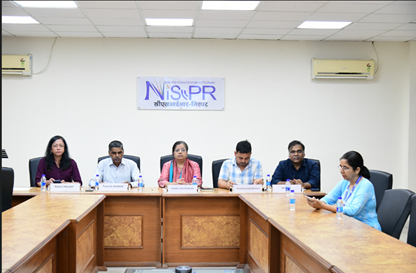
The session concluded with a shared emphasis on strengthening the connection between scientific knowledge, policy processes and societal needs. The discussions highlighted the importance of collaborative, interdisciplinary and participatory approaches to advancing inclusive, resilient and sustainable pathways for the future.
*****
NKR/AK/NM
(Release ID: 2311451)
Visitor Counter : 103