NITI Aayog
NITI Aayog Launches Ninth Edition of “Trade Watch Quarterly”
Posted On:
16 SEP 2026 5:33PM by PIB Delhi
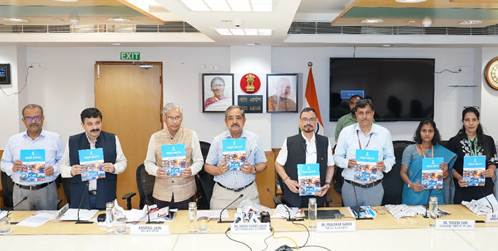
Shri Ashok Kumar Lahiri, Vice-Chairman, NITI Aayog, released the latest edition of the “Trade Watch Quarterly” publication for Quarter 1 of FY27 (Apr-Jun 2026) on 16th September 2026, in New Delhi alongwith CEO and other senior officials of NITI Aayog.
The latest edition of Trade Watch Quarterly provides a comprehensive assessment of global and domestic trade trends amid heightened geopolitical and trade policy uncertainties, even as global trade has remained resilient. Global goods trade reached $13.7 trillion in the first half of calendar year 2026, registering 12.5% y-o-y growth, while services trade expanded by 10.5%. Against this backdrop, India’s merchandise and services trade continued to expand, with total trade reaching $506.9 billion in Q1 FY27, registering 15.5% y-o-y growth. The thematic focus of this edition is India’s metals and ores trade, a strategically important sector for manufacturing, infrastructure, energy transition and advanced industries. The study examines India’s export competitiveness and growing import dependence across metals and ores, with a focus on critical minerals and higher-value non-ferrous metals, while assessing structural constraints and opportunities to strengthen domestic value addition, investment, market diversification and global competitiveness.
India’s merchandise exports grew strongly in Q1 FY27, led by mineral fuels, electrical machinery, nuclear reactors, iron and steel, and vehicles, supported by rise in shipments of petroleum products, steel, engineering goods and automobiles. Imports continued to support India’s industrial and energy requirements, with notable growth in capital goods, electronic components and copper. This trend reflects the strength of domestic investment activity, expanding industrial capacity and the growing integration of Indian industry with global value chains.
India’s export destinations continued to diversify, with Tanzania and South Africa emerging among the top ten markets, alongside strong growth in exports to Singapore. Imports from Latin America and West Africa recorded significant growth, supported in part by the diversification of crude oil sourcing, thereby enhancing resilience and flexibility in India’s import basket. At the same time, Northeast Asia, West Asia-GCC and ASEAN remained important sources of imports, together accounting for around half of India’s total imports. Trade with FTA partners also gained further momentum, with exports increasing by 36.3% and imports by 10.0%, underscoring the strengthening of economic partnerships and deeper integration of India with global trade and supply chains.
India’s position in Digitally Delivered Services (DDS) also strengthened, with exports rising from $277 billion in 2024 to $317 billion in 2025, a 15% y-o-y increase. India consequently moved from the fifth-largest to the fourth-largest DDS exporter, only behind the US, UK and Ireland.
The edition’s thematic focus on India’s Metals and Ores Trade highlights the sector’s strategic importance for manufacturing, infrastructure development, energy transition and advanced industries. Metals exports reached $34.8 billion in 2025, with iron and steel, articles of iron and steel, and aluminium together accounting for around 78% of exports. India has established strong competitiveness in these segments, providing a solid foundation for further expansion and value addition. At the same time, the evolving global demand for higher-value non-ferrous metals and critical minerals presents significant opportunities for India to deepen its capabilities, enhance domestic value chains and strengthen its position in these strategic and emerging sectors.
Metals and ores imports increased from $32.2 billion in 2015 to $60.5 billion in 2025, reflecting the growing demand for key industrial and strategic minerals, particularly copper, lithium, cobalt and nickel, in line with India’s expanding manufacturing base, infrastructure development and energy transition requirements. This evolving demand underscores significant opportunities to strengthen domestic exploration, processing and specialised production capabilities and enhance value addition across the metals and minerals value chain.
Recent reforms under the Mines and Minerals (Development and Regulation) Act, 1957, including the MMDR Amendment Act, 2026, can strengthen fiscal predictability and encourage investment in exploration, mine development and critical minerals. At the same time, the European Union’s Carbon Border Adjustment Mechanism (EU CBAM) underscores the need to enhance the competitiveness of steel and aluminium exports. A coordinated value-chain approach covering resource security, streamlined processes, lower logistics and financing costs, trade safeguards, renewable-energy access, CBAM preparedness, advanced materials and critical-mineral recycling can further strengthen India’s position in global markets.
Addressing the occasion, Shri Ashok Kumar Lahiri stated that “strengthening India’s trade competitiveness will require continued diversification of export markets and products, deeper integration with global and regional value chains, stronger domestic capabilities in strategic sectors, and a policy environment that enables firms to compete effectively in international markets.”
The edition serves as a valuable resource for policymakers, industry, researchers, and academia, offering data-driven insights and forward-looking policy recommendations to support informed decision-making and strengthen India’s trade competitiveness in an evolving global landscape.
The full publication can be accessed at: https://www.niti.gov.in/sites/default/files/2026-09/Trade-Watch-Quarterly-January-March-Q1-FY27.pdf
***
MJPS/PRK
(Release ID: 2310941)
Visitor Counter : 410