Ministry of Science & Technology
Unusual wave-like heat transport in crystalline solid signals breakthrough converting waste heat in industries
Posted On:
14 SEP 2026 5:59PM by PIB Delhi
An unusual heat transport regime detected in a newly studied copper chalcogenide material called thallium copper selenide (TlCu5Se3) could pave way for efficient conversion of waste heat to electricity via thermoelectric energy conversion in power plants, cement industries, steel plants, automobiles, data centres and battery heat management systems.
Conventional superionic materials can achieve low lattice thermal conductivity via highly mobile ions. But excessive ion migration may cause structural instability and compromise its thermoelectric performance. Confined ion diffusion, where ionic motion remains restricted within a complex crystalline framework, offers a way to suppress heat transport while preserving structural stability and promoting unconventional heat-transport mechanisms.
In crystalline materials, heat is conventionally understood to be transported by particle-like phonons, with phonon mean free path (MFP) typically much larger than the interatomic distance. In contrast, strong disorder and anharmonicity (phenomenon in which atomic vibrations become asymmetric and deviate significantly from normal parabolic behaviour, disrupting propagation of heat) in glasses reduce the MFP to nearly the interatomic length scale, suppressing conventional phonon propagation.
This conventional picture, however, becomes increasingly inadequate when strong anharmonicity and structural disorder can retain long-range crystallographic order while exhibiting highly localized, closely spaced vibrational modes that interact strongly with one another.
In this intermediate regime, thermal energy can be transported not only through particle-like phonon propagation but also through wave-like coherence between different vibrational modes, enabling ultralow lattice thermal conductivity. Such ultralow thermal conducting materials have immense importance in thermal barrier coatings, thermoelectric energy conversion, thermal decoherence free quantum technology.
Researchers at Jawaharlal Nehru Centre for Advanced Scientific Research (JNCASR), Bengaluru (an autonomous institution under the Department of Science & Technology, Govt. of India) and other research team members have found an unusual wave-like thermal transport regime in a newly studied copper chalcogenide material, TlCu5Se3 that can lead to high-performance thermoelectric conversion.
The complex crystal framework of TlCu5Se3 was expected to restrict the motion of Cu atoms rather than allowing long-range migration providing opportunity to investigate whether this confined dynamic behaviour could generate strong anharmonicity and suppress heat transport without causing structural instability.
In this work, led by Prof. Kanishka Biswas and his Ph.D. students, Ms. Sayantoni Choudhury and Dr. Animesh Bhui from the New Chemistry Unit (NCU) at JNCASR, published in the prestigious journal, Science Advances, investigated the structural and thermoelectric properties through experiments and conducted advanced theoretical calculations to understand the origin of the unusual heat transport.
They showed that the complex crystal structure and intrinsically confined dynamic disorder of the Cu sublattice generate exceptionally strong anharmonicity, leading to predominantly wave-like phonon transport and an intrinsically ultralow lattice thermal conductivity.
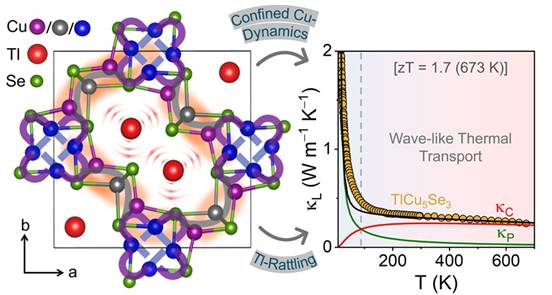
Fig 1: A schematic illustrating the complex knot-like structural framework that leads to a confined Cu dynamic, resulting in unusual heat transport and ultrahigh thermoelectric performance in TlCu5Se3.
This unusual thermal transport, together with favorable electronic transport, give rise to one of the highest thermoelectric performances (thermoelectric figure of merit, zT of 1.7) among pristine ternary chalcogenides. The origin of this unusual behaviour lies in the distinctive crystal framework of TlCu5Se3. The compound crystallizes in a tetragonal structure and forms a complex three-dimensional cloverleaf knot-like framework with open channels along the crystallographic c-axis.
The intrinsic bonding hierarchy associated with this complex framework leads to these confined dynamics. To probe the presence of this confined dynamic behaviour of Cu, the team collaborated with Prof. Umesh V. Waghmare and his postdoc Dr. Prasad V. Matukumilli from the Theoretical Sciences Unit (TSU), JNCASR, Bengaluru, to perform advanced first-principles theoretical calculations and molecular-dynamics simulations.
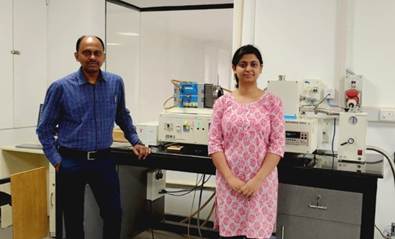
Fig 2: Prof. Kanishka Biswas (left) and Sayantoni Choudhury (right) JNCASR, Bangalore.
Molecular-dynamics simulations (computer simulations of atomic motions over time) reveal that Cu atoms exhibit localized dynamic disorder rather than the long-range, liquid-like diffusion characteristic of superionic copper chalcogenides. This confined motion acts primarily as a source of strong lattice anharmonicity. As a direct consequence, heat begins to propagate through wave-like coherence, with phonons tunnelling between localized vibrational states rather than moving as well-defined particles. To uncover how these unusual vibrations transport heat, the researchers went beyond the conventional phonon-gas model and employed the unified formalism of thermal transport. This framework considers both particle-like phonon propagation and wave-like coherence between different phonon branches.
The significance of this work extends beyond thermoelectric performance, which establishes how structural complexity and confined ion dynamics can lead to an unconventional mechanism for thermal management and high-performance thermoelectric energy conversion.
Publication link: DOI:10.1126/sciadv.aeh9096
****
NKR/FT/AA
(Release ID: 2310168)
Visitor Counter : 270