PIB Backgrounder
Water-Smart Farming with Per Drop More Crop
Transforming Indian Agriculture through Water Efficiency
Posted On:
29 AUG 2026 12:47PM by PIB Delhi
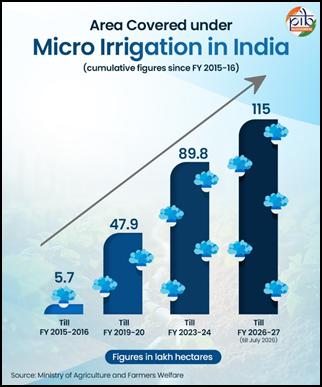
Per Drop More Crop (PDMC) promotes micro-irrigation to improve water use efficiency and enhance agricultural productivity. The scheme has brought over 115 lakh hectares under micro irrigation as of July 2026. Financial assistance through direct benefit transfer and digital implementation has improved transparency and farmer access to affordable micro-irrigation facilities. Independent studies report higher yields, significant water savings, lower cultivation costs, and increased farmers' incomes. PDMC is strengthening resource-efficient, sustainable agriculture by using every drop of water efficiently.
Improving Irrigation Efficiency with Per Drop More Crop (PDMC)
More than 80% of India's available water resources are used for agricultural irrigation. However, only about 50% of the net sown area has irrigation facilities. Improving water use efficiency has therefore become a national priority. Micro irrigation is an important solution for improving water use efficiency in agriculture. This is because it delivers water directly to crops with minimum losses. The government is implementing the Per Drop More Crop (PDMC) scheme to promote efficient water use at the farm level. It is a centrally sponsored scheme. It supports micro-irrigation systems: drip irrigation and sprinkler irrigation.
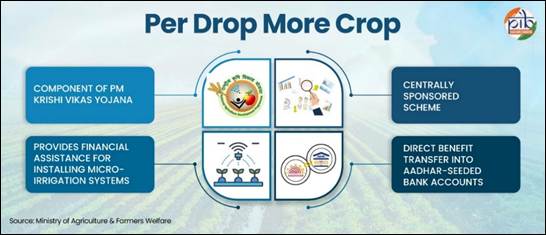
Under this scheme, the government provides financial assistance of up to five hectares per beneficiary to install micro irrigation systems. Small and marginal farmers receive 55%, and other farmers receive 45% financial assistance. Central assistance of ₹8,123.24 crore has been released in the last three years. Some state governments also provide additional subsidies from their own budgets. Farmers can receive assistance again for the same land after seven years.
The initiative originally began in January 2006 as the Centrally Sponsored Scheme (CSS) for Micro Irrigation. It was later upgraded to the National Mission on Micro Irrigation (NMMI) in 2010-11. During FY 2014-15, it became part of the National Mission on Sustainable Agriculture (NMSA) under the "On Farm Water Management" (OFWM) component. From FY 2015-16 to FY 2021-22, it was officially named Per Drop More Crop (PDMC) and implemented as a core component of the Pradhan Mantri Krishi Sinchayee Yojana (PMKSY). Since 2022-23, PDMC has been implemented under the Pradhan Mantri Rashtriya Krishi Vikas Yojana (PM-RKVY).Pradhan Mantri Rashtriya Krishi Vikas Yojana (PM-RKVY)
Launched in 2007–08, the Rashtriya Krishi Vikas Yojana promotes the holistic development of agriculture and allied sectors. The scheme was restructured as the Pradhan Mantri Rashtriya Krishi Vikas Yojana (PM-RKVY) in October 2024 to promote sustainable agriculture, acting as an umbrella scheme that merges nine schemes. It includes components such as Per Drop More Crop (PDMC), agricultural mechanization, soil health management, crop diversification, and an accelerator fund for agri-startups. A key feature of the restructured scheme is that it gives state governments the flexibility to re-allocate funds from one component to another based on their specific, local agricultural requirements. It aims to tackle emerging issues like climate resilience, improve crop productivity, and advance value chain development. During 2025-26, a total of ₹8,957.72 crore has been released/sanctioned for PM-RKVY, which includes ₹3,226.36 crore specifically dedicated to the PDMC scheme.
Strategic Focus Areas of PDMC
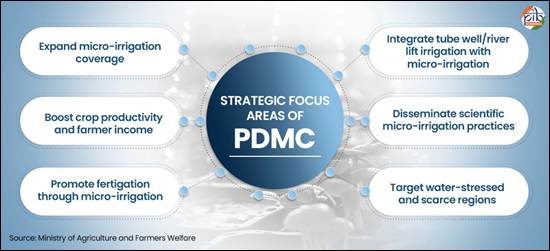
The PDMC scheme promotes precision water management to enhance crop productivity and increase farmers' incomes. The scheme also promotes fertigation to improve nutrient application efficiency and prioritizes water-scarce and groundwater-stressed regions. Fertigation is the process of applying fertilizers with irrigation water directly to the region where most of the plant’s roots develop.Further, PDMC supports the integration of micro irrigation with tube wells, river-lift irrigation, and solar-powered irrigation systems. It encourages convergence with other government programmes to maximize the utilization of water resources. The scheme also promotes scientific advancements in micro-irrigation for agriculture and horticulture.
Benefits of Micro-Irrigation
Micro-irrigation enables efficient use of water by delivering it directly to the plant root zone, reducing wastage and improving irrigation efficiency. It lowers the use of water, energy, fertilizers, and labour while supporting better crop growth and higher productivity through the precise application of water and nutrients. The technology also encourages the cultivation of horticultural crops, improves cropping intensity, and brings marginal lands under productive use. By reducing input costs and enhancing farm returns, micro-irrigation contributes to sustainable agriculture, strengthens farmers' livelihoods, and promotes long-term food and nutritional security.
Progress in Scaling Micro Irrigation across India through PDMC
Since its inception, PDMC has brought 115 lakh hectares under micro-irrigation, as of July 2026. This accounts for about 8.11% of India’s net sown area. In 2025-26:
- Maharashtra, Karnataka, Andhra Pradesh, Tamil Nadu, Gujarat, and Rajasthan recorded the highest areas covered by micro-irrigation under PDMC.
- 12.30 lakh farmers were benefitted by the scheme.
- Around 20% of the beneficiaries were women.
From Flood Irrigation to Drip Irrigation
LAM Srinivasa Rao, a farmer from Palnadu, Andhra Pradesh, adopted drip irrigation under the state Micro Irrigation Project and the PDMC scheme. He installed the system in his two-acre acid lime orchard, replacing traditional flood irrigation. The new system ensured precise application of water and nutrients through fertigation. As a result, yield increased from 90 to 105 quintals per acre. The cost of cultivation declined from ₹3.0 lakh to ₹2.4 lakh. With stable market prices, his net income increased from ₹1.5 lakh to ₹2.85 lakh. He earned an additional ₹1.35 lakh, demonstrating the benefits of micro irrigation in improving productivity and farmers' incomes.
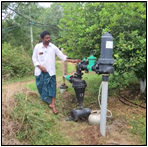
To further promote efficient water use and boost farmer income, the government has introduced new flexibilities under the PDMC scheme. The initiative empowers states and UTs to undertake micro-level water storage and conservation activities. such as the construction of diggis (large water storage tanks or farm ponds) and water harvesting systems, under the “Other Interventions” component. Because these systems can be developed for both individual and community use based on local needs, they help ensure reliable, sustainable water availability for micro-irrigation.
Crucially, the revised guidelines eliminate previous funding restrictions for these conservation projects. Earlier, funds for such activities were strictly capped at 20% of the total allocation for general states/UTs. It was 40% for North Eastern States, Himalayan States, and the UTs of Jammu & Kashmir and Ladakh. Now, States and UTs have the flexibility to exceed these limits based entirely on their specific local requirements.
Types of Micro Irrigation Systems under PDMC
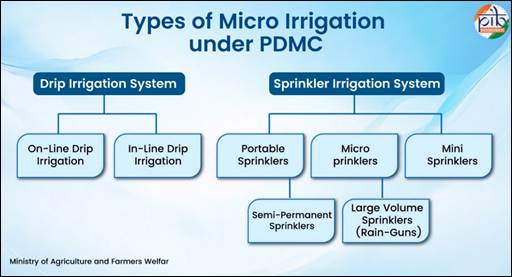
There are two major micro-irrigation systems under PDMC:
Drip Irrigation System
Drip Irrigation technology involves irrigating the root zone through emitters fitted to a lateral tube or inserted within the tubing. In simpler terms, it is a method of watering crops in which water is delivered slowly and directly to the roots of plants through small outlets (called emitters) mounted on thin pipes or tubes. This ensures that only the required area around the plant gets water, reducing wastage and improving efficiency.
There are two types of drip irrigation systems:
- On-line drip irrigation: Water is given to each plant through small drippers installed along the pipe wherever a plant is located. This makes it suitable for crops with uneven spacing.
- In-line drip irrigation: Water comes out of drippers built into the pipe at fixed intervals. In this system, all plants get water evenly.
Sprinkler Irrigation System
In sprinkler irrigation, water is discharged under pressure in the air through a set of nozzles attached to a network of pipes. This system simulates a rainfall and waters the crops evenly. Sprinkler irrigation systems are suitable for irrigating crops where the plant density is very high. It is widely used for cereals, pulses, seeds, spices and field crops.
The sprinkler irrigation system is further classified into the following types:
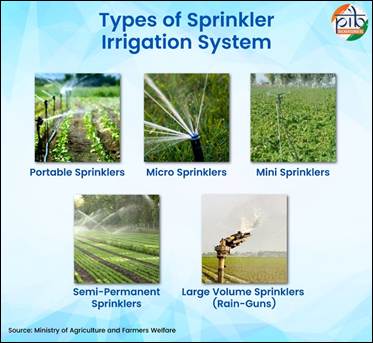
- Portable Sprinklers: In this system, the main and sub-main pipes can be shifted to different parts of the field as required. This allows irrigation according to the crop's water needs. These can be used in both, plains as well as in undulating terrains.
- Micro Sprinklers: Micro sprinklers are low radius sprinklers. They are mostly used for irrigating leafy vegetables, nurseries and hardening of seedlings. Apart from providing irrigation, the micro sprinkler also helps in changing the micro climatic conditions near the plant.
- Mini Sprinklers: They are commonly used for close growing crops like groundnut, potato, onion, ginger, short statured fodder crops, etc. Mini sprinklers are also suitable for frost protection. Their radius is larger than micro sprinklers.
- Semi-Permanent Sprinklers: In this system, the main and lateral pipes are permanently installed below the ground. Sprinkler nozzles attached to riser pipes can be moved to different locations. This allows irrigation of different parts of the field according to the crop's water requirement.
- Large Volume Sprinklers (Rain-Guns): They are used where larger areas are to be covered with one or two sprinklers. These sprinklers have a discharge ranging from 10,000 litres per hour to 32,000 litres per hour and radius of throw from 24 m to 36 m. These systems require high pressure and high discharge pipes & pumps to operate them. These are preferred for irrigating crops spread over large areas in short time.
Implementation Framework of PDMC
Since PDMC is implemented under the Pradhan Mantri Rashtriya Krishi Vikas Yojana (PM-RKVY), it adopts the scheme's overall institutional architecture. At the national level, the National Stewardship Council (NSC) provides strategic direction for guidance and planning.
At the state level, the framework operates through a three-tier structure. At the top, the State Level Sanctioning Committee (SLSC) approves the plans. The Inter-Departmental Working Group (IDWG) coordinates planning and implementation across departments.
At the district level, the District Level Implementation Committee (DLIC) oversees execution and ensures inter-departmental coordination.
Impact Assessment Studies
Independent studies have highlighted the positive impact of the PDMC scheme. An evaluation by NITI Aayog during 2020-21 found the scheme aligned with national priorities. These include improving water use efficiency, increasing crop productivity, generating employment, and enhancing farmers' incomes. The study reported income gains ranging from 10% to 69%. Water use efficiency improved by 30%-70%. The scheme also created direct and indirect employment opportunities.
Furthermore, the Economic Survey 2020-21 quantified massive resource benefits from micro-irrigation. The survey reported water savings of 20% to 48%, energy savings of 10% to 17%, labour cost reductions of 30% to 40%, and fertilizer savings of 11% to 19%. The crop yield increase of 20% to 38% was also reported. A separate 2023 study conducted by the Indian Institute of Management Ahmedabad (IIMA) across six states assessed the scheme's implementation. The study confirmed that farmers predominantly adopt micro-irrigation to address declining groundwater levels, suit their specific crop requirements, and achieve long-term agricultural benefits.
Building a Water-Efficient Future for Agriculture
Per Drop More Crop (PDMC) has transformed India's irrigation approach by promoting efficient water use through micro irrigation technologies. The scheme has expanded access to modern irrigation while improving water use efficiency, crop productivity, and farmers' incomes.
Supported by robust institutional mechanisms, digital implementation, and convergence with other government programmes, PDMC has strengthened sustainable irrigation practices nationwide. As India faces increasing pressure on its water resources, PDMC plays an important role in advancing resource-efficient, sustainable agriculture.
References
Ministry of Agriculture & Farmers Welfare
https://pdmc.da.gov.in/
https://www.pmksy.gov.in/microirrigation/Archive/August2015.pdf
https://horticulturedept.ap.gov.in/Horticulture/NewSuccessStories.aspx
https://rkvy.da.gov.in/static/download/pdf/PM_RKVY_Guidelines_2024.pdf
https://www.pib.gov.in/PressReleasePage.aspx?PRID=2179856®=3&lang=2
https://www.pib.gov.in/PressReleasePage.aspx?PRID=2061649®=48&lang=2
https://sansad.in/getFile/loksabhaquestions/annex/186/AS23_qnphui.pdf?source=pqals
https://sansad.in/getFile/loksabhaquestions/annex/185/AU448_bMl0qu.pdf?source=pqals
https://sansad.in/getFile/loksabhaquestions/annex/182/AU2428_kPCRmr.pdf?source=pqals
https://www.pib.gov.in/PressNoteDetails.aspx?NoteId=159085&ModuleId=3®=17&lang=6
https://sansad.in/getFile/lsapps/loksabhaquestions/annex/187/AU3949_3xRqy3.pdf?source=lsapps
https://sansad.in/getFile/lsapps/loksabhaquestions/annex/184/AU2767_zvN42a.pdf?source=lsapps
https://www.iima.ac.in/sites/default/files/2024-09/3.%20Micro%20Irrigation_Final%20Report_2023_final_compressed_compressed_compressed_compressed.pdf
https://sansad.in/getFile/loksabhaquestions/annex/13/AU2359.pdf?source=pqals
Food and Agriculture Organisation
https://www.fao.org/4/a1336e/a1336e16.pdf
Government of Punjab
https://tupkasinchayee.punjab.gov.in/home/mischeme
Click here to see pdf
PIB Research
(Release ID: 2304480)
Visitor Counter : 4748