Ministry of Jal Shakti
Jal Jeevan Mission Clocks Seven Years of Rural Transformation: Rural Drinking Water Tap Coverage Surges from 16.7% to Over 82%
Over 2 Lakh Villages, Now ‘Har Ghar Jal’ Certified
Focus under JJM 2.0 shifts towards service delivery, source sustainability, community ownership and long-term functionality
Posted On:
14 AUG 2026 5:35PM by PIB Delhi
As the nation prepares to celebrate the 80th Independence Day, Jal Jeevan Mission (JJM), the flagship rural drinking water programme of the Government of India, is set to complete seven years of transformative progress in improving the lives of rural households across the country. Launched by Hon'ble Prime Minister Shri Narendra Modi on 15 August 2019, Jal Jeevan Mission aims to provide every rural household with safe and adequate drinking water through a Functional Household Tap Connection (FHTC) on a regular and long-term basis.
At the time of the launch of the Mission, only 3.23 crore rural households, representing about 16.72% of rural households in the country, had tap water connections. Today more than 15.91 crore rural households have tap water supply in their homes, accounting for 82.24% of all rural households. Since the launch of the Mission, over 12.68 crore additional rural households have been provided with tap water connections, significantly improving access to safe drinking water across rural India.
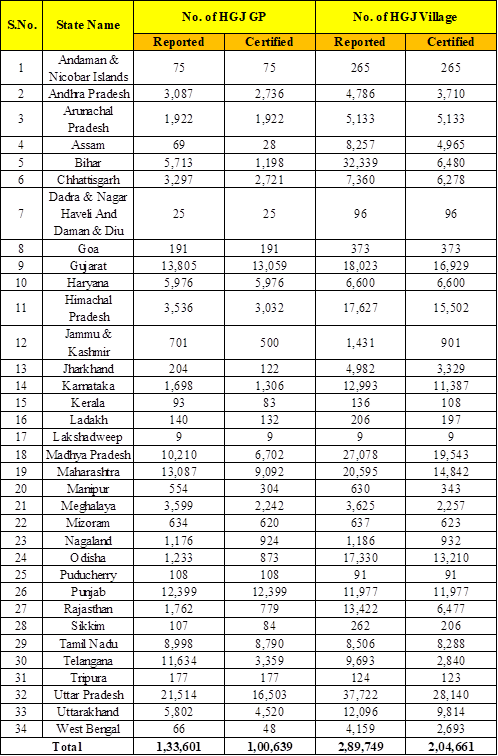
In a major milestone, a total of 188 districts, 1,090 blocks, 1.01 lakh Gram Panchayats and 2.04 lakh villages have been certified as Har Ghar Jal (HGJ) (State-wise details of HGJ Gram Panchayats and Villages at Annex below), 9.34 lakh (90.86%) schools and 9.73 lakh (86.21%) Anganwadi centres have drinking water tap connections, reflecting the scale and reach of the Mission. The same can be publicly viewed real-time on the Jal Jeevan Mission- Integrated Management Information System (JJM-IMIS) portal https://ejalshakti.gov.in/jjmreport/JJMIndia.aspx
Rural drinking water supply has been a national development priority since Independence. Over the decades, successive initiatives including the National Water Supply Programme (1954), Accelerated Rural Water Supply Programme (1972-73), National Drinking Water Mission (1986), Swajaldhara (2002) and the National Rural Drinking Water Programme (NRDWP) contributed significantly to expanding access to safe drinking water in rural areas. These programmes laid the foundation for strengthening rural water infrastructure and addressing water quality and sustainability challenges. Building upon these efforts, Jal Jeevan Mission marked a paradigm shift from habitation-level coverage to service delivery at the household level through Functional Household Tap Connections, with a focus on adequate quantity (55 lpcd.) of prescribed quality (BIS:10500) on regular and long-term basis at affordable service delivery charges leading to improvement in living standards of rural communities.
The Mission has enabled millions of women and girls to devote more time to education, livelihoods, and productive activities by reducing the burden of fetching water from distant sources. Access to tap water within households has also contributed towards improved health, hygiene, dignity, and overall quality of life in rural communities. The Mission's implementation framework, based on extensive community participation, Gram Panchayat involvement, and local ownership, has helped transform rural drinking water management across the country.
Building on the achievements of the Mission, the Union Government has extended Jal Jeevan Mission till December 2028. Over the last seven years, Jal Jeevan Mission has evolved from an infrastructure creation programme into a people-centric movement for sustainable water security. The Mission promotes source sustainability measures such as groundwater recharge, rainwater harvesting, greywater management, water conservation, and village-level water security planning to ensure long-term reliability of drinking water sources. Gram Panchayats, Village Water & Sanitation Committees (VWSCs), Self-Help Groups, and local communities are being empowered to play a central role in managing and sustaining rural water supply assets.
Under the Jal Jeevan Mission 2.0, DDWS also focuses on source sustainability through Jal Sanchay Jan Bhagidari (JSJB), a reflection of the Hon’ble Prime Minister’s unwavering resolve to make water conservation a national priority for a water secure nation. Jal Sanchay Jan Bhagidari: Catch the Rain (JSJB: CTR) – 2026 was launched on 1st June 2026 enhancing the scope of the Jal Sanchay Jan Bhagidari (JSJB). The JSJB initiative focuses on intensifying community action and mobilization to build low-cost rainwater harvesting structures. This can be ensured through active participation of Gram Panchayats, VWSCs, Self-Help Groups, schools, colleges and community institutions to promote rainwater harvesting, groundwater recharge and long-term water security.
The Government of India has also placed strong emphasis on water quality monitoring and surveillance. Through a nationwide network of water quality testing laboratories, trained community members, and Field-Testing Kits (FTKs), rural communities are increasingly participating in monitoring drinking water quality, thereby strengthening accountability and ensuring safe drinking water for all.
As Jal Jeevan Mission enters its eighth year, the Department of Drinking Water & Sanitation, Ministry of Jal Shakti, reiterates its commitment to ensuring that every rural household receives safe drinking water on a regular basis while strengthening community-led management and sustainability of rural water supply systems. The collective efforts of States, Union Territories, District Administrations, Gram Panchayats, VWSCs, frontline workers, and rural communities will continue to drive the vision of "Har Ghar Jal" and water security for every rural household in the country.
Annex: State-wise details of Har Ghar Jal (HGJ) Gram Panchayats (GP) and Villages
****
PS/AK
(Release ID: 2299487)
Visitor Counter : 2069