Ministry of Science & Technology
Two Days of the BRICS Science Academies Forum Meeting 2026 successfully concluded at IIT Hyderabad with focus on AI for Sustainability and Global South Cooperation
Posted On:
24 JUL 2026 7:32PM by PIB Delhi
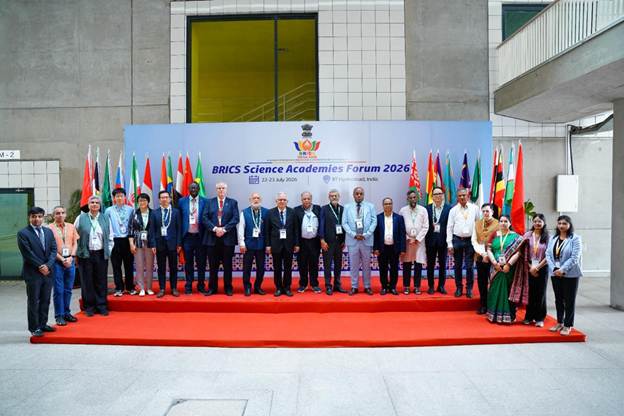
The Day 01 of the BRICS Science Academies Forum Meeting 2026 with the focal theme “Harnessing Artificial Intelligence for Sustainable Development and Strengthening Global South Cooperation” commenced today at the Indian Institute of Technology (IIT) Hyderabad, bringing together member and participating countries from BRICS to deliberate on the 3C’s Collective, Collaborative and Context sensitive approaches towards Artificial Intelligence (AI). The forum witnessed the presence of 08 BRICS member countries - Brazil, China, Egypt, Ethiopia, Indonesia, Russia and South Africa along with 05 BRICS partner countries - Nigeria, Vietnam, Belarus, Kazakhstan and Malaysia.
Delivering the Presidential Address of the host academy - Indian National Science Academy (INSA), Prof. Shekhar Mande, President of INSA, underscored the transformative role of Artificial Intelligence (AI) in addressing priority global and global south challenges, and also emphasized the importance of ensuring that AI systems remain ethical, inclusive, transparent and accessible to all socio-economic fabric of the society. Dr. Debashis Mitra, Vice President (International Affairs), INSA delivered the context-setting address, underlining the urgency for strengthened multilateral scientific engagement. This was followed by an institutional address by Prof. B. S. Murty, Director of IIT Hyderabad who focussed on the various AI associated programmes undertaken at IIT Hyderabad.
Key Focus Areas of AI Collaboration
The deliberations identified five priority verticals for AI-driven interventions:
- Advanced Materials and Manufacturing: Accelerating materials discovery, enabling smart manufacturing and optimizing supply chains.
- Healthcare: Enhancing clinical decision-making, enabling population-scale screening and advancing health research.
- Climate Change and Environmental Sustainability: Improving long-term forecasting, integrating AI with physical models and enabling risk mitigation.
- Agriculture and Food Security: Providing AI-powered advisories, accelerating seed research and leveraging digital public infrastructure.
- Disaster Prediction and Management: Strengthening forecasting capabilities, seismic analysis and resource optimization during emergencies.
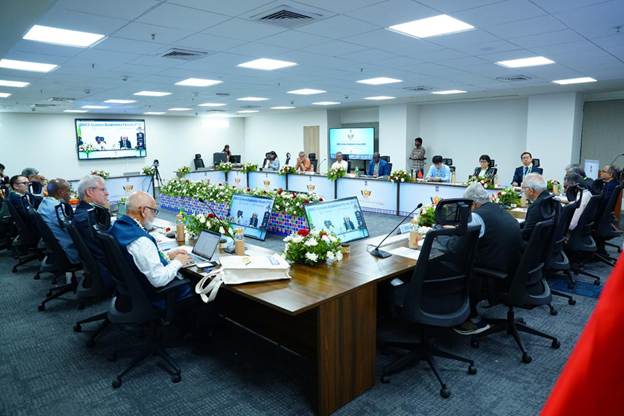
The thematic focus of the Forum was introduced in the Statement Overview session led by Prof. Ambuj Sagar, IIT Delhi and set the stage for detailed deliberations. Representatives from participating academies presented their national perspectives and engaged in substantive discussions.
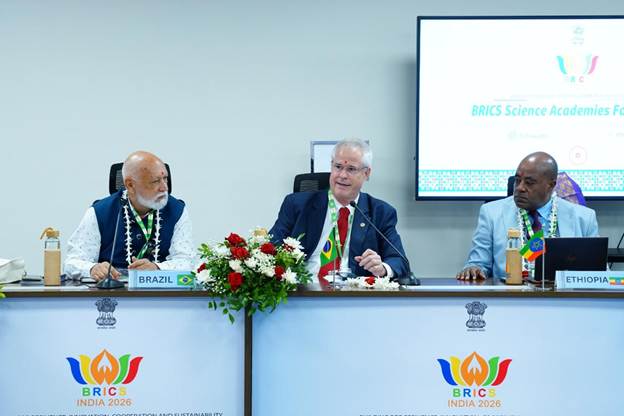
- Brazilian Academy of Sciences emphasized inclusive AI for healthcare, climate resilience and food security
- Chinese Academy of Sciences highlighted data sharing, validation and evidence-based policymaking aligned with SDGs.
- Academy of Scientific Research and Technology, Egypt called for capacity building and a BRICS AI Network
- Ethiopian Academy of Sciences stressed preservation of linguistic diversity alongside cybersecurity and AI education.
- Indonesian Academy of Sciences underlined explainability, ethical risks and the need for AI to augment human judgement.
- Russian Academy of Sciences advocated trusted AI systems with strong ethics, transparency and institutional mechanisms such as Centres of Excellence.
- Academy of Science of South Africa focused on addressing the digital divide and prioritizing climate, health and food security.
- The Nigerian Academy of Science emphasized ethical AI and data-driven planning.
- Vietnam Academy of Science and Technology raised concerns on employment, local data and environmental impacts.
- National Academy of Sciences of Belarus highlighted telemedicine and data security
- National Academy of Sciences of the Republic of Kazakhstan stressed technology access, SDG alignment and support for young scientists.
Summarizing the deliberations, Prof. U. B. Desai, Vice President (Fellowship Affairs), INSA highlighted the need for enhanced cooperation, capacity building and knowledge exchange among member countries. The day also featured a Plenary Lecture by Prof. Anurag Agrawal, Vice President (Science Policy), INSA on the topic “Why AI in healthcare? (And When Not to Use It).” The formal proceedings of Day 01 concluded with discussions, followed by a cultural programme and networking dinner.
The second day of the BRICS Science Academies Forum Meeting 2026 concluded initiated with a plenary lecture by Prof. Indranil Manna, Vice President (Science & Society), INSA. He highlighted the role of AI in materials discovery, including data collection, pattern extraction, physics-based modelling and identification of promising material candidates. The keynote lecture by Dr. Ashish Lele, Director, CSIR-NCL, focused on “Harnessing AI and Green Hydrogen: Driving Efficiency and Decarbonization.” He outlined India’s energy transition pathway, the importance of the National Green Hydrogen Mission and the need for greener logistics and decarbonized data centres.
A key highlight of the concluding day was the Open Discussion on the Joint Statement, chaired by Prof. Shekhar C. Mande, President, INSA, where representatives from BRICS member and partner science academies engaged in extensive deliberations to finalize a consensus communiqué. The Joint Statement, reflecting the shared vision and recommendations of the participating academies, is expected to be endorsed within a week and will be presented at the forthcoming BRICS Science, Technology and Innovation (STI) Ministerial Meeting in August 2026.
In his concluding remarks, Shri Shambhulingappa Hakki, Joint Secretary (MER & G20) and BRICS Sous Sherpa emphasized that science is an indispensable pillar of the Sustainable Development Goals (SDGs) and evidence-based public policy. Congratulating the participating academies for arriving at a consensus communiqué, he remarked that the deliberations were both timely and aligned with India's vision of human-centric development.
The proceedings concluded with a vote of thanks by Dr. Brajesh Pandey, Executive Director, INSA who expressed gratitude to all participating academies, delegates, speakers, IIT Hyderabad, MEA and INSA team for concluding the forum successfully.
*****
NKR/FT
(Release ID: 2289133)
Visitor Counter : 974