Ministry of Science & Technology
New ultra-sensitive ammonia sensor can enable portable, self-powered, wearable devices to prevent toxic gas exposure
Posted On:
14 JUL 2026 3:51PM by PIB Delhi
Scientists have developed an advanced ammonia sensing platform capable of detecting harmful ammonia gas at extremely low concentrations while operating at room temperature.
Ammonia is widely used in industries such as fertilizer production, refrigeration, chemical manufacturing, and agriculture. However, accidental exposure to ammonia can cause severe irritation of the eyes, skin, and respiratory system, while prolonged exposure may lead to serious health complications. Continuous and reliable monitoring of ammonia is therefore essential for ensuring workplace safety, environmental protection, and public health.
To address this challenge, researchers at the Centre for Nano and Soft Matter Sciences (CeNS), Bengaluru, an autonomous institution of the Department of Science and Technology (DST) designed a highly sensitive gas sensor based on a hybrid vanadium oxide-vanadium sulfide (VOx/VS2) heterostructure.
The sensor was engineered through a controlled surface transformation process that creates abundant active sites for ammonia adsorption while simultaneously enhancing charge transport within the sensing layer. This synergistic combination significantly improves sensing performance, enabling rapid and highly selective detection of ammonia under ambient conditions.
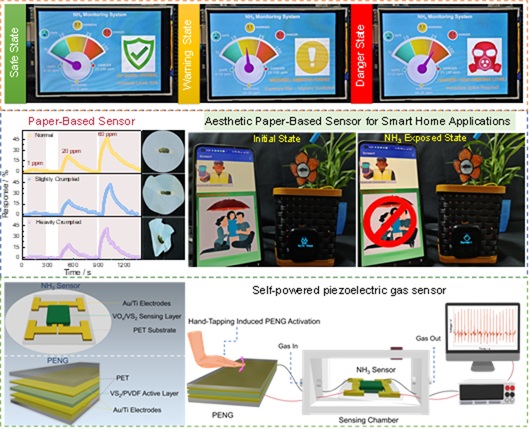
Fig: Portable, wearable, and self-powered ammonia sensing prototypes
The developed sensor demonstrated exceptional performance, detecting ammonia concentrations as low as 319 parts per billion (ppb), well below the safety limits recommended for occupational environments. In addition to its ultralow detection capability, the sensor exhibited excellent selectivity against other common gases, stable operation over repeated sensing cycles, long-term reliability exceeding ten weeks, and effective performance across a broad concentration range. Unlike many conventional gas sensors that require elevated temperatures or external activation sources, the newly developed device operates efficiently at room temperature, reducing energy consumption and simplifying deployment.
Beyond material innovation, the research team led by Prof. Angappane Subramanian accompanied by Dr. Vishnu G. Nath, along with Ankur Verma, Abhijit Paul, and Dr. Subash Cherumannil Karumuthil translated the sensing technology into practical prototypes aimed at real-world applications. A portable threshold-triggered monitoring system was developed to provide immediate alerts when ammonia concentrations exceed predefined safety levels. The device automatically classifies environmental conditions into safe, warning, and danger zones, allowing rapid interpretation and response without requiring technical expertise. Such sensing devices can be deployed in industrial facilities, storage units, laboratories, and agricultural environments where ammonia leakage poses a significant risk.
The researchers further demonstrated a self-powered ammonia detection device by integrating the sensor with a flexible piezoelectric nanogenerator. The resulting device harvests mechanical energy from simple human motions and converts it into electrical power, enabling gas detection without the need for an external power source. This feature opens opportunities for autonomous environmental monitoring in remote or resource-limited settings.
In addition, flexible and wearable versions of the sensor were successfully fabricated on polymer, paper, and textile substrates. These lightweight devices maintained sensing capability even under bending, twisting, and folding conditions, demonstrating their suitability for next-generation wearable electronics. Prototype smart bands, smart-home warning systems, and electronic textile platforms were also developed to showcase potential applications in personal safety monitoring and intelligent environmental sensing.
The study published in the journal ACS Sensors highlights how advanced nanomaterials and innovative device engineering can be combined to create practical technologies for safeguarding human health and the environment. The successful demonstration of portable, self-powered, and wearable sensor prototypes highlights the versatility of the technology and its potential for next-generation gas monitoring solutions.
Publication link: https://doi.org/10.1021/acssensors.5c02600
*****
NKR/FT/NM
(Release ID: 2284459)
Visitor Counter : 1947