Ministry of Science & Technology
India's Liver Epidemic, Diabetes Surge Part of a Larger Metabolic Nexus; Calls for Mission-Mode Public Awareness: Dr Jitendra Singh
Liver, despite being the body's most resilient organ, is increasingly coming under stress from unhealthy dietary habits, lifestyle factors, inappropriate sleep patterns, stressful behaviour, and environmental pollution: Dr Jitendra Singh
Metabolic disorders are increasingly affecting younger Indians, making it a national concern rather than merely a medical issue: Dr Jitendra Singh
Union Minister Dr Jitendra Singh Addresses 3rd Anniversary of Liver & Metabolic Disease Network (InFLiMeN) at Institute of Liver & Biliary Sciences
Posted On:
04 JUL 2026 4:08PM by PIB Delhi
Union Minister of State (Independent Charge) for Science & Technology, Earth Sciences, and Minister of State for PMO, Personnel, Public Grievances, Pensions, Atomic Energy and Space, Dr. Jitendra Singh today said India's liver epidemic and the sharp rise in Type-2 diabetes are part of a larger metabolic nexus, with disorders such as fatty liver, hypertension, dyslipidaemia and insulin resistance closely interconnected and predisposing one another.
The Minister said these diseases are now appearing at much younger ages than before, making the challenge far more than a medical issue and calling for a mission-mode national response driven by preventive healthcare and mass public awareness, in line with Prime Minister Narendra Modi's sustained emphasis on tackling obesity and lifestyle-related diseases.
Dr. Jitendra Singh was addressing the 3rd Anniversary of the Liver & Metabolic Disease Network (InFLiMeN) at the Institute of Liver & Biliary Sciences (ILBS), New Delhi. The network, supported by the Department of Science & Technology (DST), seeks to strengthen collaborative research, innovation, early diagnosis and evidence-based policy interventions to combat the growing burden of liver and metabolic diseases in India.
The programme was attended by Dr. Vinod Paul, Former Member, NITI Aayog; Dr. Silviane Pied, French Attachée for Scientific and Academic Cooperation; Prof. Mridul Kumar Daga, Vice Chancellor, ILBS; and Prof. Shiv Kumar Sarin, Director, ILBS, besides leading clinicians, scientists and researchers from across the country.
Congratulating Prof. Shiv Kumar Sarin for spearheading InFLiMeN, Dr. Jitendra Singh described the initiative as a landmark national platform that has brought together scientific institutions, clinicians and researchers to confront one of India's fastest-growing public health challenges. He said sustained scientific collaboration, coupled with public participation, would be critical for reversing the growing burden of liver and metabolic disorders.
The Minister said, India is witnessing a significant shift in the epidemiology of metabolic diseases. Conditions that were once largely associated with middle-aged and elderly populations are now increasingly being diagnosed among younger adults and even adolescents. This changing disease profile, he said, demands a corresponding shift from curative healthcare towards prevention, early detection and lifestyle modification.
Referring to India's unique metabolic profile, Dr. Jitendra Singh said the country's genetic predisposition, higher prevalence of central obesity and distinct Indian phenotype make its population particularly vulnerable to diabetes, fatty liver and cardiovascular diseases, often even among individuals with relatively lower Body Mass Index (BMI). These characteristics, he said, reinforce the need for Indian data, Indian research and Indian solutions instead of relying solely on evidence generated elsewhere.
The Minister said the liver, despite being the body's most resilient and regenerative organ, is increasingly coming under stress from unhealthy dietary habits, lifestyle factors, inappropriate sleep patterns, stressful behaviour, and environmental pollution. Addressing these preventable causes, he said, must become an integral part of India's public health strategy.
Dr. Jitendra Singh welcomed ILBS' efforts in creating a National Liver Biobank and stressed the importance of developing affordable early diagnostic technologies, community-level screening tools and indigenous biomarkers capable of identifying liver disease before irreversible damage occurs. Such initiatives, he said, complement the Government's commitment to affordable, accessible and preventive healthcare.
Calling for greater synergy across scientific institutions, the Minister said the country's expanding biotechnology ecosystem, Genome Mission and large-scale gene sequencing programme offer unprecedented opportunities to understand India's unique disease patterns. He said advances in biotechnology, genomics and Artificial Intelligence are paving the way for precision medicine, enabling treatments tailored to an individual's genetic profile, lifestyle and environmental exposure.
Dr. Jitendra Singh said scientific progress alone cannot overcome the challenge unless it is accompanied by widespread public awareness and behavioural change. He called upon medical professionals, researchers, educational institutions, civil society organisations and the media to work together in promoting scientifically validated health practices and countering misinformation relating to nutrition, obesity and lifestyle diseases.
Emphasising that a healthy population is fundamental to the vision of Viksit Bharat 2047, Dr. Jitendra Singh said reducing India's burden of diabetes and fatty liver disease is essential for preserving the productivity, aspirations and potential of the country's young population. He said the success of such efforts would not only strengthen public health but also enhance India's human capital and national development.
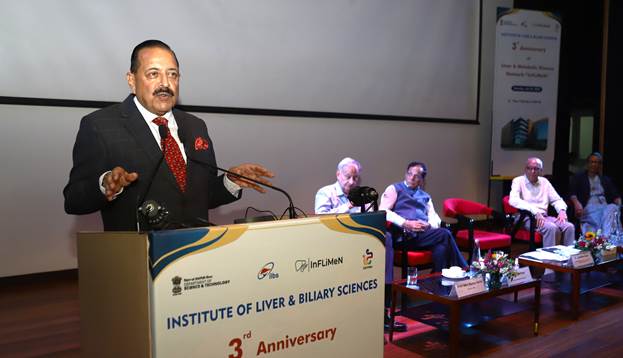
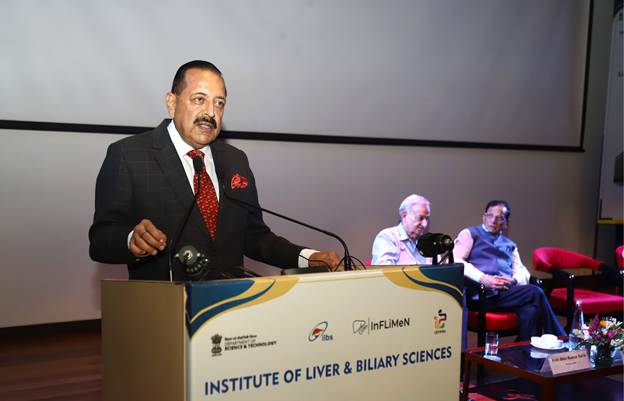
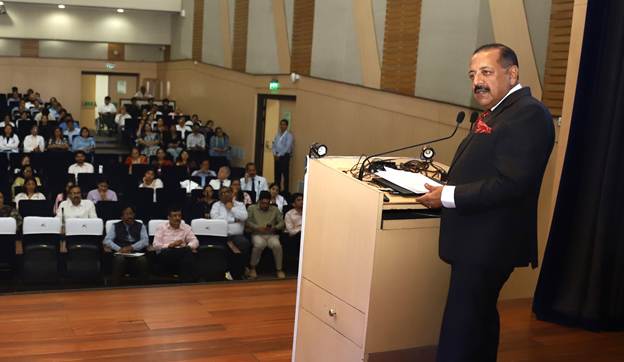
PHOTO: Union Minister Dr Jitendra Singh speaking during the 3rd anniversary of “Liver & Metabolic Disease Network" (InFLiMeN), at Institute of Liver and Biliary Science (ILBS), New Delhi on Saturday.
75DL.jpeg)
*****
NKR/AK/MJ/AV
(Release ID: 2281062)
Visitor Counter : 1828