Ministry of Science & Technology
Advancing electrolyte engineering for durable and affordable aqueous batteries
Posted On:
18 JUN 2026 3:21PM by PIB Delhi
A newly developed electrolyte additive can contribute to the development of safer, longer-lasting, and more affordable rechargeable zinc batteries.
Aqueous zinc ion batteries (AZIBs) are emerging as a low-cost, safe, and sustainable alternatives to lithium-ion batteries. However, their commercialization is hindered by zinc dendrite growth, hydrogen evolution reaction (HER), corrosion, and poor cycling stability. This study addresses these critical challenges through interface engineering rather than expensive material redesign. The work provides a practical and scalable strategy for extending battery life while maintaining safety and low cost, which is essential for large-scale renewable energy storage applications.
Researchers have been working on ways to increase zinc anode stability and the importance of the electric double layer and the role of the layer Inner Helmholtz Plane where electrochemical reactions actually occur in it.
Scientists from Institute of Nano Science and Technology (INST), an autonomous institute of the Department of Science and Technology (DST) have developed electrolyte additive, 1,3-bis (1,3-dicarboxypropyl)-1H-imidazole-3-ium chloride (BDIM), that selectively adsorbs on zinc metal surfaces and regulates the Inner Helmholtz Plane (IHP) of aqueous zinc ion batteries (AZIBs).
They dissolved Glutamic acid in sodium hydroxide (NaOH) and water, followed by the addition of glyoxal, formaldehyde, and acetic acid. The mixture was heated at 70 °C under nitrogen for 24 hours and then extracted and lyophilized to obtain a crystalline powder of BDIM.
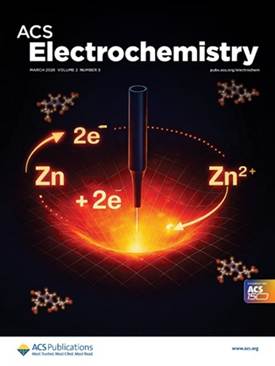
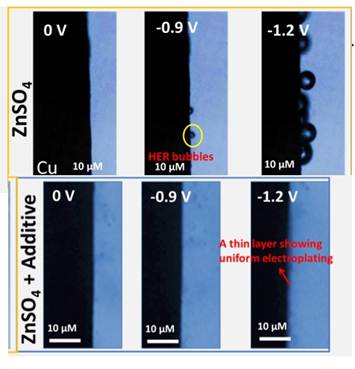
Fig: (Left) Cover image of the work accepted in ACS Electrochemistry showing how electrolyte additive controls the Zn surface. (Right) Comparison of the effect of the BDIM additive on the zinc anode surface in suppressing HER
The additive BDIM contains multiple oxygen and nitrogen donor sites that strongly interact with zinc metal. During battery operation, BDIM preferentially adsorbs on the negatively polarized zinc surface and occupies the Inner Helmholtz Plane. This absorption displaces water molecules from the interface, reducing water-induced side reactions such as hydrogen evolution and corrosion and suppressing hydrogen evolution, corrosion, and dendrite formation.
A lab-made tiny electrode called ultramicroelectrode (UME) was combined with fast-scan cyclic voltammetry (FSCV) to probe for new insights into zinc-deposition mechanisms.
The UME with dimension below around 50 micrometres in which the diffusion behaviour completely changes from linear to radial or hemispherical due to the extremely small size and helps achieve high scan rates, while the FSCV helps visualise the shift in charge-transfer regime to lower scan rates when an additive is added. These helped them directly investigate interfacial charge-transfer and mass-transfer kinetics, providing new understanding of the zinc-deposition mechanisms.
The research led by Dr. Ramendra Sundar Dey, Scientist E, INST Mohali and published in Journal ACS Electrochemistry can be directly/indirectly applied to AZIBs, grid-scale energy storage systems, renewable energy storage, and battery safety and lifetime enhancement technologies.
The technology can contribute to the development of safer, longer-lasting, and more affordable rechargeable batteries. Improved zinc-ion batteries can be used for renewable energy storage, backup power systems, and grid-scale energy storage. By enhancing battery lifetime and reducing performance degradation, the technology can lower maintenance costs and improve the reliability of sustainable energy infrastructure.
Publication link - https://doi.org/10.1021/acselectrochem.5c00322
******
NKR/FT/NM
(Release ID: 2274565)
Visitor Counter : 2068