PIB Backgrounder
India’s Evolving Metrology Ecosystem
Strengthening Trade, Transparency, and Consumer Protection
Posted On:
20 MAY 2026 12:12PM by PIB Delhi
India’s evolving metrology ecosystem is strengthening fair trade, consumer protection, industrial quality, and global competitiveness. The Legal Metrology Act, 2009 anchors a modern regulatory structure that has evolved from ancient systems of weights and measures. Institutions like the National Physical Laboratory and Regional Reference Standard Laboratories support national measurement standards and verification systems. Initiatives like eMaap Portal, One Nation One Time, and authority to issue OIML certification are enhancing transparency, efficiency and consumer satisfaction. They are also supporting ease of trade through India’s integration with global measurement and quality infrastructure.
Metrology: Building Trust in Trade through Measurement Science
Measurement forms the foundation of modern economic systems, industrial production, scientific advancement, and consumer protection. Standardized measurements ensure transparency and public trust across sectors such as trade, healthcare, infrastructure, telecommunications, energy distribution, and digital technologies. In this context, metrology, the science of measurement, and legal metrology, the regulation of measurements, ensure fairness in trade and commerce. Metrology establishes common standards for units and measuring instruments. These standardized units are established for various kinds of measurements used in the trade of commodities, like length, weight, volume, time, temperature, and other physical quantities. It has a wide range of applications, including in navigation, construction, product development, environmental monitoring, medicine, and food processing.
Metrology focuses on the science and accuracy of measurement. Legal metrology meanwhile focuses on ensuring accuracy and reliability in weights and measurements for public protection and fair trade. India has developed a comprehensive legal metrology framework through progressive legislative reforms, institutional strengthening, and digital governance initiatives. From ancient systems of weights and measures to the enactment of the Legal Metrology Act, 2009, India’s measurement ecosystem is continuously evolving. The evolving framework seeks to address changing trade practices, emerging technologies, and growing consumer protection requirements.
World Metrology Day
World Metrology Day, observed annually on 20 May, highlights the importance of measurement science in modern society. This day was established in 1999 by the International Committee for Weights and Measures. It commemorates the signing of the Metre Convention on 20 May 1875. This convention laid the institutional and scientific foundation for a globally uniform and continuously evolving metric measurement system. The International Bureau of Weights and Measures (BIPM) and the International Organization of Legal Metrology (OIML) jointly coordinate the celebrations. The theme for this year, “Metrology: Building Trust in Policy Making,” emphasizes metrology’s role in evidence-based and transparent governance.
Metrology in Everyday Life: Ensuring Accuracy, Trust, and Fairness
Metrology significantly influences everyday life by ensuring accuracy, reliability, and fairness in routine transactions and public services. Legal metrology systems regulate various kinds of weighing and measuring instruments. These include instruments used in petrol pumps, grocery stores, jewellery shops, hospitals, electricity meters, water supply systems, packaged commodities. It ensures consumers receive the correct quantity and value for their purchases and services. These systems help prevent the delivery of lesser quantities, inaccurate billing, and unfair trade practices, thereby strengthening consumer confidence in daily commercial transactions.
Accurate measurement systems also contribute to public welfare and safety. Metrology ensures the standardization of technical instruments, measuring units, and machines used in service delivery. This ensures precise medical testing and diagnosis, reliable monitoring of electricity, water, and gas consumption, and effective road safety enforcement through speed-measuring devices. Thus, by maintaining uniform standards and verification mechanisms, metrology enhances trust, transparency, and efficiency in everyday economic and public activities.
Ancient India’s Measurement Heritage and Commercial Systems
Ancient India possessed a well-structured system of weights and measures. These played a significant role in trade, commerce, taxation, jewelry-making, agriculture, and everyday economic transactions. These systems were based on standardized units derived from seeds, grains, body measurements, and mathematical ratios. These practices evolved into organized and widely accepted commercial measurement standards.
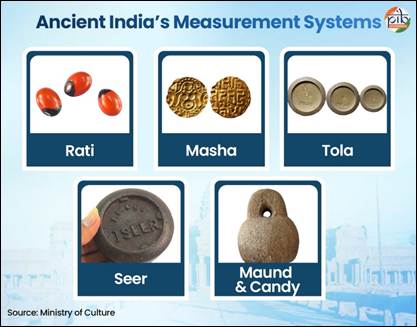
Several standardized units were widely used in ancient India for commercial and practical purposes:
· Rati: A small seed-based unit mainly used for weighing gold, gemstones, and other precious items.
· Masha: A higher unit derived from a fixed number of Ratis.
· Tola: A widely used unit for commercial transactions and precious metals.
· Seer: A larger unit commonly used in trade and market transactions.
· Maund and Candy: Large-scale units used for bulk trade, storage, and agricultural transactions.
Ancient Indian measurement practices also included:
· Systems for measuring length, weight, and capacity.
· Body-based measurements such as cubits and hand spans.
· Use of binary, decimal, and octonary numerical systems for calculation and proportional division.
The Indus Valley Civilization had developed highly standardized measurement systems, reflecting advanced urban planning, trade, and architecture. During the Maurya Empire (322–185 BCE), organized systems of weights and measures were introduced for administration, taxation, and trade regulation. Later, Sher Shah Suri standardized weights and measures and introduced the Rupiya coin, which became the precursor to the modern rupee.
Evolution of India’s Legal Metrology Framework
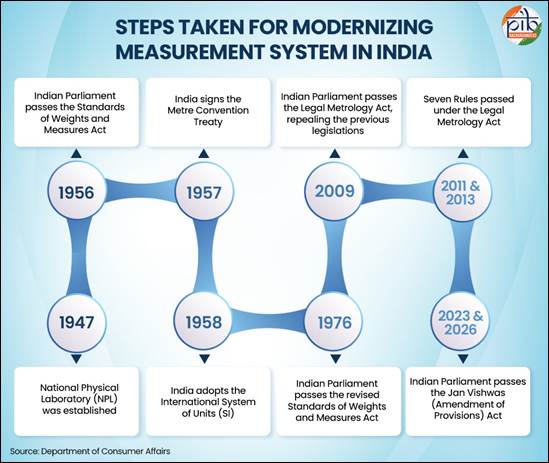
India’s modern metrology journey began to take shape with the establishment of the National Physical Laboratory in 1947. This was followed by the enactment of the Standards of Weights and Measures Act, 1956, which established nationwide uniformity. India further strengthened global alignment by signing the Metre Convention and adopting the International System of Units (SI) during 1957–58. Subsequent legislative reforms, including the laws enacted in 1976 and 2009, further modernized and strengthened India’s legal metrology framework.
International System of Units (SI)
SI units are internationally accepted standard units used for measurement worldwide. These units are defined using fixed scientific constants that never change. This ensures measurements remain accurate, uniform, and reliable everywhere in the world. Units such as metre, kilogram, and second are part of the SI system. The system helps maintain consistency in science, trade, industry, and daily life.
National Physical Laboratory-1947
The National Physical Laboratory (NPL) emerged as India’s National Measurement Institute and the custodian of the national prototypes of the metre and kilogram. Regional Reference Standard Laboratories (RRSLs) were established to strengthen standardization and verification systems across states. These compare and verify standards used in laboratories and commercial trade activities.
Some Notable Achievements of the National Physical Laboratory (NPL)
· India’s NPL served as a founding member of the Asia Pacific Metrology Program (APMP). The APMP is a group of national metrology institutes from the Asia-Pacific region. They are engaged in improving regional metrological capability through the sharing of expertise and the exchange of technical services.
· NPL has developed the globally recognized indelible ink. Used in elections across 37 countries, it symbolizes India’s democratic impact on the world stage.
· NPL has also established India’s first certification facility for environmental monitoring equipment, a world-class solar cell calibration facility, and developed carbon composite materials for strategic sectors. These advancements not only enhance India’s industrial and defense capabilities but also align with the nation’s renewable energy and sustainability goals.
Standards of Weights and Measures Act, 1956 and 1976
The Standards of Weights and Measures Act, 1956, was enacted to establish a uniform, scientific, and standardized system of measurements in India. It is based on the metric system and internationally accepted measurement standards. The legislation facilitated India’s alignment with the SI Units and global legal metrology practices developed under the International Organization of Legal Metrology (OIML), of which India is a member.
The Act was amended in 1976, leading to the enactment of Standards of Weights and Measures Act, 1976, which included:
· Introduction of standardized numeration in accordance with the international form of Indian numerals.
· Regulation of inter-state trade and commerce involving weights, measures, and packaged commodities.
· Approval and standardization of weighing and measuring instruments.
· Facilitation of the establishment of the Indian Institute of Legal Metrology for training inspectors and legal metrology officials.
· Penalties and Punishments for violations related to weights and measures laws.
Legal Metrology Act, 2009
The Legal Metrology Act, 2009, was enacted to establish and enforce standards of weights and measures in India. The Act incorporates advancements in technology, modern trade practices, and evolving standards of measurement and standardization. The purpose was to regulate trade and commerce of goods sold by weight, measure, or number through a modern legal framework. Ensuring accuracy, transparency, and consumer protection in commercial transactions were the main objectives. The Act was implemented with effect from April 1, 2011. With its enforcement, the Standards of Weights and Measures Act, 1976, and the Standards of Weights and Measures (Enforcement) Act, 1985, were repealed.
Key Features of Legal Metrology Act, 2009 include:
· Mandatory adoption of the metric system and standardized units of measurement across India.
· Regulates weighing and measuring instruments used in trade and commercial transactions.
· Requires verification and stamping of weights and measures prior to their commercial use.
· Prescribes mandatory declarations for pre-packaged commodities, including details on quantity, weight, and measurement.
· Provides registration for manufacturers, dealers, repairers, and importers of weighing instruments.
· Empowers Legal Metrology Officers to undertake inspections, searches, seizures, and other enforcement actions.
· Introduces penalties for the use of non-standard or unverified weights and measures.
Key Commodities Covered Under the Legal Metrology Act
The following are the key commodities included in the rules under the Legal Metrology Act:
1. Weighing Instruments: Weighing machines used in shops and markets must be verified and stamped by Legal Metrology authorities. This ensures consumers receive the correct quantity for the amount paid and prevents tampering or short weighing.
2. Packaged Commodities: Packaged goods such as food items, medicines, and household products must carry declarations related to quantity, MRP, manufacturing date, and manufacturer details. These declarations help consumers make informed choices and prevent misleading packaging practices.
3. Fuel Dispensers: Fuel dispensing machines at petrol pumps are regularly verified and calibrated. This ensures consumers receive the exact quantity of fuel displayed on the machine.
4. Water and Electricity Meters: Water and electricity meters must accurately record consumption to promote transparency and fairness in billing.
5. Clinical and Medical Instruments: Medical instruments such as thermometers, blood pressure monitors, and weighing machines are regulated under Legal Metrology laws. Accurate measurements are essential for proper diagnosis and treatment.
6. Telecommunications and Digital Services: Digital systems such as mobile networks, internet services, and online payment platforms require highly accurate time and signal measurements. Precise measurement ensures smooth, reliable, and secure digital communication.
7. Electronics and Semiconductor Manufacturing: Electronic devices such as smartphones, laptops, and smart televisions depend on precision manufacturing. Metrology ensures accuracy during semiconductor production and supports the proper functioning of electronic products.
Rules Framed under this Act (2011 and 2013)
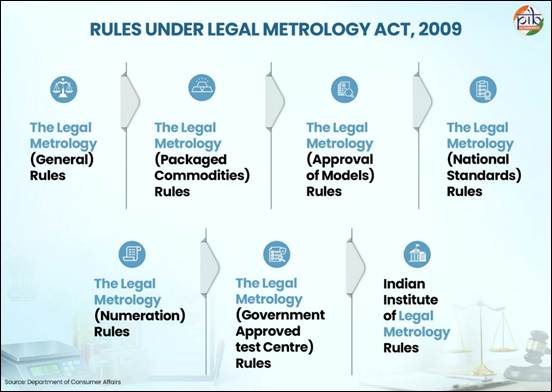
There are total of 7 rules framed under this Act governing different commodities:
1. The Legal Metrology (General) Rules: These cover around 40 types of weighing and measuring instruments, including electronic weighing machines, petrol pumps, weighbridges, water meters, clinical thermometers, and sphygmomanometers.
2. The Legal Metrology (Packaged Commodities) Rules: These rules regulate the sale of pre-packaged goods and ensure that consumers receive clear information about the products before purchase.
3. The Legal Metrology (Approval of Models) Rules: These require manufacturers and importers of specified weighing and measuring instruments to obtain model approval from the government before manufacturing or importing such equipment.
4. The Legal Metrology (National Standards) Rules: Under these rules, National Prototypes and primary standards of weights and measures are maintained at the National Physical Laboratory (NPL).
5. The Legal Metrology (Numeration) Rules: Under these rules, provisions are made for making Numeration and the manner in which numbers shall be written.
6. Indian Institute of Legal Metrology Rules: The Indian Institute of Legal Metrology (IILM), Ranchi, functions as the training institute for Legal Metrology Officers in India. These rules prescribe provisions on training courses, the Institute's functions, and the qualifications required for admission to the Institute.
7. The Legal Metrology (Government Approved Test Centre) Rules: These rules are framed for the approval of GATCs established by private persons for the verification of certain weights and measures.
In alignment with these rules, states/ UTs have also framed their Enforcement Rules.
These rules are amended from time to time to ensure they keep up with the evolving conditions of trade and technology. Recently, in October 2025, the scope of Government Approved Test Centres (GATCs) was expanded to include 18 categories of measuring instruments, including water meters, gas meters, energy meters, and sphygmomanometers.
Jan Vishwas Act, 2023, and Jan Vishwas Act, 2026
The Jan Vishwas (Amendment of Provisions) Act, 2023, introduced amendments to several laws across different Ministries, including the Legal Metrology Act, 2009. Under these reforms, seven sections of the Legal Metrology Act were decriminalized by replacing imprisonment provisions with monetary penalties in selected cases. The amendments to the Legal Metrology Act came into force on1 October 2023. The reforms aim to improve ease of doing business, reduce compliance burden, and encourage voluntary compliance, while continuing to protect consumer interests and maintain accountability in trade and measurement systems.
The Jan Vishwas (Amendment of Provisions) Act, 2026, introduced reforms to reduce compliance burdens. It further promotes ease of doing business, particularly for Micro, Small, and Medium Enterprises (MSMEs). The amendments seek to encourage voluntary compliance by allowing businesses to rectify procedural lapses without facing immediate punitive action. Under the earlier provisions of the Legal Metrology Act, 2009, failure to maintain or produce prescribed records could attract direct penalties. The amendments introduce an “improvement notice” mechanism for first-time lapses. This allows MSME importers and businesses to rectify compliance gaps within a specified period before penalties are imposed. This reform reflects a shift towards trust-based governance, facilitative regulatory enforcement, and a business-friendly compliance framework.Major Government Initiatives in Metrology and Legal Metrology
eMaap Portal

The eMaap portal, launched by the Department of Consumer Affairs, aims to enhance Ease of Doing Business and G2B service delivery. The portal simplifies and rationalizes rules and guidelines under the Legal Metrology Act. It uses information technology to enable efficient, transparent governance. The portal also integrates Legal Metrology systems of all States with the central platform. The portal provides online registration services nationwide to manufacturers, dealers, repairers, importers, packers, and producers of packaged commodities.
One Nation, One Time Initiative
India has launched the ‘One Nation, One Time’ initiative to disseminate Indian Standard Time (IST) with millisecond-to-microsecond accuracy across the country. The project is being implemented by the Department of Consumer Affairs in collaboration with the National Physical Laboratory (NPL) and ISRO through five Legal Metrology laboratories located across India.
The initiative aims to establish a uniform, highly precise time synchronization system across sectors such as telecommunications, banking, navigation, power grids, digital governance, 5G services, artificial intelligence, IoT, and scientific research. It also seeks to reduce dependence on foreign time sources such as GPS and strengthen national security, critical infrastructure management, accurate financial transactions, emergency response coordination, industrial efficiency, and reliable public services.trengthening Global Trade through OIML Certification Recognition

India became a member of the International Organization of Legal Metrology (OIML) in 1956. In 2023, it became the 13th country globally authorized to issue internationally accepted OIML approval certificates for weighing and measuring instruments. This recognition enables Indian manufacturers to export instruments worldwide without additional international testing costs, while also strengthening India’s role in global trade, standard-setting, and Legal Metrology governance.
The certification system, supported by Regional Reference Standard Laboratories (RRSLs), also allows India to provide certification services to foreign manufacturers, generate foreign exchange earnings, and contribute to international OIML policy and strategy development.
Measuring Sustainability: How Metrology Supports the SDGs
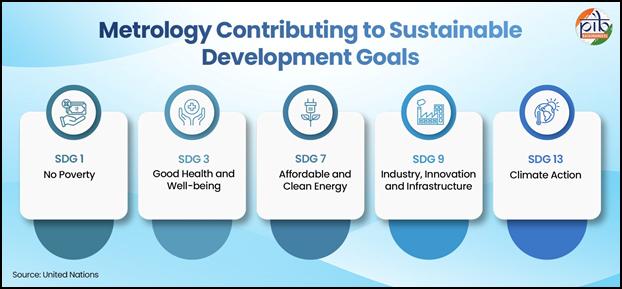
Metrology contributes significantly to achieving the Sustainable Development Goals (SDGs) by ensuring accurate, reliable, and standardized measurements. It supports SDG 1 (No Poverty) by promoting fair trade practices, transparent pricing, and consumer protection through reliable measurement systems. Under SDG 3 (Good Health and Well-being), metrology strengthens healthcare systems through precise medical diagnostics, clinical measurements, and safe treatment practices. It advances SDG 7 (Affordable and Clean Energy) by enabling efficient energy distribution, renewable energy integration, and accurate energy monitoring and billing. Metrology also contributes to SDG 9 (Industry, Innovation and Infrastructure) by improving industrial quality, calibration, testing, and technological innovation. Furthermore, it supports SDG 13 (Climate Action) through accurate environmental monitoring, climate research, and scientific assessment of atmospheric and ecological changes.
Building a Transparent and Consumer-Centric Measurement Ecosystem
India’s legal metrology framework continues to evolve in response to technological advancements, changing trade practices, and emerging consumer requirements. Recent initiatives undertaken by the Government have focused on reducing compliance burdens, ensuring uniform measurement standards, improving accuracy, and streamlining regulatory procedures through digital governance mechanisms.
Consumer protection measures have also been strengthened through mandatory declaration requirements on pre-packaged commodities and the introduction of country-of-origin disclosure provisions for e-commerce platforms, effective from 1 July 2027. Collectively, these reforms are contributing towards greater transparency, enhanced ease of doing business, stronger consumer confidence, and the development of India’s overall quality infrastructure ecosystem.
References
Ministry of Consumer Affairs, Food & Public Distribution
https://emaap.gov.in/about_us
https://iilm.gov.in/more/act-rules
https://consumeraffairs.gov.in/pages/legal-metrology-act
https://consumeraffairs.gov.in/pages/legal-metrology-overview
https://www.pib.gov.in/PressReleasePage.aspx?PRID=2096622®=3&lang=2
https://www.pib.gov.in/PressReleasePage.aspx?PRID=2033114®=3&lang=2
https://www.pib.gov.in/PressReleasePage.aspx?PRID=2183777®=3&lang=1
https://www.pib.gov.in/PressReleasePage.aspx?PRID=2188363®=3&lang=2
https://www.pib.gov.in/PressReleasePage.aspx?PRID=2184053®=3&lang=2
https://www.pib.gov.in/PressReleaseIframePage.aspx?PRID=1957429®=3&lang=2
Ministry of Culture
https://ignca.gov.in/Asi_data/2517.pdf
Ministry of Science & Technology
https://www.pib.gov.in/PressReleaseIframePage.aspx?PRID=2078069®=3&lang=2
https://www.nplindia.in/wp-content/uploads/2021/10/Angela-Historical-perspective-20171129-APMP-2017-NPLI-Symposiumfin.pdf
United Nations
https://www.unesco.org/en/days/metrology
https://www.unido.org/sites/default/files/files/2020-08/The_role_of_Metrology_in_the_context_of_SDGs.pdf
International Organization of Legal Metrology (OIML)
https://www.oiml.org/en/files/pdf_e/e002-e03.pdf
https://www.worldmetrologyday.org/press_release.html
https://www.oiml.org/en/publications/oiml-bulletin/online-bulletin-1/2024-07/the-importance-of-metrology-from-early-civilization-to-digitalisation-the-indian-perspective
International Bureau of Weights and Measures (BIPM)
https://share.google/xMAPHbZcQO1eHojmD
Asia Pacific Metrology Programme
https://www.apmpweb.org/portal/list/channel/id/3.html
Government of NCT of Delhi
https://weightnmeasures.delhi.gov.in/weightnmeasures/about-us
Government of Kerala
https://lmd.kerala.gov.in/2025/06/04/2-meter-convention/
PIB Backgrounder
https://www.pib.gov.in/PressNoteDetails.aspx?NoteId=158002&ModuleId=3®=3&lang=3
Click here to see pdf
PIB Research
(Release ID: 2263113)
Visitor Counter : 2591