PIB Backgrounder
Empowering the Grassroots Economy: A Comprehensive Push for Rural and Semi-Urban MSMEs
Posted On:
14 MAY 2026 11:53AM by PIB Delhi
MSMEs continue to drive India’s economic growth. They contribute over 31% to GDP, 48.58% to exports, and support livelihoods for nearly 32.8 crore people across the country. The Government has accelerated formalization of unregistered enterprises through Udyam and Udyam Assist platforms. This has brought over 7.9 crore enterprises into the formal economy. Targeted policy measures are improving access to credit, strengthening legal safeguards, and enhancing ease of doing business. Digital platforms like GeM, TReDS, and SAMADHAAN are enabling better market access and faster payments. Together, these efforts are strengthening the MSME ecosystem and advancing inclusive growth across rural and semi-urban India.
|
MSMEs Strengthening Domestic Economy
Micro, Small and Medium Enterprises (MSMEs) play a vital role in India’s economic development. They promote entrepreneurship, generate employment, and support decentralized industrial growth. MSMEs are especially important for strengthening rural and semi-urban economies. Recognizing this, the Government has introduced several policy initiatives for the sector. These initiatives aim to improve access to finance, encourage formalization, strengthen market linkages and promote digital integration of small enterprises.
These measures aim to strengthen local production systems and encourage self-employment. They also support traditional crafts and rural industries, contributing to inclusive and balanced economic growth.
Sectoral Overview
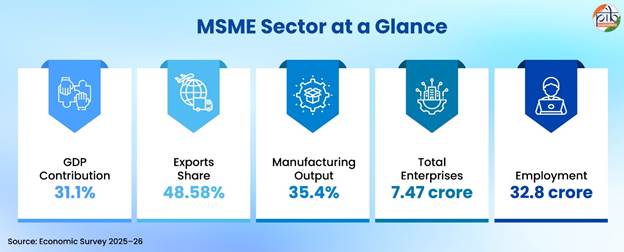
MSMEs contribute about 31.1% to India’s GDP, account for 48.58% of total exports, and generate around 35.4% of manufacturing output. The sector encompasses more than 7.47 crore enterprises across manufacturing, services, and trade activities. It provides livelihoods to approximately 32.8 crore people, making it the second-largest source of employment after agriculture.
A large share of these enterprises operates in rural and semi-urban areas. They support local value chains, promote non-farm employment, and contribute to regional economic development.
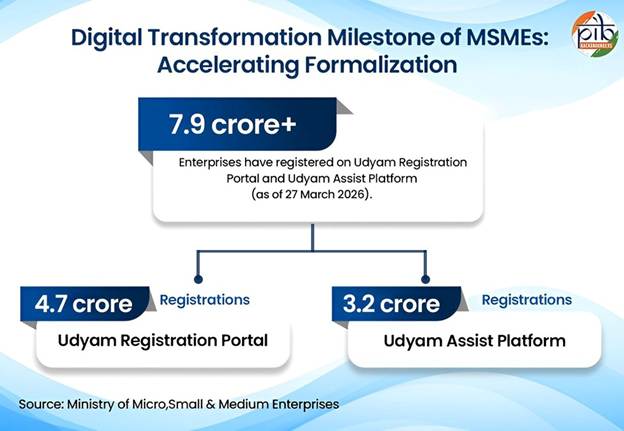
Given their importance, strengthening MSMEs in rural and semi-urban areas is critical. This helps promote inclusive growth, improve productivity, and integrate small enterprises into national and global supply chains. Many of the MSMEs exist as unregistered and informal enterprises. It is necessary to formalize them so that they can avail credit and other support being extended to the sector. In recent years, formalization has accelerated through digital registration platforms. As of March 2026, over 7.9 crore MSMEs and informal micro enterprises have been registered through Udyam and Udyam Assist Platforms. This reflects the expanding reach of institutional support mechanisms for small businesses.
Credit and Financial Support Measures
Access to affordable and timely credit remains one of the most critical requirements for MSME growth. It is more important for micro enterprises in rural and semi-urban areas. The Government has put in place multiple credit and financial support mechanisms to address this gap.
Credit Guarantee Scheme (CGS)
The Ministry of MSME implements the Credit Guarantee Scheme (CGS) through the Credit Guarantee Fund Trust for Micro and Small Enterprises (CGTMSE). It is a joint initiative of the Government and the Small Industries Development Bank of India (SIDBI). The scheme facilitates the flow of collateral-free and third-party guarantee-free credit to Micro and Small Enterprises (MSEs). It enables first-generation and underserved entrepreneurs to access institutional finance.
As per the Union Budget 2025-26, the ceiling of guarantee coverage under CGS has been enhanced from ₹5 crore to ₹10 crore for banks. The revised guidelines are applicable to all guarantees approved on or after 1 April 2025. Additionally, a special provision has been introduced for MSEs promoted by transgender entrepreneurs. These enterprises are eligible for a 10% concession in guarantee fees along with enhanced guarantee coverage of up to 85%, effective from 1 March 2025.
Self-Reliant India (SRI) Fund
The Self-Reliant India (SRI) Fund was launched to provide ₹50,000 crore in equity support to MSMEs through a Fund of Funds mechanism. The Fund comprises ₹10,000 crore from the Government and ₹40,000 crore to be raised through Private Equity and Venture Capital funds. It operates through a Mother Fund–Daughter Fund structure, managed by NSIC Venture Capital Fund Limited (NVCFL), a SEBI-registered Category-II Alternative Investment Fund.
As of November, 2025, the SRI Fund has supported 682 MSMEs with investments worth ₹15,442 crore. Union Budget 2026-27 has provided an additional ₹2,000 crore to the Self-Reliant India Fund. This is to keep supporting micro enterprises with risk capital.
Emergency Credit Line Guarantee Scheme (ECLGS)
The ECLGS (2020) supports eligible MSMEs and business enterprises in meeting their operational liabilities. It is also aimed at helping them restart their businesses in the context of disruptions caused by the COVID-19 pandemic. The scheme was extended till March 2023.
As on January 2023, guarantees amounting to ₹3.61 lakh crore were issued under ECLGS. These guarantees benefited 1.19 crore borrowers. A State Bank of India research report on ECLGS noted that almost 14.6 lakh MSME accounts were saved from slipping into NPA classification. About 98.3% of these accounts belonged to the micro and small enterprises categories. The report also noted that MSME loan accounts worth around ₹2.2 lakh crore improved since the inception of ECLGS.
Legal and Institutional Support for MSMEs
Timely realisation of payments for goods and services is essential for the financial stability and operational continuity of MSMEs. These enterprises often operate with limited working capital. Recognising this, the Government has established a robust legal and institutional framework to address this issue.
MSMED Act, 2006 — Payment Protection
The Micro, Small and Medium Enterprises Development (MSMED) Act, 2006 provides statutory protection to Micro and Small Enterprises against delayed payments. Under the Act, buyers are mandated to make payments to MSEs within 45 days of acceptance of goods or services. This may be as agreed upon in writing, not exceeding 45 days. To adjudicate disputes arising from payment delays, 161 Micro and Small Enterprises Facilitation Councils (MSEFCs) have been set up across States and Union Territories.
The Ministry of MSME launched the SAMADHAAN Portal (samadhaan.msme.gov.in) in October 2017. It provides a technology-enabled mechanism for MSEs to file and monitor delayed payment applications online. Cases are automatically referred to the respective MSEFC for adjudication This eliminates the need for physical visits or engagement of intermediaries.
A dedicated sub-portal was created in June 2020 to track payment dues from Central Ministries, Departments, and Central Public Sector Enterprises (CPSEs). As of December 2022, dues of ₹1,65,034 crore had been paid to MSME by Central Ministries, Departments, and CPSEs since May 2020.
Building on this framework, the Ministry of MSME launched an Online Dispute Resolution (ODR) Portal in June 2025.The portal provides end-to-end digitized resolution of delayed payment cases. It further reduces the time and cost involved in redressal for MSEs across the country.
Formalisation and Priority Sector Inclusion
A large proportion of India's micro enterprises operate outside the formal economic system, without official registration or documented financial history. This structural informality limits their access to institutional credit, government schemes, and formal markets. The Government has undertaken targeted measures to bring these enterprises within the formal fold.
Udyam Portal and Udyam Assist Platform (UAP)
The UAP, launched in January 2023, brings Informal Micro Enterprises (IMEs), lacking formal registration, into the formal financial system. It enables such enterprises to register and access Priority Sector Lending benefits, facilitating their integration into the institutional credit ecosystem. Between the Udyam Registration Portal and the Udyam Assist Platform, the Government has significantly accelerated the formalisation of micro enterprises.
As of March 2026, over 7.9 crore enterprises were registered across both platforms, 4.72 crore on the Udyam Portal and 3.21 crore on the Udyam Assist Platform. This marks a significant milestone in MSME digitization.
Inclusion of Traders under MSME
From July 2021, retail and wholesale traders have been included within the ambit of MSMEs through revised government’s guidelines. This has enabled enterprises to register on the Udyam Registration Portal and avail benefits under Priority Sector Lending (PSL) norms. This measure expanded MSME coverage and facilitated the integration of trading activities into the formal MSME ecosystem.
Support during MSME Classification Transition
To avoid penalising growth, the Government allows non-tax benefits to continue for three years. This applies in cases where an MSME graduates to a higher classification category. This measure removes a key disincentive for smaller enterprises to scale up their operations.
Digitalisation and Market Access Initiatives
Digital integration is increasingly central to MSME competitiveness. It enables enterprises to access government procurement markets, obtain faster payment realisation, streamline compliance, and expand their customer base. The Government has built a comprehensive ecosystem of digital platforms to support MSMEs at each stage of their operational lifecycle.
Digital India Support for MSMEs
Under the Digital India programme, the Government has focused on strengthening digital infrastructure. It also aims at delivering governance and services on demand, and promoting digital empowerment of citizens and enterprises. For MSMEs, digital enablement translates into improved market access, better financial inclusion, and enhanced ease of compliance.
Key MSME Digital Platforms
A wide ecosystem of digital platforms has been developed to support MSME formalisation, financing, market linkages, and dispute resolution. These include:
- Udyam Portal for online MSME registration and issuance of Udyam Registration Number;
- Government e-Marketplace (GeM) for public procurement and enabling MSMEs to sell directly to government buyers;
- Trade Receivables Discounting System (TReDS) for facilitating invoice financing through multiple financiers;
- MSME Champions Portal for grievance redressal and handholding support;
- MSME SAMBANDH for monitoring public procurement from MSMEs;
- PMEGP Portal for application, approval, and tracking of PMEGP-supported projects;
- PM Vishwakarma Portal for registration and support to traditional artisans and;
- Online Dispute Resolution portal for digital resolution of disputes.
Entrepreneurship and Livelihood Promotion Schemes
Prime Minister's Employment Generation Programme (PMEGP)
PMEGP is a flagship credit-linked subsidy scheme of the Ministry of MSME. It is implemented nationally through the Khadi and Village Industries Commission (KVIC). At the State level, it operates via KVIC offices, KVIBs, and District Industries Centres (DICs). The scheme aims to generate self-employment opportunities by supporting the establishment of new micro enterprises in non-farm sectors.
The maximum project cost eligible for Margin Money subsidy is ₹50 lakh for the manufacturing sector and ₹20 lakh for the service/business sector. Margin Money Subsidy is a government-funded financial assistance provided as a back-ended subsidy on bank loans to set up new micro-enterprises.
Under the scheme, subsidy varies based on the beneficiary category and location. For special categories, the subsidy is 35% of the project cost in rural areas. It is 25% in urban areas.
|
Special category includes SC/ST, OBC, minorities, women, ex-servicemen, persons with disabilities, and applicants from the North-East Region, Hill and Border areas.
|
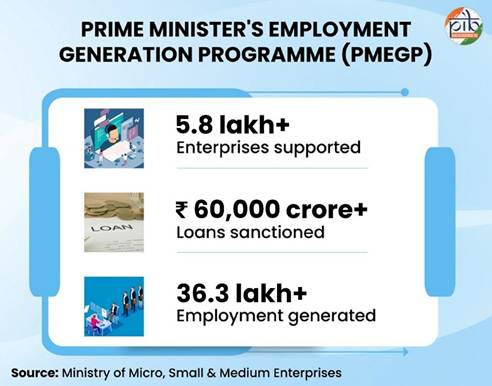
From FY 2021–22 to FY 2025–26, PMEGP has supported the establishment of over 5.8 lakh projects. Bank loans worth more than ₹60,000 crore have been sanctioned. During the same period, margin money subsidy of over ₹13,450 crore has been disbursed to over 4 lakh units. This has resulted in estimated employment generation of nearly 36.3 lakh persons.
PM Vishwakarma Scheme (2023) provides end-to-end holistic support to artisans and craftspeople who work with their hands and tools. The scheme provides a comprehensive package of support across 18 traditional trades. It includes formal recognition through a PM Vishwakarma Certificate and ID card. It also offers skill upgradation through Basic Training of 5–7 days and Advanced Training of 15 days or more. A stipend of ₹500 per day is also provided under the scheme. Beneficiaries also receive a toolkit incentive of up to ₹15,000 through e-vouchers, along with market linkage support.
Collateral-free Enterprise Development Loans of up to ₹3 lakh are provided in two tranches of ₹1 lakh and ₹2 lakh. The tenures are 18 months and 30 months respectively. These loans are offered at a concessional interest rate of 5%, with the Government providing an interest subvention of 8%.
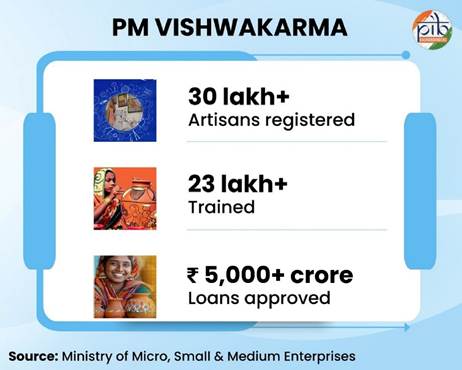
As of March 2026, over 30 lakh artisans have registered under the PM Vishwakarma Scheme. Among them, more than 26.7 lakh beneficiaries have completed skill verification, while over 23.7 lakh have undergone basic training. This reflects the scheme’s focus on skill upgradation. In addition, nearly 5.9 lakh loans amounting to nearly ₹5,050 crore have been approved. This is along with the issuance of more than 25.8 lakh e-vouchers to support toolkit incentives and enterprise development.
Towards a Stronger MSME Ecosystem
The Government's approach to strengthening MSMEs, particularly in rural and semi-urban areas, reflects a comprehensive strategy. It addresses structural barriers across credit, compliance, formalisation, and market access. A ₹10,000 crore SME Growth Fund and additional allocations to SRI Fund under Union Budget 2026–27 have further strengthened equity support. It also mandates TReDS across Central Public Sector Enterprises. These measures are reinforcing the policy framework to meet evolving sectoral needs.
Going forward, continued convergence between digital platforms, financial institutions, and grassroots implementation agencies will be crucial. It will ensure that the benefits of these schemes reach last-mile entrepreneurs, artisans, rural traders, and first-generation micro enterprise owners. These stakeholders form the foundation of India’s self-reliant economic growth.
References
Ministry of Finance
https://www.indiabudget.gov.in/economicsurvey/doc/echapter.pdf
https://www.pib.gov.in/PressReleseDetailm.aspx?PRID=1898880®=3&lang=2
MSME
https://dashboard.msme.gov.in/?utm
https://www.cgtmse.in/Home/VS/3
https://www.pib.gov.in/PressReleasePage.aspx?PRID=2099687®=3&lang=2
https://www.pib.gov.in/PressReleasePage.aspx?PRID=2209712®=3&lang=1
https://www.pib.gov.in/PressReleasePage.aspx?PRID=2238984®=6&lang=1
https://www.pib.gov.in/PressReleaseIframePage.aspx?PRID=1943193®=3&lang=2
https://www.pib.gov.in/newsite/PrintRelease.aspx?relid=172056®=3&lang=2
https://www.pib.gov.in/Pressreleaseshare.aspx?PRID=1881703®=3&lang=2
https://www.pib.gov.in/PressReleasePage.aspx?PRID=2153722®=3&lang=2
https://msme.gov.in/1-prime-ministers-employment-generation-programme-pmegp
https://www.pib.gov.in/PressReleasePage.aspx?PRID=1795121®=3&lang=2
https://www.pib.gov.in/PressReleasePage.aspx?PRID=1959098®=3&lang=2
DD News
https://ddnews.gov.in/en/union-budget-2026-27-puts-msmes-at-the-core-of-indias-global-growth-strategy/
Click here for pdf file
****
PIB Research
(Release ID: 2260904)
Visitor Counter : 6712