Ministry of Science & Technology
Massive stars regulate star formation in nearby molecular cloud
Posted On:
08 MAY 2026 3:51PM by PIB Delhi
New evidence has been unearthed which show that massive stars can initiate star formation in nearby areas thus helping shape the evolution of star-forming regions.
Stars are born inside vast clouds of gas and dust known as molecular clouds. While most stars in our Galaxy have masses similar to the Sun, a few are much larger (more than eight times the mass of the Sun). Although these massive stars are rare, they play a significant role in shaping their surroundings and sometimes even contribute to the formation of the next generation of stars.
Scientists from the Aryabhatta Research Institute of Observational Sciences (ARIES), Nainital, an autonomous research institute under the Department of Science and Technology (DST), Government of India, investigated a region known as Bright Rimmed Cloud 44 (BRC 44), situated approximately 900 parsecs from Earth within the Cepheus OB2 star-forming complex and found that massive stars give out UV radiation that propagates into the cloud, giving birth to new stars.
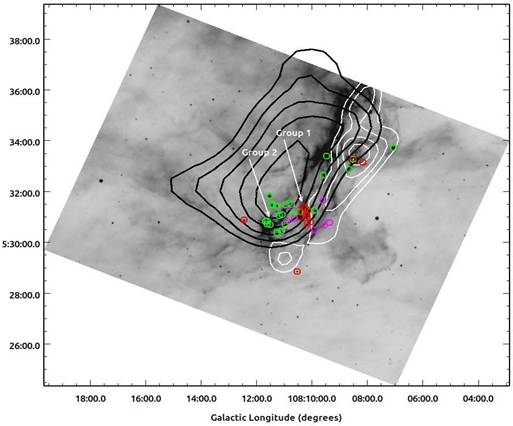
Fig: The CO (black color) and 1.4 GHz NVSS (white color) contours are overplotted on the 8 µm Spitzer image of the region. Circles represent the identified YSO candidates. The red circles are optically visible YSOs (Group 1), green circles are embedded. Young YSOs(Group 2), and magenta circles are identified as BD candidates.
Bright Rimmed Clouds get their name from their glowing edges, which shine brightly when exposed to intense ultraviolet (UV) radiation from nearby massive stars. In the case of BRC 44, the researchers found that UV radiation from a massive star ionizes the surface of the cloud, which leads to heating and compression of the gas. This compression creates shock waves that propagate into the cloud, increasing its density and triggering the formation of new stars.
The research, led by Mr. Rishi C., a PhD scholar along with Dr. Neelam Panwar and other researchers from India, UK, China & Thailand, employed a multi-wavelength approach to study the region. Observations were done using the 3.6-m Devasthal Optical Telescope (DOT) and the Devasthal Fast Optical Telescope (DFOT) in India, along with the data from the Spitzer Space Telescope and radio observations from the Purple Mountain Observatory in China. By combining optical, infrared, and radio data, the scientists were able to study both the stars and the surrounding gas in great detail.
One of the most exciting results of the study is the discovery of 22 new young stellar objects in BRC 44. Among these are several brown dwarfs—objects that are smaller than normal stars to sustain hydrogen fusion in their cores. Finding such low-mass objects provides essential clues about how stars and sub-stellar objects form under the influence of massive stars. Apart from this finding, they also found two groups of young stars, with one group formed from the interplay of cloud and radiation from the nearby massive star and the other group formed around the same time as the massive star.
The results, published in The Astrophysical Journal, show that massive stars play a complex role in the Galaxy. Instead of only destroying their surroundings, they can also trigger new star formation.
Publication Link: https://doi.org/10.3847/1538-4357/ae0f03
*****
NKR/FT
(Release ID: 2259045)
Visitor Counter : 965