Ministry of Science & Technology
A novel smart oxide can store energy and also indicate the level of charge in it
Posted On:
28 APR 2026 4:33PM by PIB Delhi
Scientists have come up with a new material that does not just store energy but also changes colour to show that how much charge is there and the change in colour indicates a discharged cell that requires fresh charging.
Everything from our phones to solar grids relies on stored power on batteries which are faster and efficient. However, most electronic devices are faced with the limitation that it can either store energy or display information, but rarely both.
Scientist from Nano and Soft Matter Sciences (CeNS), Bengaluru, an autonomous institute of Department of Science and Technology (DST), have developed an oxygen-deficient bimetallic oxide based on molybdenum and tungsten (Mo0.11W0.89O3-x), a unique compound that addresses this limitation by serving both purposes. The colour change in a device made with this oxide from blue (charged state) to transparent (discharged state) shows one whether the device is in charged or discharged state.
The researchers, led by Principal Researcher Dr. Ashutosh Kumar Singh, synthesized the material using a solvothermal method. The new material combined both these functions.
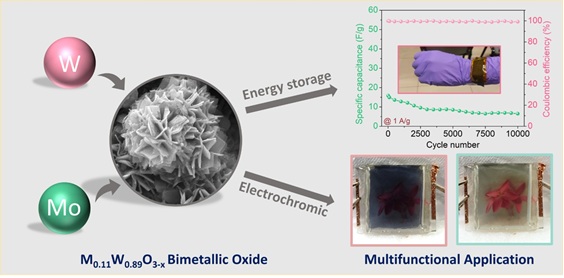
Fig: Morphology of Bimetalllic oxide and its application demonstration in energy storage and electrochromic devices
The science behind this unique property lies in the "oxygen-deficient" nature of the oxide. By creating a lattice where specific oxygen atoms are missing, the researchers generated extra space and active sites within the material's structure. These gaps allow ions to move freely. As the ions move to store charge, they trigger a simultaneous shift in the material’s electronic structure, resulting in a visible colour change that acts as a live charge indicator.
The team also explored its use in electrochromic applications and fabricated large-area device (5×5 cm2) showed a high optical modulation of 43% at 700 nm with a colouration efficiency of 147 cm2 C-1, indicating a low power requirement to operate the window made from this material. As a supercapacitor electrode, it exhibited a specific capacitance of 234 F g-1 at a current density of 5 A g-1 and a remarkable areal capacitance of 975 mF cm-2 at a scan rate of 5 mV s-1.
The new material which resulted in a publication in the journal Materials Chemistry A demonstrated excellent cycling stability (10000 charge-discharge cycles) and retained functionality under various mechanical bending and environmental conditions. The developed material showed good optical contrast and fast switching time. The device was able to power an LCD timer and light up an LED.
Publication details (DOI): https://doi.org/10.1039/D6TA01049K
*****
NKR/FT
(Release ID: 2256264)
Visitor Counter : 1244