Ministry of Science & Technology
World witnessing a paradigm shift to "Circular Economy", the idea of “waste” is rapidly disappearing, says Dr Jitendra Singh;
Minister cites the example of the government having earned more than Rs 4,000 cr from Scrap including E-Waste during the Swachhata campaign;
The emerging model of circular economy, backed by recycling and biotechnology-driven innovations, is set to redefine industrial growth and sustainability across sectors, says the Minister;
Policy Support, Startups and Industry Participation Accelerate India’s Circular Economy Transition
Posted On:
20 APR 2026 6:11PM by PIB Delhi
Union Minister of State (Independent Charge) for Science & Technology, Earth Sciences, and MoS PMO, Personnel, Public Grievances, Pensions, Atomic Energy and Space, Dr. Jitendra Singh said that the world is witnessing a paradigm shift to "Circular Economy" and there is a decisive shift in economic thinking, where the idea of “waste” is rapidly disappearing and every discarded material is increasingly being seen as a source of economic value. He cited the example of the government having earned more than Rs 4,000 cr simply from Scrap including E-Waste during the Swachhata campaign.
The Minister said, the emerging model of circular economy, backed by recycling and biotechnology-driven innovations, is set to redefine industrial growth and sustainability across sectors.
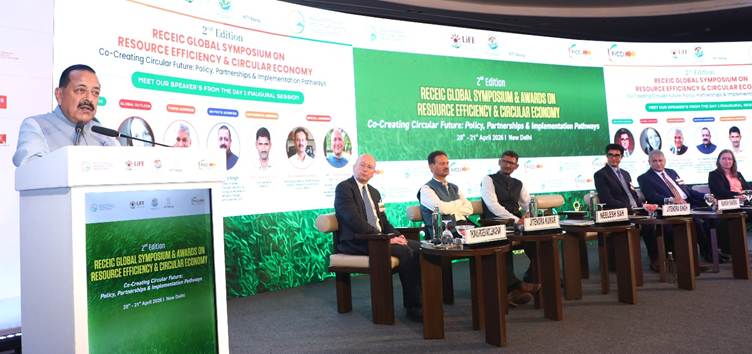
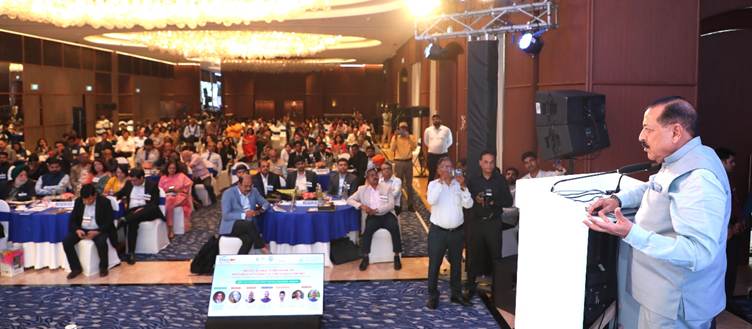
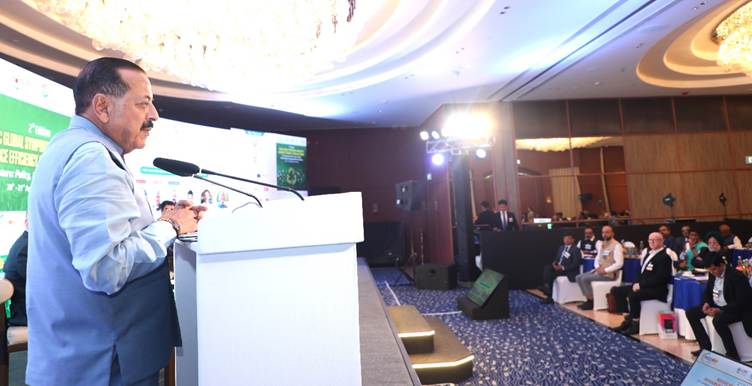
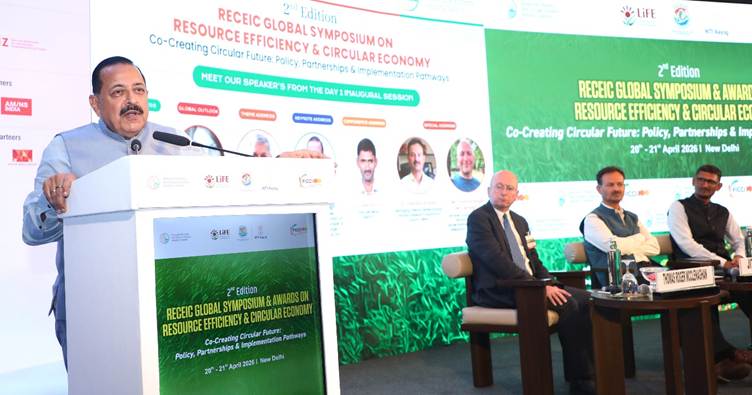
Dr Jitendra Singh was addressing the 2nd edition of the Global Symposium and Awards on Resource Efficiency and Circular Economy in New Delhi, attended by representatives from government, industry, research institutions and international organisations, including delegates associated with European and German missions, along with key stakeholders from the Resource Efficiency and Circular Economy Industry Alliance.
Dr. Jitendra Singh said that environmental discourse has evolved significantly over the years, from a focus on preservation to a recognition of its strong economic dimension. He said the growing realisation that sustainability can generate revenue has brought greater seriousness and wider participation to the movement.
The Minister said the next phase of industrial development will increasingly be driven by recycling, bio-technology and genetically oriented processes, adding that experts across the world are already viewing this transition as the foundation of the next industrial revolution.
Giving practical examples, he said materials once treated as waste, such as plastic, used cooking oil and industrial by-products like steel slag, are now being converted into valuable resources, including road construction inputs, biofuels and commercially viable industrial materials. He said industries which earlier incurred costs to dispose of such waste are now deriving economic returns from it.
Dr. Jitendra Singh shared that sustained cleanliness and recycling efforts have already demonstrated tangible financial outcomes. Referring to a dedicated nationwide campaign, he said that the collection of electronic waste alone resulted in revenues exceeding ₹4,000 crore, indicating the vast untapped potential of resource recovery.
He said the benefits of a circular economy are not confined to large industries but extend across the entire economic spectrum, from households and informal sectors to startups and MSMEs, creating new livelihood and business opportunities at multiple levels.
The Minister also spoke about the importance of public participation and behavioural change, stating that large-scale transformation will require collective involvement beyond government initiatives. He said that as the government continues to open up sectors and facilitate collaboration, industry, startups and civil society must actively come forward to invest, innovate and participate.
Referring to evolving economic practices, he said that India is witnessing a transition where value chains are being redefined and new opportunities are emerging in areas such as waste management, green technologies and circular production systems. He added that this shift will also contribute significantly towards India’s commitment to achieving net-zero emissions by 2070.
Dr. Jitendra Kumar, Managing Director, BIRAC, spoke about India’s traditional strengths in circular practices rooted in its cultural and agricultural systems, and emphasised the need to integrate this legacy with modern scientific innovation. He said BIRAC continues to support startups working on green technologies and sustainable solutions, while also encouraging lifecycle-based approaches and mechanisms such as carbon credits.
The symposium served as a platform for deliberations on policy frameworks, partnerships and implementation strategies to accelerate India’s transition towards a resource-efficient and circular economy.
*****
NKR/AK/SK
(Release ID: 2253876)
Visitor Counter : 1239