Ministry of Science & Technology
India Emerges as Cradle of Jamun Evolution
Posted On:
20 APR 2026 5:41PM by PIB Delhi
Jamun, has been found to have originated much earlier than previously believed, with India playing a central role in its evolutionary history according to a new study.
The study which points at East Gondwanan origin of the genus Syzygium, dating back to ~80 million years ago with India acting as a major centre of early diversification, reshapes our understanding of plant evolution.
The origin of Syzygium (commonly known as Jamun) was earlier believed to be restricted to Australia or Southeast Asia. However, researchers spotted inconsistencies between fossil evidence and molecular phylogenetic timelines of around 51 million years ago origin estimates. Additionally, earlier fossil reports from India ranging from around 60 to 20 million years ago had not been comprehensively reassessed.
The discovery of new Miocene fossils (~20 million years ago) provided an opportunity to re-evaluate the origin and dispersal history of Syzygium in an integrated framework.
In a study led by Birbal Sahni Institute of Palaeosciences (BSIP), an autonomous institute of the Department of Science and Technology (DST) along with Academy of Scientific and Innovative Research (AcSIR), Central Department of Geology, Tribhuvan University, Kirtipur, Kathmandu, Department of Geology, Birendra Multiple Campus, Tribhuvan University, Chitwan, Bharatpur, researchers collected fossil specimens from the Kasauli Formation around 20 million years ago in Himachal Pradesh following initial exploration of Early Miocene sedimentary sequences conducted to elucidate plant evolutionary history.
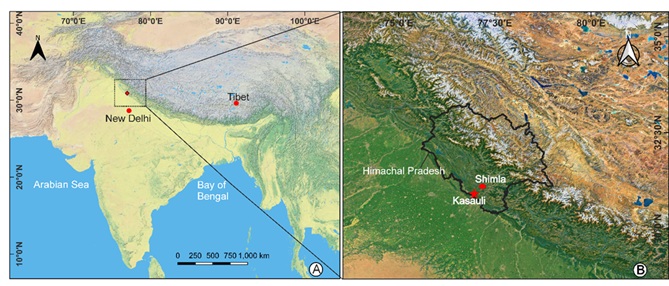
Fig 1: Map showing the fossil locality from where the fossil leaves were collected
These were analysed using microscopy and detailed morphological characterization. The scientists carried out comparative analysis using herbarium collections and global databases. Statistical methods were applied to validate taxonomic placement. Additionally, previously reported fossils from Paleogene and Neogene deposits (60–20 million years ago) were critically re-examined to reconstruct a continuous evolutionary timeline.
Detailed analysis of fossil leaf morphology, including shape, size, and venation patterns, comparison with modern plant species using quantitative statistical methods and analysis based on 22 morphological characters helped accurate identification and evolutionary interpretation of the fossils.
A total of 11 well-preserved fossil leaves of Syzygium from the Early Miocene (20 million years ago) deposits of India named as Syzygium paleosalicifolium Sadanand, Bhatia et Srivastava was found. A reinvestigation of earlier fossil records from India indicates that the genus was already present in the Indian region since the early Eocene (55 million years ago), demonstrating a much earlier and continuous presence in India. From here, the genus is believed to have dispersed to Southeast Asia and Australia, rewriting the biogeographic history of this ecologically and economically important plant group.
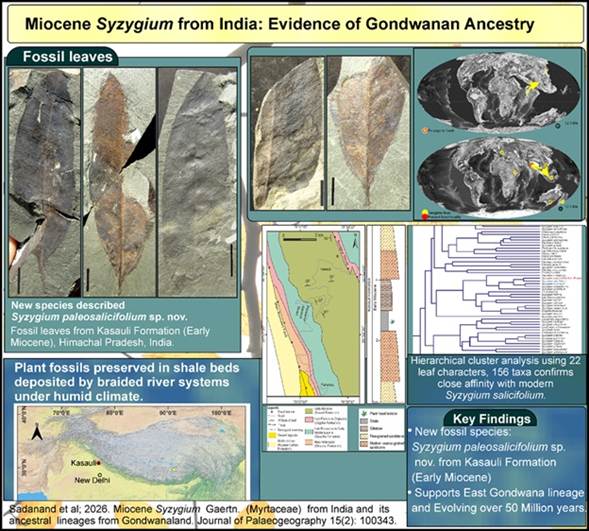
The study published in Journal of Palaeogeography, provides important insights into India’s role in plant evolution and biodiversity of Asian floras. Understanding past vegetation and climate changes over millions of years helps improve predictions of future climate scenarios. It also contributes to biodiversity conservation, ecological planning, and strengthens India’s contribution to global research on evolution and biogeography.
Publication link: https://doi.org/10.1016/j.jop.2026.100343
*****
NKR/FT
(Release ID: 2253853)
Visitor Counter : 1752