Ministry of Science & Technology
Simultaneous oscillations in solar filaments provides new clues to their properties
Posted On:
17 APR 2026 5:05PM by PIB Delhi
A new study by astronomers has unveiled a powerful method to estimate the hidden physical properties of solar filaments by analysing their oscillations, offering deeper insights into the Sun’s magnetic structure.
Solar filaments, which are gigantic clouds of cool plasma suspended in the Sun’s atmosphere, are held in place by magnetic fields. Understanding their properties, such as magnetic field strength, size, and internal structure is crucial for studying solar eruptions and space weather, which can impact satellites, communication systems and power grids on Earth.
However, directly measuring these properties remains extremely challenging. Scientists instead rely on a technique that interprets oscillations in solar filaments called prominence seismology to infer their internal conditions, similar to how earthquakes are used to study Earth’s interior. Researchers from the Aryabhatta Research Institute of Observational Sciences (ARIES), along with collaborators from the Indian Institute of Technology, Delhi, Institute de Astrofísica de Canarias, Spain have taken this approach a step further.
The team consisting of Upasna Baweja, Vaibhav Pant, Iñigo Arregui, M. Saleem Khan studied rare cases where solar filaments exhibit simultaneous longitudinal and transverse oscillations. These dual oscillations offer a unique opportunity to tightly constrain the filament's physical parameters.
Using advanced statistical methods called Bayesian analysis, the team combined observational data with theoretical models to estimate key properties of these filaments.
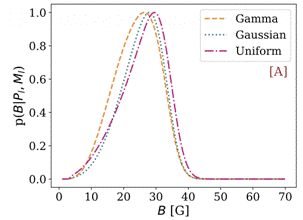
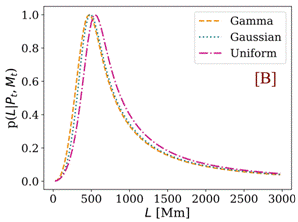
Fig: Marginal probability distributions obtained from Bayesian analysis of solar filament oscillations. Panel [A] shows the probability distribution of the magnetic field strength, while the panel [B] shows the probability distribution of length of the flux tube. The curves correspond to different prior assumptions, uniform (dash–dotted), Gaussian (dotted), and gamma (dashed), illustrating the influence of prior knowledge on the inferred physical parameters.
Their analysis revealed that the probable range of magnetic field holding the filaments can be robustly inferred even with limited knowledge of plasma density. Besides, magnetic flux tubes that support filaments can be very long about 100 to 1000 megameters showing that quiescent prominences cover large areas of the Sun’s atmosphere and that the twist in magnetic field lines is generally low, typically less than three turns, suggesting relatively stable magnetic configurations.
To achieve this, the study first estimated the magnetic field strength from observed longitudinal oscillations and then used this information to determine the length and structure of the supporting flux tubes from transverse oscillations. This combined approach significantly improved the accuracy of the inferred parameters.
This work published in the journal Astrophysics can significantly advance the understanding of solar magnetic fields and properties of the magnetic features present in the solar atmosphere. Such insights are crucial for improving models of solar eruptions and enhancing our ability to predict space weather events.
Publication link: https://arxiv.org/abs/2601.01730
*****
NKR/FT
(Release ID: 2253011)
Visitor Counter : 658