Posted On:
17 APR 2026 1:11PM by PIB Delhi
Key Takeaways
- The RBM Scheme promotes basin-level planning to ensure sustainable use, protection, and development of surface and groundwater resources.
- The scheme will continue during the 2026–27 to 2030–31 period with an estimated cost of ₹2183 crore, fully funded by the government.
- The scheme prioritizes major basins such as the Brahmaputra, Barak, Teesta, and Indus.
- Modern tools such as GIS, remote sensing, LiDAR, and drone-based surveys are being used to improve planning accuracy and future projects.
|
Water is one of the most critical natural resources, supporting ecosystems, livelihoods, and economic development. It plays a central role in agriculture, industry, energy generation, and overall human well-being. As societies continue to rely on water for multiple purposes, the need for efficient and coordinated use of water has become increasingly important.
River Basin Management (RBM) is a comprehensive scheme for the management, protection, improvement, and sustainable use of water resources across river basins. These resources include rivers, lakes, streams, groundwater, and associated ecosystems. The approach emphasizes integrated planning and development of water resources to ensure optimal utilization. In India, where river systems are complex and interlinked, basin-level planning has become essential for addressing challenges such as floods, erosion, uneven water distribution, and ecological degradation. Recognizing these challenges, the River Basin Management (RBM) Scheme is being implemented in a structured and scientific manner.
Overview of the River Basin Management (RBM) Scheme
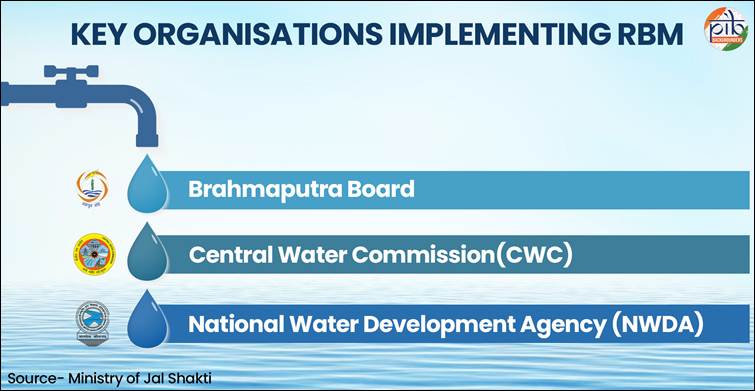
RBM is a central sector scheme of the Department of Water Resources, River Development, and Ganga Rejuvenation under the Ministry of Jal Shakti. The scheme aims to facilitate integrated planning, investigation, and development of water resources at the river basin level, including both surface water and groundwater systems. It is implemented through three key organisations—namely, the Brahmaputra Board, the Central Water Commission (CWC), and the National Water Development Agency (NWDA)—and supports activities such as the preparation of basin master plans, the survey and investigation of projects, and the planning of multipurpose projects.
Geographical Scope and Priority Areas
The RBM Scheme primarily focuses on strategically important and water-rich but underdeveloped regions, particularly:
-
- North Eastern Region river basins.
- Indus Basin in Jammu & Kashmir / Ladakh.
- Key basins such as Brahmaputra, Barak, Teesta, and Indus.
These basins are prioritised due to their importance in:
-
- National water security.
- Cross-border water management.
- Flood control and erosion management.
- Ecological stability.
The scheme also addresses capacity gaps in states such as Jammu & Kashmir, Sikkim, Mizoram, Manipur, and Nagaland, which require central support for project planning and development.
Financial Outlay and Duration
The RBM Scheme is proposed to be continued during the 16th Finance Commission period from 2026–27 to 2030–31 with a fully funded estimated financial outlay of ₹2183 crore. In the previous phase, covering 2021–22 to 2025–26, the total budget allocation for the scheme was ₹1276 crore. This reflects a continued and increased commitment toward integrated water resource planning and development.
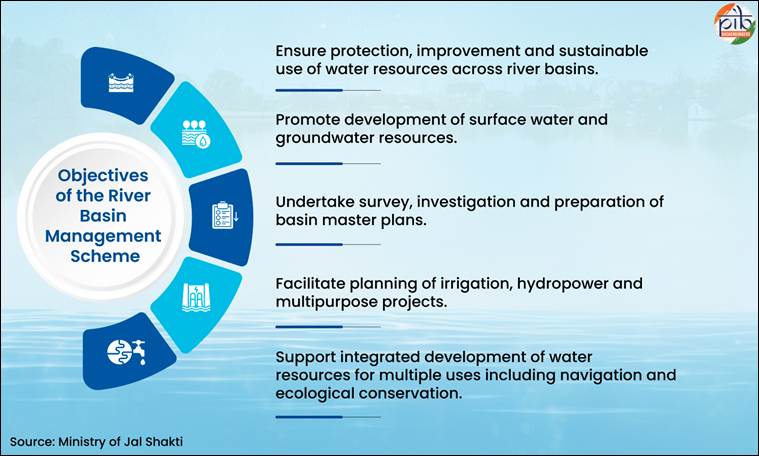
The River Basin Management Scheme is designed to address the diverse challenges associated with water resource planning and development at the basin level. The objective of the scheme is to focus on promoting sustainable use of water while supporting irrigation, hydropower, and flood management. These objectives guide the overall planning and implementation of the scheme.
The RBM Scheme consists of two broad components:
Brahmaputra Board Component
The Brahmaputra Board plays a key role in basin-level planning and flood management in the North Eastern Region. Its major functions include:
- Surveys & investigations, and to formulate a Master Plan-
- Periodically revise, whether in whole or in part.
- For the control of floods, prevention of bank erosion, and improvement of drainage therein with due regard to the development and utilisation of water resources for irrigation, hydropower, navigation, and other beneficial purposes.
- As far as practicable, indicate there in the requisite works and measures for such development.
- Prepare detailed reports and estimates in respect of the dams and other projects proposed in the Master Plan as approved by the Central Government.
The Board also undertakes:
- Anti-erosion works in critical areas (e.g., protection of Majuli Island and other vulnerable areas).
- Drainage development schemes.
- Construction of raised platforms in flood-prone areas.
- Development and Management of Water Resources for sustainable use. (Scientific dissemination of water management practices of indigenous people and Springshed management works).
- Capacity building in Water Resources Management/Development (Training of Officers of NER and Brahmaputra Board at NEHARI).
Investigation of Water Resources Development Scheme (IWRDS)
The IWRDS component is implemented through:
- Central Water Commission (CWC)
Under the RBM Scheme, the Central Water Commission undertakes surveys, investigations, and preparation of Detailed Project Reports (DPRs) for water resource projects. The scheme prioritises DPR preparation in:
-
- Indus Basin
- Brahmaputra Basin
- Barak Basin
- Teesta Basin
Projects are located in remote and difficult terrains, particularly in the North East and Jammu & Kashmir, where working seasons are limited, and logistics are challenging. Completion of DPRs is expected to lead to:
-
- Expansion of irrigation capacity.
- Hydropower generation.
- Improved flood control.
- Socio-economic development of beneficiary regions.
- National Water Development Agency (NWDA)
The NWDA component focuses on water resource planning at the national level, particularly under the Interlinking of Rivers (ILR) programme. Key functions include:
-
- Preparation of Pre-Feasibility Reports (PFRs), Feasibility Reports (FRs), and DPRs.
- Conducting water balance studies.
- Planning inter-basin water transfer projects.
A series of coordinated activities are carried out under the RBM framework. These efforts include basin planning, project investigations, and interventions to manage floods, erosion, and drainage systems.
Basin Planning
Basin planning forms the foundation of the framework and involves the preparation and periodic updating of river basin master plans. These plans provide a long-term roadmap for the development, utilization, and conservation of water resources within each basin.
Survey and Investigation
Extensive survey and investigation work is undertaken to support informed decision-making. This includes field investigations such as drilling and drifting operations, hydrological and topographical surveys, and the collection of primary and secondary data required for the preparation of master plans and Detailed Project Reports (DPRs).
Project Development
Project development focuses on the preparation of DPRs for multipurpose water resource projects. It also includes planning for flood and erosion management, drainage development, and other initiatives to ensure systematic project implementation.
Flood and Erosion Management
Specialized measures are implemented to reduce the impact of floods and riverbank erosion in vulnerable areas. These include anti-erosion works, flood control measures, and bio-engineering interventions aimed at protecting communities, infrastructure, and agricultural land.
Drainage Development
Drainage development activities are carried out to improve water flow and address waterlogging in drainage-congested regions. These efforts help enhance land productivity and support better water management in both rural and urban areas.
Community-Based Interventions
Community-based initiatives play an important role in strengthening local water management practices. These include promoting improved water use among local and tribal communities, along with activities such as spring shed management and the development of water bodies and basin ecosystems.
Strategic Significance of the Scheme
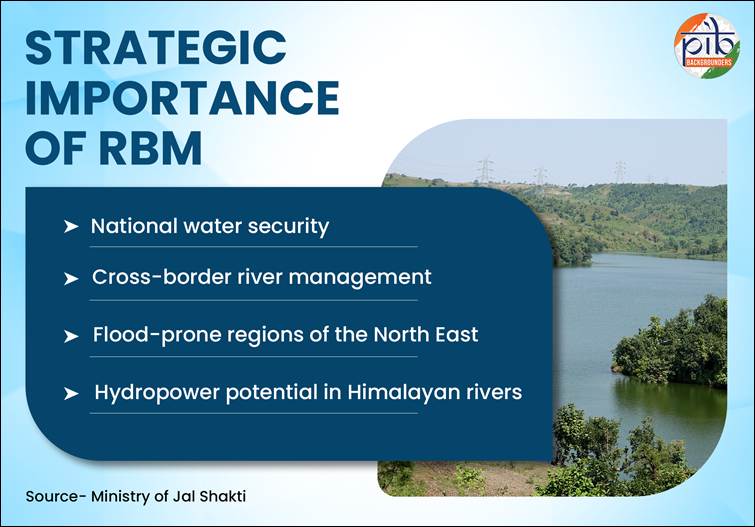
The RBM Scheme focuses on river basins that are critical for national water security, cross-border river management, flood-prone regions of the North East, and hydropower potential in Himalayan rivers.
The scheme also supports less developed states that lack financial and technical capacity for water resource planning.
Progress and Milestones under RBM Scheme (2021-26)
Over time, sustained efforts under the River Basin Management framework have translated into visible results on the ground. From improved basin studies to enhanced flood and erosion control measures, these milestones demonstrate steady institutional and technical advancement.
- Basin Planning and Master Plans
- Preparation and updating of River Basin Master Plans for major river systems in the Brahmaputra and Barak basins.
- Basin-level studies undertaken to support integrated water resource planning and flood management strategies.
- Substantial protection to Majuli Island from flood and erosion of the river Brahmaputra.
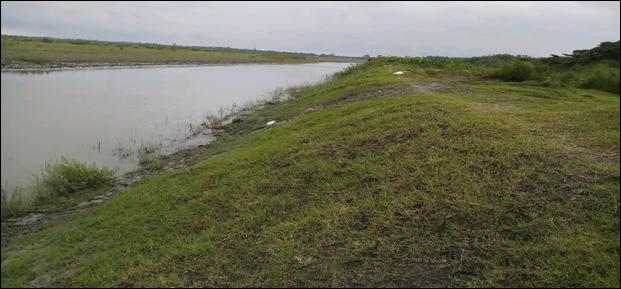
Post construction of Bank revetment work at Sumoimari, Majuli, Assam.
- Survey and Investigation of Projects
- Extensive survey and investigation work carried out across river basins in the North Eastern Region and the Himalayan areas.
- Field investigations included topographical surveys, geological investigations, and hydrological data collection.
- These studies form the basis for future irrigation, hydropower, and multipurpose projects.
- Preparation of DPRs (CWC Component)
- Preparation of Detailed Project Reports (DPRs) for multiple water resource projects in Brahmaputra Basin, Barak Basin, Teesta Basin, and Indus Basin (Jammu & Kashmir / Ladakh).
- DPRs developed for projects in remote and strategically important regions, enabling future investments in irrigation, hydropower, and flood control.
- Progress under NWDA (Interlinking of Rivers)
- Significant technical progress has been achieved by the National Water Development Agency through the identification of 30 river link projects as part of the National Perspective Plan. Pre-Feasibility Reports have been completed for all identified links.
- Feasibility Reports have been finalized for 26 projects and Detailed Project Reports for 15 link projects, including the Kosi–Mechi intra-state link project in Bihar. These studies support inter-basin water transfer and long-term water security planning.
- Flood and Erosion Management (Brahmaputra Board)
- Implementation of anti-erosion and flood management works in vulnerable areas of the North East.
- Protection works undertaken in critical locations such as Majuli Island (Assam) along with other erosion-prone stretches of the Brahmaputra.
- Construction of raised platforms to provide shelter during floods.
- Execution of drainage development schemes in drainage-congested areas.
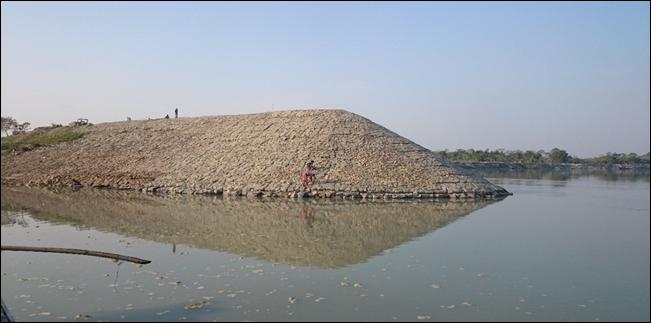
Spur No. 2 at Salmara Besamara reach, Majuli, Assam.
- Community-Oriented Interventions
- Implementation of spring shed management and water body development in hilly regions of the North East.
- Initiatives aimed at improving water availability and local water management practices among rural and tribal communities, and popularizing the best indigenous practices with scientific improvement.
- Strengthening Technical Capacity
- Adoption of modern technologies in survey and planning, such as Geographic Information System (GIS) and remote sensing, Light Detection and Ranging (LiDAR) and drone-based surveys, and advanced hydrological modelling tools.
- Improved accuracy and efficiency in DPR preparation and basin studies.
- Support to Special Category and Border States
- Focused technical and financial support provided to North Eastern States, Jammu & Kashmir, Ladakh, and Sikkim.
- Enabled these regions to undertake water resource planning despite capacity constraints.
- Continuous Nature of Outputs
- The scheme successfully maintained continuity of long-term activities, such as basin planning, DPR preparation, and flood management works.
- Established a pipeline of future water resource projects for implementation by States and Central agencies.
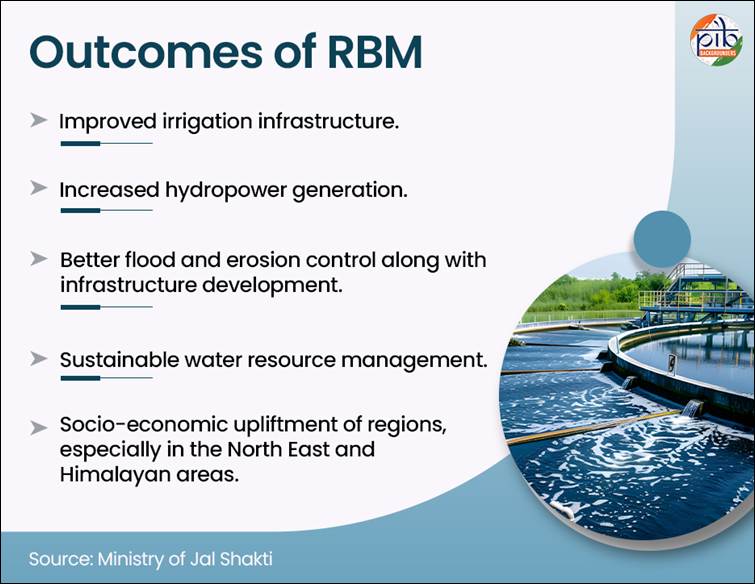
Measurable Outcomes and Development Gains
The River Basin Management (RBM) Scheme has led to measurable improvements in water resource planning and infrastructure development across key river basins. These outcomes reflect the scheme’s contribution to sustainable water management and regional socio-economic development.
The River Basin Management framework represents an important step toward strengthening India’s capacity to manage its river systems in a coordinated and forward-looking manner. By promoting scientific assessments, infrastructure readiness, and institutional collaboration, the initiative has laid the groundwork for more resilient water systems across strategically important regions. Its continued implementation will play a vital role in addressing emerging challenges such as climate variability, population growth, and increasing demand for water across sectors. At the same time, sustained technical support and targeted investments will help vulnerable and remote regions build stronger systems for flood protection, water storage, and resource utilization. In the long run, the success of River Basin Management will depend not only on physical infrastructure but also on sustained coordination among institutions, adoption of modern technologies, and community participation. Together, these efforts contribute to improved water security, greater regional stability, and more balanced socio-economic growth across the country.
Ministry of Jal Shakti
See In PDF
***
PIB Research