Posted On:
16 APR 2026 6:07PM by PIB Delhi
Union Minister of State (Independent Charge) for Science & Technology, Earth Sciences, and MoS PMO, Personnel, Public Grievances, Pensions, Atomic Energy and Space, Dr. Jitendra Singh said here today that India is steadily positioning itself as a global player in the Clean Energy landscape through a calibrated mix of policy support, technological innovation, and industry participation.
The Minister said the country is simultaneously advancing green hydrogen, expanding Nuclear Energy capacity, and strengthening renewable sources, while building indigenous capabilities in critical technologies such as electrolyzers. Emphasising the need for scaling up through public-private partnerships, he said India’s approach is focused on creating a robust and self-reliant ecosystem supported by enhanced research funding and innovation-led growth.
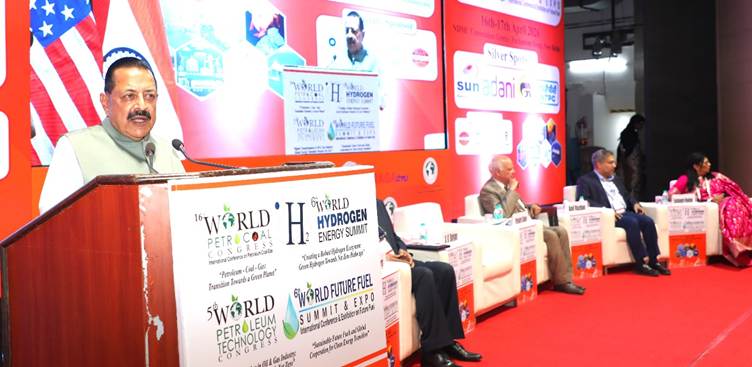
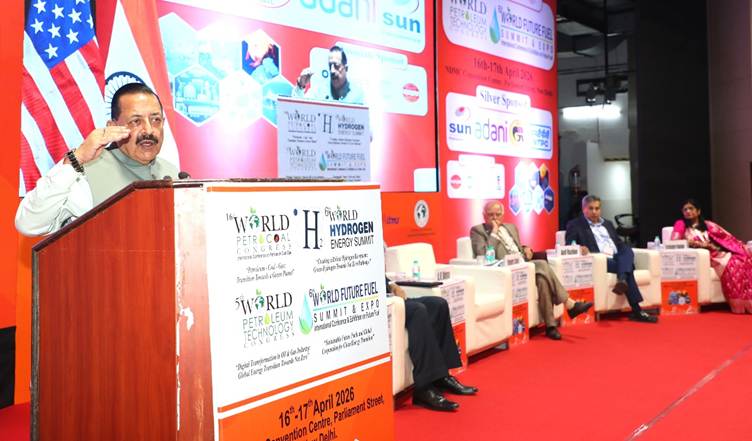
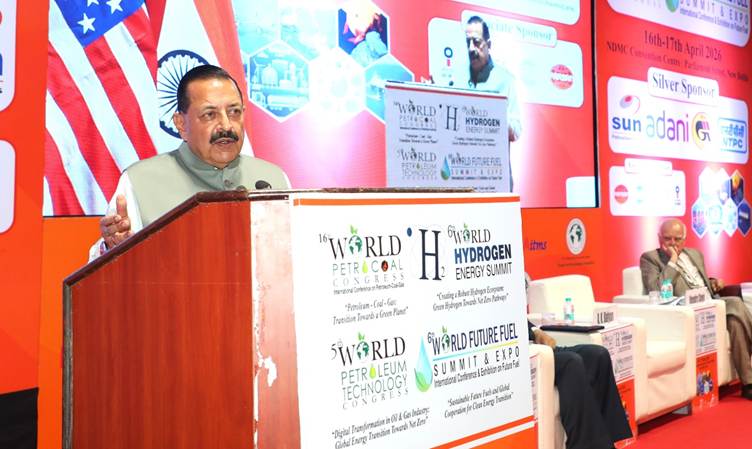
Dr. Jitendra Singh was addressing the World Hydrogen Energy Summit alongside the World Petrocoal Congress at the NDMC Convention Centre, New Delhi. The conference brought together policymakers, global industry leaders, domain experts and stakeholders from petroleum, coal, gas and emerging hydrogen sectors, providing a platform for deliberations on future energy pathways.
Referring to India’s evolving energy roadmap, the Minister said the country is pursuing a multi-dimensional strategy that combines energy security with sustainability. He said India is targeting nearly 100 billion US dollars in oil and gas investments, expansion of exploration areas to 1 million square kilometres, and increasing the share of natural gas in the energy mix to 15 percent. At the same time, India’s refining capacity continues to expand, placing it among leading nations globally.
On clean energy transition, Dr. Jitendra Singh said the National Green Hydrogen Mission, with outlay of Rs 19,744 cr, has placed India among the frontrunners in developing alternative fuel ecosystems. He said green hydrogen will play a key role in decarbonising hard-to-abate sectors such as steel and cement, while efforts are underway to reduce production costs through domestic manufacturing and innovation.
The Minister also shared progress in India’s nuclear energy programme, stating that the recently announced Nuclear Energy Mission aims to achieve 100 GW of nuclear power capacity by 2047. He said India has entered the next phase of its nuclear programme with indigenous technological advancements, placing it among a select group of nations.
Highlighting the role of small reactors, Dr. Jitendra Singh said India plans to develop five Small Modular/Small Reactors by 2033, with work already underway on three of them. These include a Bharat Small Modular Reactor (SMR), a Bharat Small Reactor (BSR) based on established heavy water technology, and a small-scale hydrogen-linked reactor of a few megawatts’ capacity. He said such reactors will enable flexible, scalable, and decentralised clean energy solutions, while also supporting emerging hydrogen applications.
The Minister said recent policy reforms have opened the nuclear sector for private participation, along with rationalised liability provisions to facilitate wider industry engagement. He said these steps will encourage startups, MSMEs and private players to contribute to the expansion of clean energy infrastructure.
Dr. Jitendra Singh also spoke about emerging opportunities in green jobs and innovation, noting that sectors such as electric mobility, battery recycling, grid management, and renewable manufacturing are generating new livelihood avenues. He referred to ongoing initiatives in the circular economy, including conversion of used cooking oil and agricultural residue into biofuels, as well as new frontiers like ocean energy under the Deep Ocean Mission.
The Union Minister said India’s demographic strength, technological capabilities and policy direction position it to play a significant role in global decarbonisation efforts, while ensuring sustainable growth and energy access for its population.
*****
NKR/AK