Ministry of Statistics & Programme Implementation
MoSPI Breaks New Ground: First-Ever Deep Dive into Unincorporated Construction Sector in Decades
Nearly 1 crore households built their own homes or undertook construction for self-use
10 Lakh+ Small Builders Power Economy: Unincorporated Construction Sector Comes into Focus
Posted On:
10 APR 2026 4:00PM by PIB Delhi
|
Snapshot:
- MoSPI releases the technical report of pilot study on construction - marking NSO’s first such effort in decades to estimate key economic indicators of construction activities in the unincorporated sector and own-account household construction in a reference period of last 365 days.
- During the reference period, an estimated 98.54 lakh households undertook own-account construction for their own use.
- 10.27 lakh construction agencies (unincorporated establishments) were estimated to be engaged in this sector.
- Approximately 77 per cent of these agencies engaged at least one hired worker on a fairly regular basis.
- Estimated average value of fixed assets owned by such construction establishments was ₹5.21 lakh.
- Nearly 23% of rural households undertaking own-account construction for own-use availed institutional funding reflecting increasing access to formal credit in rural areas.
|
The Ministry of Statistics and Programme Implementation (MoSPI) has released a technical report presenting the key findings from a Pilot study conducted on Construction Activities in Unincorporated Sector Establishments and Households. This study marks the first comprehensive attempt in decades by the National Statistics Office (NSO) to estimate key economic indicators for construction activities undertaken by unincorporated construction agencies (establishments engaged in construction activity), as well as own-account construction carried out by households for their own use. The study underscores MoSPI’s sustained efforts to bridge critical data gaps in sectors where reliable information has been limited. Data from the pilot study also served as an important input for the revised series of the national accounts statistics brought out by MoSPI. A brief overview of the pilot study in terms of coverage, sampling strategy, data collection mechanism, etc., is provided in the Endnote.
The construction sector plays a crucial role in Indian economy, serving both as a driver of growth and an indicator of economic progress. As a key engine of development, it contributes significantly to output, employment, and capital formation, while maintaining strong backward and forward linkages with various other sub-sectors of the economy. While the incorporated segment of the construction sector is to be covered under the recently launched Annual Survey of Incorporated Services Sector Enterprises (ASISSE), data remains limited for unincorporated construction enterprises and households undertaking own-account construction for own use in India. Recognizing the importance of generating robust and reliable estimates of key economic parameters in the construction sector, this pilot study was undertaken alongside Annual Survey of Unincorporated Sector Enterprises (ASUSE) 2025 in the same First Stage Units (FSUs) during the survey period from July to December 2025.
The pilot study, apart from capturing expenses and receipts, was designed to collect key information on employment and a broader set of economic parameters for construction establishments (both market and non-market), including fixed assets, outstanding loans, and various components of expenditure. For households, it focuses on capturing expenditure on construction activities, details of labour engagement, and sources of finance.
The findings of this pilot study served as a crucial input for the National Accounts Division (NAD) in updating and refining the rates and ratios used for estimating several economic indicators in the construction sector under the new series of national accounts.
Estimated number of construction activities undertaken:
It was estimated that 98.54 lakh households have undertaken construction during last 365 days (the reference period of the estimates)[1]. It was also estimated that 10.27 lakh unincorporated construction agencies were engaged in this sector which included both market and non-market establishment.
Average number of worker engaged in the construction sector:
On an average, an unincorporated builder establishment engaged in construction activities employed about five workers during the reference period. Further, approximately 77 per cent of such establishments reported engaging at least one hired worker on a fairly regular basis.
A household undertaking own-account construction for its own use during the reference period engaged around four labourers on an average.
Fixed Assets and Loan:
Fixed assets owned per unincorporated establishment engaged in construction activity has been estimated to be ₹5.21 lakh. The financial access, as reflected by the outstanding loan per establishment in the sector, was estimated to be little more than ₹1.40 lakh.
Value Addition and productivity:
The GVA per market establishment[2] for the unincorporated construction sector was estimated to be about Rs. 7.98 lakh and the corresponding output per establishment was Rs. 16.25 lakh.
The NVA and output per non-market establishment was observed to be Rs. 2.77 lakh and Rs. 5.59 lakh respectively.
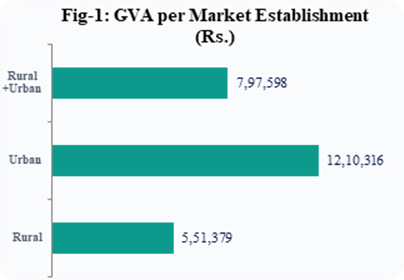
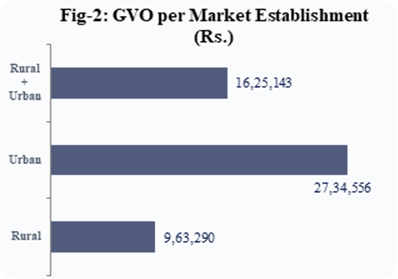
Financing Sources and Cost Composition of Household Construction Activities
On an average, about 97% of households reported their own income as one of the sources of fund to undertake construction activities, which accounted for approximately 77% of the total amount spent on construction.
Nearly 21% of households availed institutional (financial or non-financial) loan for financing their construction activities accounting for about 17% of the total construction expenditure. The proportion of households accessing institutional loans was higher in rural areas (23%) compared to urban areas (13%).
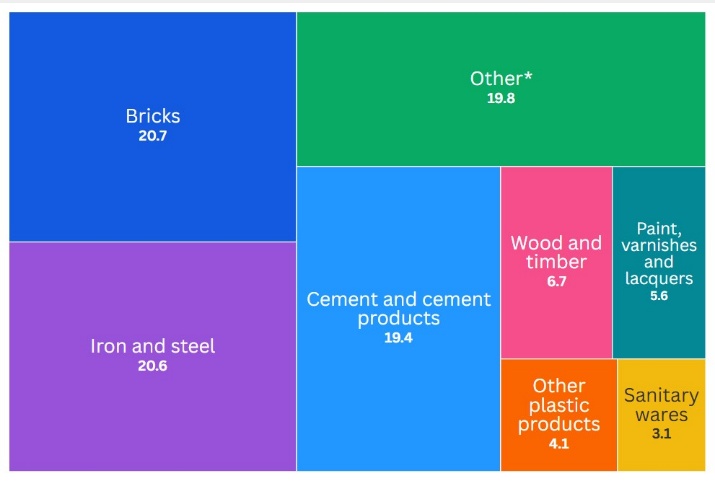
About three-fourths of household construction expenditure was on materials, with labour accounting for around 22 per cent. Within materials used for construction, bricks, cement, and iron and steel together comprised nearly 60 per cent of total expenditure.
|
Fig-3: Percentage Distribution of expenditure of materials: Household
|
|
|
|
*other includes petroleum, coal tar products, glass and glass products and other materials.
|
|
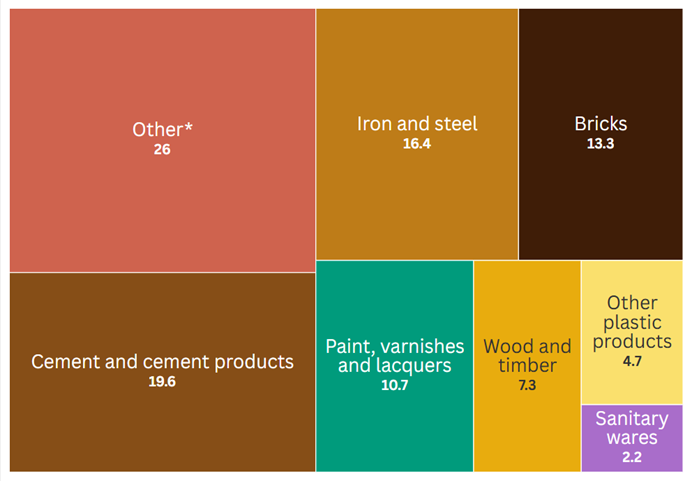
Fig-4: Percentage Distribution of expenditure of materials: Establishment
|
|
|
|
*other includes petroleum, coal tar products, glass and glass products and other materials.
|
Estimates of key indicators of the pilot study are given in Table 1 below. The detailed technical report also contains insights on major states and is available in the website of the Ministry (https://www.mospi.gov.in). Further, interactive tables and visualizations on other surveys conducted by NSO may be accessed on the Data Catalogue section of https://esankhyiki.mospi.gov.in/.
|
Table 1: Estimates of key indicators from Pilot Study on Construction Activities in Unincorporated Sector Establishments and Households
|
|
Indicator
|
Rural
|
Urban
|
Rural + Urban
|
|
(1)
|
(2)
|
(3)
|
(4)
|
|
Number of households undertaking own-account construction for own use
|
75,07,391
|
23,47,089
|
98,54,480
|
|
Number of establishments engaged in unincorporated construction activities
|
6,51,791
|
3,75,168
|
10,26,959
|
|
No. of Labourers engaged per household undertaking own account construction
|
4.2
|
4.4
|
4.3
|
|
No. of workers engaged per establishment in unincorporated construction activities
|
4.5
|
5.5
|
4.8
|
|
GVA per market establishment (Rs.)
|
5,51,379
|
12,10,316
|
7,97,598
|
Endnote: A brief about the coverage, sampling scheme, sample size and data collection mechanism in the Pilot Study on Construction Activities in Unincorporated Sector Establishments and Households:
A. Coverage of the pilot study:
A.1. Unincorporated Establishments: Market and non-market establishments engaged in construction activities
A.2. Households: own account construction undertaken by households for own use
A.3. Construction Activities: all activities under 2-digit NIC (2008) codes 41, 42 and 43 were considered in the definition of construction for the purpose of this pilot.
A.4.Expenditure on construction (for last 365 days or last financial year): Eligibility of establishments engaged in construction activities, as well as households undertaking own-account construction for own use, was determined based on whether their expenditure exceeded pre-specified thresholds, which varied by sector and type of sample entity. The expenditure threshold was set at ₹25,000 in rural areas and ₹50,000 in urban areas for establishments, and ₹10,000 in rural areas and ₹20,000 in urban areas for households. Any amount spent on construction below these cut-offs were not treated as construction work for this pilot study.
B. Sampling Scheme:
The survey has been conducted following a multi-stage stratified sampling scheme where first stage units (FSUs) were census villages in rural and UFS (Urban Frame Survey) blocks in urban areas. The ultimate stage units (USU) were either establishments engaged in construction activities or households who has undertaken own account construction for own use.
C. Sample Size:
In the pilot study, data were collected from a total of 19,154 households, 4,470 market establishments, and 717 non-market establishments pertaining to 11,981 surveyed FSUs (5,104 in rural and 6,877 in urban).
D. Data Collection Mechanism:
The pilot study has been conducted based on area frame and establishments/households have been listed in the selected FSUs of both rural and urban sector. Mostly, data were collected from the selected establishments/households through oral enquiry for the last 365 days. The data for the survey were collected in tablet using Computer Assisted Personal Interviewing (CAPI).
This pilot study has been carried out with Annual Survey of Unincorporated Sector Enterprises (ASUSE) 2025 in the same FSUs selected for the survey period July, 2025 – December, 2025. The listing schedule of ASUSE was suitably modified to accommodate the listing and selection of establishments and households undertaking construction under the coverage of the pilot study. The detailed establishment schedule was canvassed independently of ASUSE for collecting construction related information.
E. Detailed Technical Report of the Pilot Study:
For detailed understanding of the objectives, coverage, concepts, methodology and key findings from the pilot study one may refer to the Technical Report on Pilot Study on Construction Activities in Unincorporated Sector Establishments and Households published by NSO, MoSPI and available on the website of the ministry (https://www.mospi.gov.in).
|
Scan QR code to access MoSPI Publications/ Reports

|
(Release ID: 2250808)
Visitor Counter : 1697