Office of Principal Scientific Advisor to GoI
29th Prime Minister’s Science, Technology & Innovation Advisory Council (PM-STIAC) Meeting discusses on Advanced Manufacturing Systems
Posted On:
10 MAR 2026 7:01PM by PIB Delhi
Principal Scientific Adviser to the Government of India, Prof. Ajay Kumar Sood chaired the 29th Prime Minister’s Science, Technology & Innovation Advisory Council (PM-STIAC) meeting on 10th March 2026, at Kartavya Bhawan 3 in New Delhi to discuss the Advanced Manufacturing Systems.
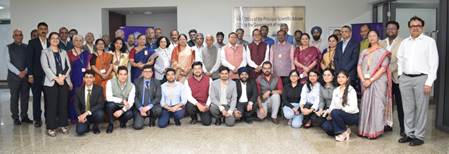
PM-STIAC members namely Dr. A.S. Kiran Kumar, Former Chairman, ISRO; Retd. Lt. Gen. Madhuri Kanitkar, former Deputy Chief of Integrated Defence Staff (Medical); Prof. Sanghamitra Bandyopadhyay, Former Director, Indian Statistical Institute, Kolkata; Prof. Subhash Kak, Professor, Oklahoma State University; Shri Baba Kalyani, Chairman and Managing Director, Bharat Forge; and Dr. V.K. Saraswat, Member (Science & Technology), NITI Aayog were present in the meeting. The meeting brought together key government officials, industry leaders, researchers and academicians to deliberate on the need for strengthening India’s advanced manufacturing systems ecosystem.
The meeting was also joined by Dr. Parvinder Maini, Scientific Secretary, Office of the PSA; Shri S. Krishnan, Secretary, Ministry of Electronics and Information Technology; Prof. Abhay Karandikar, Secretary, Department of Science and Technology; Dr. (Mrs.) N. Kalaiselvi, DG, CSIR; Dr. Ajit Mohanty, Secretary, Department of Atomic Energy; Shri Samir V. Kamat, Chairman, DRDO; Dr. V. Narayanan, Secretary, Department of Space; Shri Sanjay Garg, Director General, BIS; Dr. Shivkumar Kalyanaraman, CEO, ANRF; Ms. Mohini Kelkar, Founder, Grind Master Machines Pvt. Ltd. and President, IMTMA; Shri P.G. Jadeja, Chairman and Managing Director, Jyoti CNC Automation Ltd. and Shri Ravi Raghavan, Managing Director, Bharat Fritz Werner Ltd. (BFW).
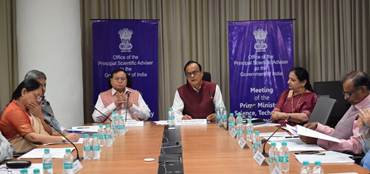
In his opening remarks, Prof. Sood highlighted that manufacturing remains central to economic growth, industrial competitiveness and strategic autonomy. He noted that advanced manufacturing systems, including high-precision machine tools, CNC control systems, robotics, additive manufacturing, and testing and metrology infrastructure, form the backbone of modern industrial production and Industry 4.0. He emphasised that strengthening domestic capability in these technologies is essential for enhancing global competitiveness and reducing technological dependence. He stated that the meeting aimed to provide strategic guidance for a cohesive national approach to enable India to move from being primarily an importer of advanced manufacturing technologies to becoming a designer, developer and producer of these systems.
Dr. V.K. Saraswat, Member, PM-STIAC, observed that digital engineering tools such as product lifecycle management, digital design platforms and multidisciplinary design optimisation have transformed modern engineering and manufacturing practices. He noted that India’s transition to advanced manufacturing, including connected machines, robotics and digital simulation platforms, has been slower than required, and underlined the continued dependence on imported platforms, tools and technologies underpinning Industry 4.0 systems. He stressed the importance of developing domestic capabilities in manufacturing technologies, platforms, algorithms and equipment, and called for stronger collaboration between academia, industry and research institutions to advance indigenous manufacturing solutions.
Dr Rakesh Kaur, Adviser/Scientist 'G', OPSA set the context of the meeting by reaffirming the importance of indigenous advanced manufacturing systems, in the backdrop of recent developments and geopolitical shifts that have led to rethinking the technology policy. The aim is to move ahead in a strategic direction and strengthen the ecosystem by capitalising on India's strength in expanded innovation system, advanced skilling, and human resources.
Shri Vijay Mittal, Joint Secretary, Ministry of Heavy Industries (MHI), highlighted that machine tools are a strategically important sector with wide downstream impact on manufacturing and GDP. Referring to the recent stakeholder consultation at CMTI, he noted that the present moment is opportune for a major national intervention in advanced manufacturing systems. He stated that while earlier efforts under the Capital Goods Schemes had shown progress, a more integrated national-scale programme is now required. He conveyed the Ministry’s readiness to work with CMTI, industry and other ministries to develop the concept into a formal scheme and take it forward with broader inter-ministerial support.
A presentation on Advanced Manufacturing Systems was made by Dr. Nagahanumaiah, Director, Central Manufacturing Technology Institute (CMTI), Bengaluru. The presentation highlighted India’s continued import dependence in critical machine tool subsystems, specialised high-precision machines, robotics subsystems, and additive manufacturing equipment and materials. It emphasised the need for indigenous development, along with testing, validation and certification infrastructure, and proposed a mission-oriented programme with clear targets for localisation, robotics adoption and domestic value addition.
Three thematic presentations were held on: (i) CNC Machine Tool Control Systems, Aggregates, Advanced/Special Purpose Machines, Testing & Metrology; (ii) Industrial Robotics & Automation; and (iii) Advanced Additive Manufacturing (3D & 4D Printing). On the first theme, presentations were made by Dr. Ramesh Babu, Centre Head, AMTDC, IIT Madras and Mr. Deepak Joglekar, Director, Pragati Automation, Bengaluru; on the second theme, by Prof. B. Gurumoorthy, Director, FSID, IISc Bengaluru and Dr. Sameer Gandhi, Managing Director, Omron Automation India; and on the third theme, by Prof. K. P. Karunakaran, IIT Bombay and Dr. Anil Kumar Vesangi, Scientist SG & DGM, VSSC, ISRO. The presentations highlighted the need for indigenous development of critical technologies and subsystems, stronger translational R&D, shared testing, validation and certification infrastructure, specialised talent development, stronger industry-academia partnership, and coordinated efforts to accelerate commercial deployment of advanced manufacturing technologies in India.
The interventions from special invitees and PM-STIAC members highlighted the need for a larger and more integrated national-scale programme on advanced manufacturing systems, supported by coordinated action across ministries, research institutions and industry. The PM-STIAC members highlighted the importance of shared national infrastructure, standards and certification frameworks, stronger policy support, and a national database or portal to map capabilities, facilities, technologies and expertise across the country.
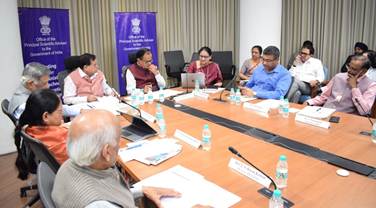
Summarising the discussion, Dr. Parvinder Maini, Scientific Secretary, OPSA, noted that the deliberations reflected a strong national consensus on the need to move from prototype-level capability to commercial-scale deployment. She highlighted the recurring need for world-class testing, validation and certification facilities, shared national infrastructure, indigenous CAD/CAM and related software tools, specialised skill development, and effective use of financial instruments such as RDI and ANRF. Considering the ongoing efforts in Advanced Manufacturing Systems, Dr. Maini reemphasised the need for a formal national database or repository of capabilities, facilities, technologies and expertise.
In his concluding remarks, Prof. Sood observed that India already possesses significant technological capabilities across institutions, industry and strategic sectors, but these remain fragmented and insufficiently integrated. He stated that there is now a need to consolidate these strengths into a coherent national mission on Advanced Manufacturing Systems, to be led by Ministry of Heavy Industries and coordinated participation from relevant departments. As a way forward, he suggested that within the next three months, stakeholders may jointly prepare a practical action plan outlining the scope, priorities, institutional architecture and funding requirements of the proposed mission.
*****
MJPS/ST
(Release ID: 2237793)
Visitor Counter : 4607