Ministry of Health and Family Welfare
Post-Budget Webinar Breakout Session on “Scale-up Allied Health Professionals” Discusses Strategy to Expand Allied Healthcare Workforce
Posted On:
09 MAR 2026 2:44PM by PIB Delhi
As part of the Post-Budget Webinar series on the theme “Sabka Saath Sabka Vikas – Fulfilling Aspirations of People”, a breakout session was held on the Budget Announcement under Para 53: “Scale-up Allied Health Professionals”. The session brought together policymakers, regulators, industry leaders, academic experts and state representatives to deliberate on strategies for expanding allied healthcare education and strengthening the allied health workforce in India.
The discussion focused on the Government’s ambitious initiative to add 1,00,000 Allied Health Professionals (AHPs) over the next five years, aligning with the broader objective of improving the accessibility, quality and sustainability of allied healthcare services and education across the country.
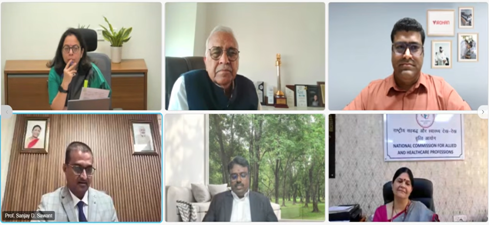
The session was moderated by Dr Vinod Kotwal, Additional Secretary, Ministry of Health and Family Welfare, who highlighted the rising demand for allied health professionals driven by demographic transition, increasing burden of non-communicable diseases, expansion of healthcare infrastructure and rapid adoption of advanced medical technologies. She noted that sectors such as diagnostics, imaging, physiotherapy, emergency care and anaesthesia technology are witnessing growing demand for skilled allied healthcare professionals.
Dr Kotwal also outlined priority disciplines for scaling up training capacity, including Optometry, Physiotherapy, Medical Laboratory Sciences, Dialysis Therapy, Radiology and Imaging Technology, Radiotherapy Technology, Anaesthesia and OT Technology, Emergency Medical Technology, Occupational Therapy, Applied Psychology and Behavioural Health and Palliative Care.
She further highlighted that India has over 500 government institutes offering around 48,000 seats, while about 3,800 private institutes offer more than 3.6 lakh seats, with variations in infrastructure, laboratories, equipment and trained faculty. She further stressed on the need to ensure uniform standards across all the Institutes as laid down by the National Commission for Allied and Healthcare Professions under the National Commission for Allied and Healthcare Professions Act, 2021.
The initiative aims to expand seats across diploma, undergraduate and postgraduate programmes, modernize government AHP institutions in line with NCAHP norms, strengthen laboratories and simulation facilities, address faculty shortages and increase awareness among youth about career opportunities in allied health professions.
The distinguished panel included Dr. Yagna Unmesh Shukla, Chairperson, National Commission for Allied and Healthcare Professions (NCAHP); Dr. Abhijat Chandrakant Sheth, Chairperson, National Medical Commission (NMC); Ms. Aswathy S, Commissioner-cum-Secretary, Department of Health & Family Welfare, Odisha; Shri Siddhartha Bhattacharya, Director General, NATHEALTH; Dr. Sanjeev Singh, Medical Director, Amrita Group of Institutes, Faridabad; Dr. Anurag Shahi, Head of Academics, Virohan; Dr. Sanjay Dinkar Sawant, Director, Regional Institute of Paramedical and Nursing Sciences (RIPANS), Aizawl; Dr. D. Jagadeswaran, Dean, Allied Health Sciences, SRM Medical College Hospital & Research Centre; Dr. Girdhar J. Gyani, Director General, Association of Healthcare Providers (India) and Shri Rahul Singh, Director, Infrastructure Support and Development Division, Department of Economic Affairs (DEA).
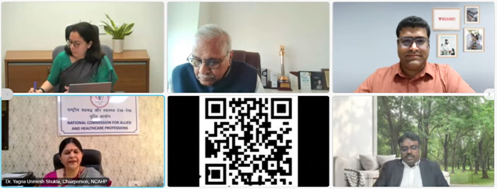
The panellists highlighted the critical role of allied health professionals in strengthening healthcare delivery systems, particularly in areas such as diagnostics, rehabilitation, emergency care and patient management. They appreciated the Government’s decision to add 1 lakh allied health professionals over the next five years and welcomed the initiative to strengthen existing medical colleges so that they evolve into comprehensive ecosystems supporting not only medical education but also allied health and paramedical training.
The discussions underscored the importance of expanding allied healthcare education infrastructure, standardizing curricula, strengthening regulatory mechanisms and enhancing industry–academia collaboration. Panellists also stressed the need to increase awareness among youth about diverse career pathways in allied and healthcare professions, making it an attractive and viable career option.
They further noted that the goal should be to mobilize a large and skilled pool of allied health professionals across the country to meet both present and future healthcare demands, while positioning allied health professions as respectable, professional, and rewarding career pathways. In this context, it was suggested that existing hospitals could be leveraged and developed into allied health science teaching and skill training hubs to expand training capacity.
The panellists also suggested strengthening faculty exchange programmes between universities and medical colleges to address faculty shortages and enhance the quality of teaching and training in allied health disciplines. Such collaboration can facilitate knowledge sharing, exposure to best practices and capacity building across institutions.
It was further highlighted that the district medical colleges across the country could be leveraged as hubs for allied health sciences, given that several components of the medical college ecosystem and curriculum align closely with allied health science training. Utilizing these institutions as centres for allied health education and skill development would significantly expand training capacity and support the large-scale development of allied health professionals.
With the operationalization of the National Commission for Allied and Healthcare Professions (NCAHP) under the National Commission for Allied and Healthcare Professions Act, 2021, the regulatory framework governing allied health education and professional standards has undergone a transformative shift. The panellists noted that this provides a strong foundation for scaling up quality education and ensuring standardized training across institutions.
The webinar was attended by senior officers from the Ministry of Health & Family Welfare, along with representatives from NCAHP, the National Medical Commission (NMC), State Health Ministries, industry associations, healthcare providers and faculty from leading allied healthcare institutions. It served as a collaborative platform for dialogue between government, academia and industry stakeholders to translate the policy vision outlined in the Union Budget into actionable strategies.
The insights and recommendations emerging from the session will contribute to shaping a robust implementation roadmap for expanding allied healthcare education and building a skilled workforce to support India’s evolving healthcare needs.
***
SR
HFW/Post-Budget Webinar Allied Healthcare Breakout Session/09th March 2026/1
(Release ID: 2236913)
Visitor Counter : 5751