Ministry of Environment, Forest and Climate Change
Posted On:
24 FEB 2026 3:44PM by PIB Delhi
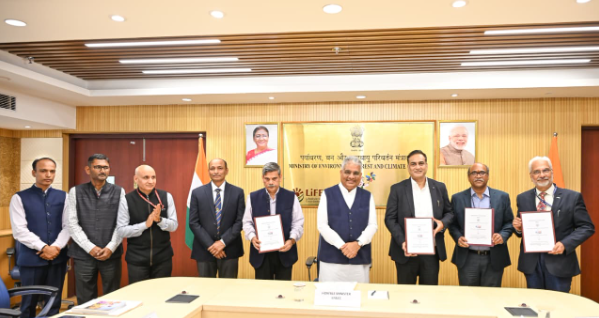
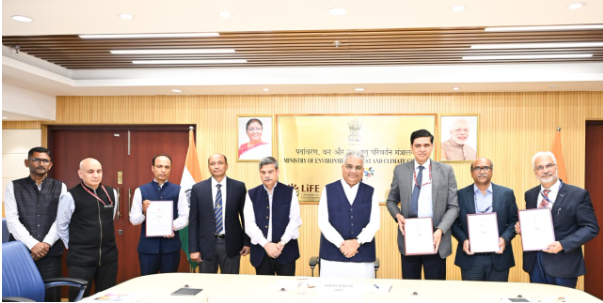
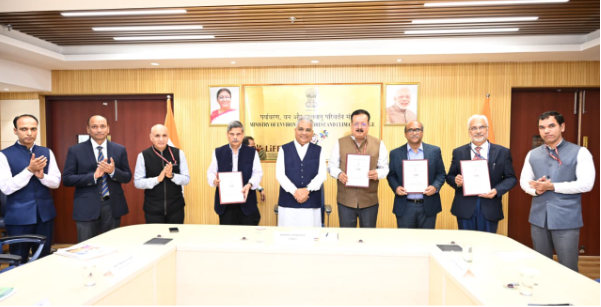
In a significant step towards abatement of road dust pollution in the National Capital Region (NCR), four Memoranda of Understanding (MoUs) were signed today among the Public Works Department (PWD)/Urban Development Departments of NCR States (Delhi, Haryana, Uttar Pradesh and Rajasthan), CSIR-Central Road Research Institute (CSIR-CRRI) and the School of Planning and Architecture (SPA), New Delhi, in the august presence of Union Minister for Environment, Forest and Climate Change Shri Bhupender Yadav at Indira Paryavaran Bhawan, New Delhi.
The MoUs are in line with the standard framework for paving and greening of urban roads issued by the Commission for Air Quality Management in National Capital Region and Adjoining Areas (CAQM), along with the detailed guidance document dated 07.01.2025. The framework aims to improve road cross-sections, right-of-way (RoW) utilisation, greening measures and road maintenance protocols across the NCR. The need for such coordinated implementation has been emphasised in high-level review meetings to prepare structured action plans for control of dust from roads and open areas.
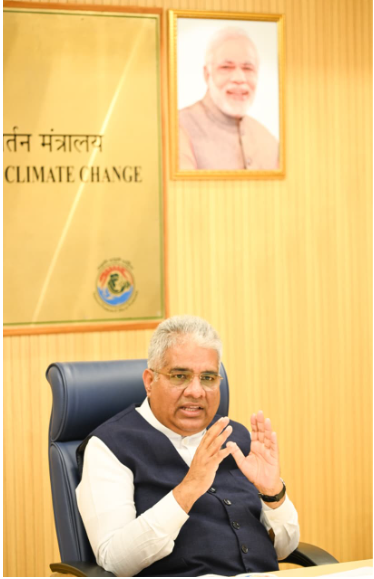
Addressing the MoU signing ceremony, Shri Yadav said that air pollution remains a major challenge in the Delhi-NCR region. He noted that the annual action plans of NCR states and their respective municipal corporations have been reviewed, with Delhi alone having 448 action points. Highlighting the significant role of dust pollution, the Minister said that dust is a major contributor of PM10 pollution in the region. He said that a special task force needs to be constituted to evaluate the social impact of the initiative and roads most affected by traffic congestion and dust pollution should be scientifically mapped. Emphasising the role of greening, Shri Yadav said that bushes requiring less water should be planted in open areas, with around 30 suitable species already identified by MoEFCC.
The Minister appreciated the coordinated efforts of CAQM, NCR State Governments, CSIR-CRRI and SPA in advancing long-term structural measures for control of dust pollution from roads and emphasised the need for time-bound implementation and robust digital monitoring. CSIR-CRRI and SPA were requested to integrate greening components into their road design plans. He also suggested that such activities could be taken up under Corporate Social Responsibility (CSR) initiatives in the NCR. The Minister added that the greening guidelines already issued by the Commission for Air Quality Management (CAQM) must be incorporated into development plans.
Describing the initiative as a strong example of a ‘whole-of-government’ approach, Shri Yadav said that policymakers, experts and executing agencies have come together through this effort. He stressed that Information, Education and Communication (IEC) activities must actively involve all stakeholders contributing to particulate matter emissions. The Minister underlined that the MoU signing is not merely a procedural exercise but a collective commitment and mission to bring visible, on-ground change with tangible social impact.
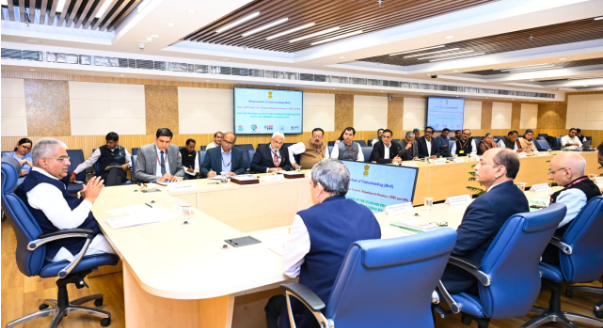
Earlier, on 10.06.2025, CAQM had entered into a tripartite MoU with CSIR-CRRI and SPA for facilitation of implementation of the Standard Framework and for setting up a Project Monitoring Cell (PMC) to provide institutional and technical oversight. The MoUs signed today extend and operationalise the framework by formally integrating the State road-owning agencies along with CSIR-CRRI and SPA.
The core objective of the MoUs is to ensure systematic implementation, monitoring and evaluation of road development works in accordance with the CAQM Standard Framework through the following modules:
- Space standards and cross-section design to standardise right-of-way (RoW), geometric design and cross-sectional elements;
- Mitigation of road dust within the RoW through greening measures for dust suppression;
- Road maintenance practices through RAMS to institutionalise a Web-GIS-based Road Asset Management System (RAMS) for preventive and predictive maintenance;
- New technologies for road construction to strengthen maintenance, mechanisation and monitoring technologies.
Scope and implementation
Under the MoUs:
- Concerned NCR State agencies shall implement road development, paving and greening works in accordance with CAQM guidelines;
- CSIR-CRRI and SPA shall provide technical support, advisory services, guidance and monitoring inputs;
- RAMS shall be developed and operationalised to enable data-driven planning, prioritisation and maintenance scheduling;
- Separate project agreements may be executed, as required, detailing technical scope and financial arrangements.
Further, the following key components shall be targeted:
- Evaluation of road redevelopment using concepts such as PCI (Pavement Condition Index) and timely maintenance of road infrastructure;
- Mitigation of road dust within the RoW through structured greening measures, including plantation of native species in medians, footpaths, traffic hotspots and under flyovers;
- Development and commissioning of a Web-GIS-based RAMS for scientific road condition assessment, maintenance planning and monitoring;
- Adoption of sustainable and low-emission technologies in road construction and maintenance;
- Preparation of a comprehensive road inventory and digital mapping of identified road networks in NCR States;
- Use of modern data collection technologies, including Network Survey Vehicles (NSV), Falling Weight Deflectometer (FWD), Ground Penetrating Radar (GPR), Automatic Vehicle Counter and Classifier (AVCC), etc.
The MoUs shall initially be valid for a period of three years from the date of signing and may be extended by mutual consent. As per the roadmap, each State shall identify a Nodal Agency and establish a dedicated Paving and Greening Cell for coordinated implementation. CSIR-CRRI and SPA shall function as Technical Advisors, providing institutional support for data integration, technical analysis, design validation and preparation of maintenance strategies under RAMS.
The total road length communicated by NCR States for coverage under this initiative includes approximately 10,099 km in Delhi, 10,133 km in Haryana, 6,891 km in Uttar Pradesh and 1,747 km in Rajasthan. Implementation shall be undertaken in a phased manner, with development of targeted action plans over a three-year horizon. The structured deployment of RAMS and standardised road development practices is expected to:
- Significantly reduce road dust emissions, a major contributor to PM10 levels in NCR;
- Improve durability and service life of urban road infrastructure;
- Promote integrated greening and sustainable corridor design;
- Strengthen technology-enabled road maintenance regimes;
- Enhance inter-agency coordination across NCR States under the overall guidance of MoEF&CC and CAQM.
With the approaching summer season, dust from roads is expected to be a major contributor to the overall air pollution load in the region. In this direction, the Commission has initiated intensified action in Delhi and has also directed all Dust Control and Management Cells (DCMCs) in the NCT of Delhi to strengthen measures to abate dust pollution from roads and open areas. This collaborative initiative marks another important step towards cleaner, greener and dust-mitigated urban mobility corridors in the National Capital Region.
*****
VM/GS