PIB Backgrounder
Artificial Intelligence (AI) Transforming Rural India
Posted On:
23 FEB 2026 1:35PM by PIB Delhi

Key Takeaways
- AI is emerging as a foundational driver of inclusive rural development in India.
- India’s AI governance frameworks prioritize fairness, accountability, transparency, and context-specific risk mitigation to prevent exclusion and administrative harm.
- AI integration within Panchayati Raj Institutions, Digital Public Infrastructure, and welfare systems enhances transparency, efficiency, planning, and grassroots participation.
- Multilingual and voice-enabled platforms such as BHASHINI, BharatGen, and Adi Vaani reduce linguistic and literacy barriers, expanding access to services and governance.
- National missions, sectoral initiatives, state-led innovations, and the India–AI Impact Summit 2026 reflect a coordinated shift toward scalable, people-centric AI-aligned with inclusive growth and the vision of Viksit Bharat@2047.
Introduction
Artificial Intelligence (AI) refers to the ability of machines to perform cognitive tasks such as learning, reasoning, and decision-making. In recent years, AI has rapidly moved from experimental use to large-scale deployment, driven by advances in data, computing power, and connectivity. In India, AI is being developed within a social-purpose framework aligned with the vision of inclusive welfare, positioning it as a public good aimed at equity and broad-based access rather than exclusivity. By strengthening service delivery, supporting data-driven governance, and integrating marginalised communities into formal systems, AI is particularly relevant to rural development across agriculture, healthcare, skilling, employment, and local governance. The people-centric orientation of this approach is reflected in the India–AI Impact Summit 2026, which emphasises rural livelihoods, social inclusion, and service delivery across sectors such as agriculture, healthcare, education, and governance. By fostering institutional coordination and scaling proven use cases under the IndiaAI Mission and Digital India, the Summit signals a transition from pilot initiatives to system-wide implementation for equitable and sustainable rural development.
National AI Policy and Governance Framework for Inclusive Development
India’s approach to AI is anchored in a dual framework that combines a forward-looking national strategy for inclusive growth with a robust governance architecture to ensure responsible, transparent, and equitable deployment across sectors, particularly in rural and socially sensitive contexts.
National Strategy for Artificial Intelligence: AI for All
The National Strategy for Artificial Intelligence, launched by NITI Aayog in June 2018, identifies AI as a transformative tool to address India’s development challenges by improving access, affordability, and quality of essential services. It prioritises inclusive and socially oriented growth, particularly in underserved sectors and regions, with rural India recognised as a key focus area due to persistent service and infrastructure gaps. In sectors such as agriculture, healthcare, and education, AI-enabled decision-support systems and data-driven platforms are envisaged to strengthen frontline workers and local institutions, extending services to remote populations without extensive physical infrastructure expansion.
The strategy emphasises augmentation rather than displacement of human labour, positioning AI as a support system for farmers, health workers, teachers, and administrators. It also highlights AI’s role in promoting inclusive economic participation through decentralised skilling, digital work opportunities, and technology-aligned training. Under the #AIforAll framework, AI is framed as a catalyst for inclusive rural growth, strengthened governance, and enhanced human capacity.
India AI Governance Guidelines: Deploying AI Responsibly in Rural India
The India AI Governance Guidelines, launched by the Ministry of Electronics and Information Technology (MeitY) in November 2025, reorient AI policy from a focus on applications to governance frameworks, safeguards, and institutional preparedness-an approach particularly significant for rural India. The guidelines establish people-centric principles, such as fairness, accountability, and transparency, to mitigate the risks of bias, exclusion, and opaque decision-making. Recognising that global risk models may not fully capture India’s socio-economic context, the framework advocates India-specific risk assessment and protections, especially in welfare delivery systems where automated tools influence targeting and service provision.
The framework comprises four key components:
- Seven guiding principles (Sutras) for ethical and responsible AI.
- Key recommendations across six pillars of AI governance.
- An action plan mapped to short, medium, and long-term timelines.
- Practical guidelines for industry, developers, and regulators to ensure transparent and accountable AI deployment.
It further promotes system-level governance through Digital Public Infrastructure, embedding privacy, interoperability, and accountability by design. A whole-of-government approach enhances coordination across ministries and states, strengthening transparency, grievance redressal, and institutional capacity to ensure inclusive and trust-based AI-enabled governance.
AI in Rural e-Governance and Decentralized Administration
Artificial Intelligence is increasingly being used to strengthen rural governance by improving transparency, efficiency, and citizen access to public services.
AI Tools for Gram Panchayat and Local Governance

AI is being directly integrated into Panchayati Raj Institutions to strengthen decentralised governance. One such tool is SabhaSaar, an AI-enabled tool that generates structured minutes of Gram Sabha and Panchayat meetings from audio or video inputs. By automating documentation, SabhaSaar reduces manual effort, improves consistency, and ensures timely and unbiased records. Integrated with BHASHINI, it supports functionality in 14 Indian languages, enabling multilingual accessibility across rural communities. By streamlining administrative processes, SabhaSaar allows local officials to focus more effectively on governance outcomes and service delivery.

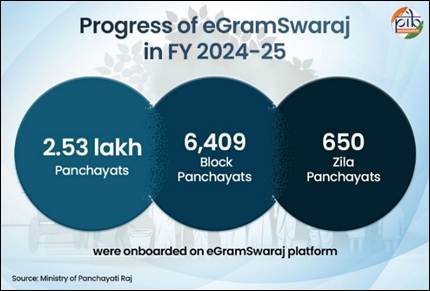
AI-enabled governance is further strengthened through digital platforms such as eGramSwaraj and Gram Manchitra. Developed under the e-Panchayat Mission Mode Project and launched in April 2020, eGramSwaraj consolidates key Panchayat functions-including planning, budgeting, accounting, monitoring, asset management, and payments-into a unified digital system. In FY 2024-25, the platform onboarded over 2.53 lakh gram panchayats, along with 6,409 block panchayats and 650 Zila panchayats, reflecting its extensive adoption in decentralised governance.
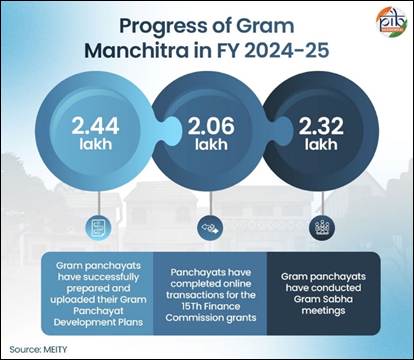
Gram Manchitra complements administrative systems by offering GIS-based visualisation and planning tools to support rural development. It enables Panchayats to map assets, monitor projects, and integrate spatial data into Gram Panchayat Development Plans (GPDPs). By linking geotagged infrastructure with demographic and environmental data, the platform enables evidence-based decision-making across infrastructure planning, natural resource management, and disaster response, thereby strengthening alignment between planning and implementation. As of FY 2024–25, 2.44 lakh gram panchayats have prepared and uploaded GPDPs, 2.06 lakh have completed online transactions under the 15th Finance Commission grants, and 2.32 lakh have conducted Gram Sabha meetings.
AIKosh: Use-Cases for Rural e-Governance

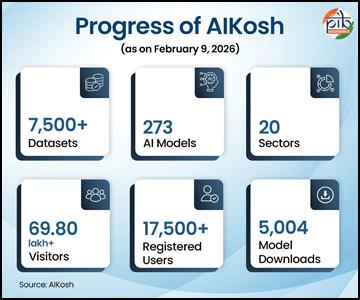
AIKosh serves as a national repository of AI datasets and models to advance public-sector innovation. It consolidates data from governmental and non-governmental sources and offers ready-to-deploy AI models across diverse sectors. With more than 7,500 datasets and 273 AI models spanning 20 industries, the platform lowers entry barriers for developers designing governance and service delivery applications. By enabling the reuse of foundational AI components, AIKosh accelerates the development of solutions for rural e-governance and public administration. As of 9 February 2026, the platform has recorded over 69.80 lakh visits, 17,500 registered users, and 5,004 model downloads, underscoring the expanding role of shared data infrastructure in scaling AI for public good.
AI Infrastructure and Sectoral Integration in Rural India
The effective use of Artificial Intelligence in rural development extends beyond application design to the establishment of robust digital and institutional infrastructure. In India, AI infrastructure is being advanced through collaborative efforts involving government agencies, academic institutions, and national platforms. These initiatives integrate data resources, computational capacity, and domain expertise to enhance planning, monitoring, and service delivery in rural contexts. Collectively, they form the foundational ecosystem needed to scale AI solutions and align them with grassroots development priorities.
BhuPRAHARI: AI and Geospatial Infrastructure for Rural Asset Management
BhuPRAHARI, launched in May 2025 by the Ministry of Rural Development in collaboration with IIT Delhi, integrates AI and geospatial technologies to monitor assets created under MGNREGA. Initially, the platform was utilised as a water observatory for monitoring Amrit Sarovars, enabling scientific assessment of water availability, and storage status through satellite- and ground-based data. The platform will now be utilised for monitoring assets created under the Viksit Bharat-Guarantee for Rozgar and Ajeevika Mission (Gramin) (VB-G RAM G). By leveraging ground- and satellite-based data with AI-driven analytics, the platform enables real-time asset tracking, enhancing transparency, accountability, and resource optimisation. This convergence of AI and geospatial infrastructure strengthens the planning and implementation of large-scale rural development programmes.
Digital ShramSetu Mission and AI for Informal Workers
The Digital ShramSetu Mission is a coordinated initiative to deploy AI and other frontier technologies within the informal sector. By aligning technological deployment with regulatory frameworks and impact assessment, the mission enhances service delivery and livelihood support for informal and rural workers, thereby promoting inclusive and sustainable rural development.
AI Infrastructure in Agriculture

In agriculture, AI operates as a decision-support system at the farm level, enabling data-driven management practices. Applications include weather forecasting, pest detection, and optimization of sowing and irrigation schedules. The Ministry of Agriculture and Farmers Welfare has deployed AI through initiatives such as Kisan e-Mitra, a virtual assistant providing information on government schemes, including income support programmes. Additionally, platforms such as the National Pest Surveillance System and Crop Health Monitoring integrate satellite imagery, meteorological data, and soil information to generate real-time advisories. These interventions reduce production risks, enhance productivity, and strengthen farmers’ income security, particularly in vulnerable regions.
AI Infrastructure for Education and Skilling


At the national level, NCERT’s DIKSHA platform incorporates AI-enabled features such as keyword-based video search and read-aloud tools to enhance accessibility and promote inclusive learning, particularly for students with visual impairments and diverse educational needs. Complementing this, the National e-Governance Division under the Ministry of Electronics and Information Technology has introduced Youth for Unnati and Vikas with AI (YUVAI)-to equip students from Classes VIII to XII with foundational AI and socio-technical skills through experiential learning. By enabling AI across sectors, including agriculture, health, and rural development, the programme fosters real-world problem-solving and future-ready competencies across diverse contexts.
A State-Led Initiative to Promote AI in Rural Development
The Suman Sakhi WhatsApp Chatbot illustrates state-level adoption of AI to strengthen rural healthcare delivery. Launched under the National Health Mission in Madhya Pradesh, it employs AI-enabled conversational tools to provide women and families with accessible maternal and newborn health information. The platform offers details on delivery services, nearby health facilities, and support from frontline workers such as ASHAs and ANMs. Leveraging WhatsApp enhances last-mile outreach, particularly in rural and high-risk areas. Planned features, including multilingual access, grievance redressal, and real-time updates, demonstrate the potential of locally contextualised AI solutions to advance inclusive and responsive rural healthcare systems.
AI for Language Inclusion and Multilingual Governance
Artificial Intelligence is playing a central role in expanding language access and inclusion in India by enabling citizens, especially in rural, remote, and tribal areas, to interact with digital services in their own languages, thereby strengthening last-mile service delivery and participatory governance.
BHASHINI – National Mission on Natural Language Translation

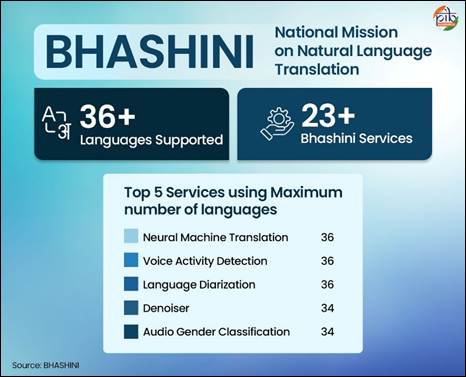
BHASHINI is an AI-enabled language platform designed to reduce linguistic barriers to accessing digital services and is currently integrated with over 23 government services. Launched in July 2022, it offers translation, speech-to-text, and voice-based interfaces across more than 36 Indian languages, promoting inclusion for users with limited literacy or digital proficiency, particularly in rural areas. Through integration with public digital infrastructure and cross-sector partnerships, the platform has scaled significantly. As of October 2025, BHASHINI supports over 350 AI language models and has surpassed one million downloads.
BHASHINI operates as a collaborative ecosystem fostering co-creation and innovation, partnering with over 50 ministries, startups, and private entities to develop multilingual solutions across agriculture, governance, education, and public administration. By integrating voice-first and language-inclusive design into digital platforms, it enhances last-mile connectivity and promotes equitable participation in the digital economy. In rural development contexts, BHASHINI ensures that linguistic diversity does not impede access to welfare schemes, information, or public services.
BHASHINI Sanchalan is a collaborative initiative of central ministries and the Digital India BHASHINI Division that strengthens multilingual governance through AI-enabled language technologies. Implemented under the broader BHASHINI programme, it integrates voice-first interfaces and translation capabilities into public digital systems to enhance governance processes and service delivery. The initiative supports the development of domain-specific language models, enhances translation accuracy, and standardises terminology through collaborative model training. The initiative promotes linguistic inclusion and citizen participation, particularly in rural and underserved regions.
BharatGen AI: India’s Multilingual AI Model

BharatGen, launched in June 2025, is India’s first government-funded, sovereign, multilingual, and multimodal Large Language Model. Developed under the National Mission on Interdisciplinary Cyber-Physical Systems and advanced through the IndiaAI Mission, it supports 22 Indian languages and integrates text, speech, and document-vision capabilities. Built on India-centric datasets and led by a consortium of academic institutions, BharatGen establishes a domestically developed AI stack for public and developmental applications.
In the context of rural development, BharatGen enables inclusive, language-accessible AI solutions that reduce literacy and digital barriers. Its voice-enabled and multilingual capabilities support applications in agriculture, governance, and citizen services, strengthening last-mile delivery and rural participation in the digital economy.
Adi Vaani: Enabling Inclusive Rural and Tribal Development

Adi Vaani is an AI-enabled language platform designed to address communication barriers faced by tribal communities in remote and underserved regions. Under the Adi Karmayogi framework, it facilitates access to governance, education, and healthcare services in native tribal languages. Developed using authentic linguistic data from State Tribal Research Institutes, the platform integrates technological innovation with community knowledge. It incorporates feedback mechanisms to ensure linguistic accuracy, cultural relevance, and continuous improvement.
Beyond translation, Adi Vaani supports language preservation, cultural documentation, and digital learning by digitising endangered languages and oral traditions. By enhancing linguistic inclusion in public services and supporting community empowerment, the platform exemplifies the responsible use of AI to advance inclusive rural and tribal development aligned with national priorities.
Conclusion
Artificial Intelligence is steadily evolving into a foundational pillar of rural transformation in India, not merely as a technological intervention but as an integrated public infrastructure aligned with inclusive development goals. Through a combination of strategic vision, governance safeguards, digital public infrastructure, multilingual platforms, and sectoral integration across agriculture, healthcare, education, skilling, and local governance, AI is being institutionalised to augment human capacity rather than replace it. When embedded within principles of fairness, transparency, and linguistic inclusion, AI strengthens last-mile service delivery, enhances participatory governance, and reduces structural inequalities. As India advances toward Viksit Bharat@2047, the responsible and people-centric deployment of AI in rural ecosystems will remain central to building resilient, equitable, and future-ready development systems.
References
Ministry of Rural Development
https://www.pib.gov.in/PressReleasePage.aspx?PRID=2013810®=3&lang=2
Ministry of Panchayati Raj
https://www.pib.gov.in/PressReleasePage.aspx?PRID=2198178®=3&lang=1
https://www.pib.gov.in/PressReleasePage.aspx?PRID=2039084®=3&lang=2
Ministry of Tribal Affairs
https://www.pib.gov.in/PressReleasePage.aspx?PRID=2162846®=3&lang=2
Ministry of Communications
https://www.tec.gov.in/pdf/Studypaper/AI%20Policies%20in%20India%20A%20status%20Paper%20final.pdf
Ministry of Electronics and Information Technology
https://aikosh.indiaai.gov.in/home
https://bhashini.gov.in/our-impact
https://bhashini.gov.in/sanchalan
https://indiaai.gov.in/hub/aikosh-platform
https://www.pib.gov.in/PressReleasePage.aspx?PRID=2186639®=3&lang=2
https://informatics.nic.in/uploads/pdfs/51ebda15_28_30_egov_grammanchitra_jan_25.pdf
https://static.pib.gov.in/WriteReadData/specificdocs/documents/2025/nov/doc2025115685601.pdf
Ministry of Science and Technology
https://www.pib.gov.in/PressReleasePage.aspx?PRID=2194204®=3&lang=2
Niti Aayog
https://niti.gov.in/sites/default/files/2025-10/Roadmap_On_AI_for_Inclusive_Societal_Development.pdf
https://www.niti.gov.in/sites/default/files/2023-03/National-Strategy-for-Artificial-Intelligence.pdf
PIB Backgrounder
https://www.pib.gov.in/PressNoteDetails.aspx?NoteId=155273&ModuleId=3®=3&lang=2
https://www.pib.gov.in/PressNoteDetails.aspx?NoteId=156786&ModuleId=3®=3&lang=2
https://www.pib.gov.in/PressNoteDetails.aspx?NoteId=157023&ModuleId=3®=3&lang=1
Government of Madhya Pradesh
https://www.linkedin.com/posts/mpsedc_mpsedcachievement-madhyapradesh-women-activity-7374329781489860608-j6JT/
Click here to see pdf
***
PIB Research
(Release ID: 2231706)
Visitor Counter : 12537