Lok Sabha Secretariat
DEEPFAKES AND MISINFORMATION POSE SERIOUS THREATS TO DEMOCRACY: LOK SABHA SPEAKER
AI MUST BE USED TO STRENGTHEN TRUTH AND CREDIBILITY, NOT TO DISTORT OR SUPPRESS FACTS: LOK SABHA SPEAKER
AI HAS THE POTENTIAL TO MAKE DEMOCRACY MORE TRANSPARENT, ACCOUNTABLE AND CITIZEN-CENTRIC: LOK SABHA SPEAKER
DIGITAL PARLIAMENT AND AI ARE STRENGTHENING DEMOCRATIC ACCOUNTABILITY: LOK SABHA SPEAKER
INDIA’S DIGITAL INFRASTRUCTURE A MODEL FOR THE WORLD: LOK SABHA SPEAKER
AI TO ACCELERATE ‘VIKSIT BHARAT 2047’ IN EDUCATION, HEALTHCARE AND AGRICULTURE: LOK SABHA SPEAKER
LOK SABHA SPEAKER ADDRESSES “AI FOR DEMOCRACY” SPECIAL SESSION AT INDIA AI IMPACT SUMMIT
Posted On:
20 FEB 2026 8:30PM by PIB Delhi
Lok Sabha Speaker today drew attention to the growing challenges posed by deepfakes and misinformation. Describing them as serious threats to democracy, he emphasized that Artificial Intelligence (AI) must be used to strengthen truth and credibility, not to distort or suppress facts. He stressed the need for developing robust safeguards alongside technological advancements to protect democratic discourse from manipulation and confusion.
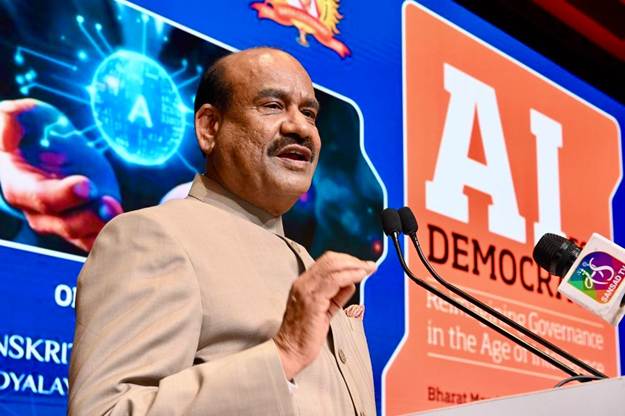
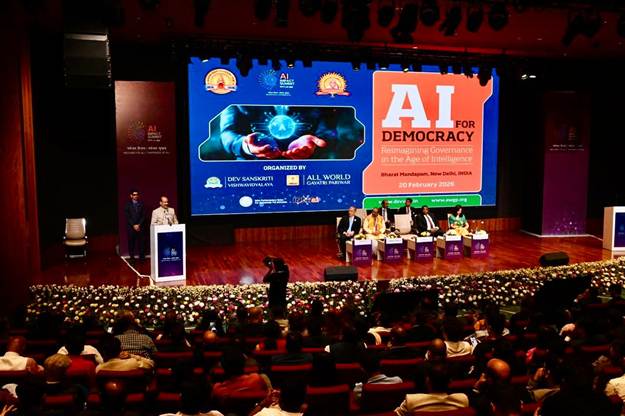
Addressing the special session on the theme “AI for Democracy” at the India AI Impact Summit being held at Bharat Mandapam today, Shri Birla noted that that AI has the potential to make democracy more transparent, accountable and citizen-centric. He stressed that the nation’s guiding principle has always been “Sarvajan Hitaya, Sarvajan Sukhaya”—for the welfare and happiness of all. India, he noted, works with the spirit of global well-being, rooted in its enduring civilizational values.
Highlighting the transformative role of technology in legislative functioning, the Speaker observed that AI is emerging as a significant tool for strengthening democratic institutions. He was happy to note that initiatives such as “Digital Parliament” are simplifying communication between citizens and Parliament, bridging digital and information divide in a diverse country like India. He informed that under the Digital Parliament initiative, parliamentary proceedings have been made paperless, modern and environmentally sustainable. With the help of AI tools, thousands of hours of parliamentary debates and records have been systematically organized and made easily searchable and accessible to the public. This, he emphasized, enhances transparency and enables citizens to closely monitor the performance of their elected representatives, thereby increasing accountability.
Referring to India’s linguistic diversity, the Speaker underlined the importance of the “Sansad Bhashini” initiative, through which parliamentary debates are being made available in multiple regional languages using AI-enabled translation tools. Citizens across the country can now access and understand parliamentary discussions in their own languages, strengthening trust and participation in the democratic process.
The Speaker highlighted that the discussions during international parliamentary forums, including global engagements of presiding officers, have underscored the importance of aligning democratic institutions with modern technology. In this context, he noted that India’s innovations in leveraging AI for legislative efficiency have been widely appreciated as a global model. He added that AI tools and modern data systems are also helping Members of Parliament better understand the needs and aspirations of their constituencies, thereby enabling more informed and citizen-focused policymaking.
Shri Birla stated that India’s AI strategy is guided by the principle of inclusive development; and the use of AI in sectors such as education, healthcare and agriculture will accelerate the country’s journey towards the vision of “Viksit Bharat 2047.” By enhancing access to quality education, improving healthcare delivery systems and empowering farmers with data-driven solutions, AI can transform the lives of millions, particularly those in underserved and unorganized sectors. Shri Birla further stated that India’s digital infrastructure has become exemplary for the world. With its scale, inclusivity and efficiency, India’s digital public infrastructure is being studied and appreciated globally. He reiterated that India is committed to sharing its digital experiences and technological expertise with the international community for collective progress.
While advocating the adoption of AI, Shri Birla cautioned that technology cannot replace human sensitivity and ethical judgment. “AI is a means, not an end,” he remarked, emphasizing that human values, democratic principles and ethical standards must remain paramount in the development and deployment of emerging technologies. He called for nurturing a generation of youth equipped not only with technological expertise but also with compassion and a strong moral foundation. He expressed confidence that deliberations at the “AI for Democracy” session would contribute meaningfully to shaping a future where technology and democratic values move forward together. He also hoped that the harmonious integration of innovation and civilizational ethos would pave the way for a strong, inclusive and developed India by 2047.
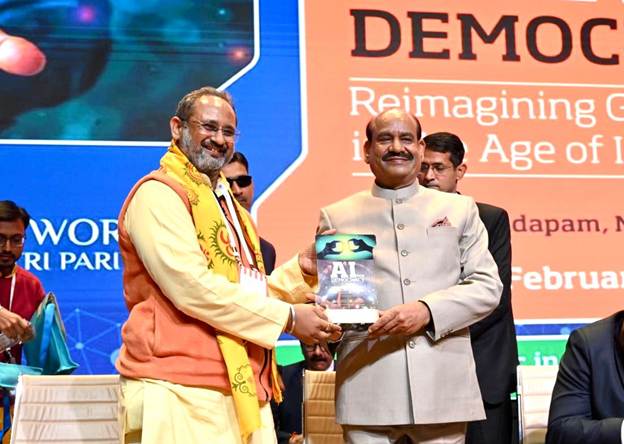
Several dignitaries including Minister for AI & Online Safety, UK; Deputy Speaker, Parliament of Hungary and Secretary – General, IPU also addressed the participants. The programme was jointly organized by Dev Sanskriti Vishwavidyalaya and the Inter-Parliamentary Union.
***
AM
(Release ID: 2230951)
Visitor Counter : 589