PIB Backgrounder
Transforming Healthcare Delivery Through Artificial Intelligence
Posted On:
13 FEB 2026 1:08PM by PIB Delhi
Introduction
The revolution of healthcare delivery in India is leveraging AI-powered diagnostics, telemedicine, and surveillance tools across both public and private sectors. By integrating these frontier technologies, the Government of India is fulfilling its commitment to Universal Health Coverage—effectively bridging delivery gaps, elevating the standard of medical services and products, and ensuring affordable care for every citizen.
Guided by the vision of 'Welfare for All, Happiness for All' (Sarvajana Hitaya, Sarvajana Sukhaya), the Union Cabinet launched the IndiaAI mission in March 2024 to advance inclusive development, strengthen governance, and improve public service delivery—including healthcare. The mission embodies two core principles:
- Democratisation of technology, ensuring AI tools reach all segments of society including rural and underserved populations
- Technology for humanity, deploying AI not merely for technological advancement but to address critical societal challenges, improve quality of life, and advance the public good.
This comprehensive approach aims to transform healthcare delivery as part of India's journey toward Viksit Bharat by 2047.
The Union Government recognised AI’s transformative potential in healthcare delivery years ago. In 2018, the Niti Aayog published the National Strategy for Artificial Intelligence, which envisions AI, robotics and the Internet of Medical Things as the “new nervous system for healthcare”, among its myriad applications across various sectors.[1][2][3]
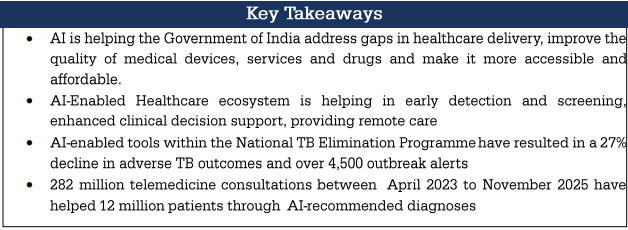
AI-powered tools, adopted by the Ministry of Health and Family Welfare’s various national programmes, are democratising healthcare expertise across India. For example, these tools enable frontline workers to screen for TB and diabetic retinopathy while supporting 282 million telemedicine consultations nationwide. Together, these efforts have delivered measurable impact, including a 27% reduction in adverse TB outcomes and 12–16% increase in case detection.
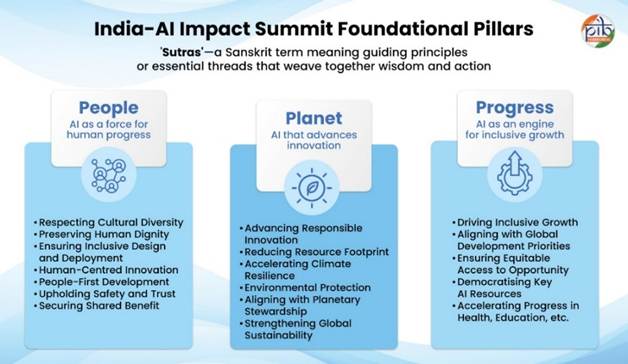
India-AI Impact Summit 2026
India will host the Global South's first international AI summit in New Delhi from 16 to 20 February, bringing together global leaders, policymakers, technology firms, innovators, and experts. The summit will cover AI-centred policy, research, industry, and public engagement.[4]
AI in Healthcare Delivery
AI has enabled better delivery of various public health initiatives by leveraging technology for public health impact. It demonstrates how technology-driven solutions can address persistent developmental challenges and promote inclusive and holistic social development.[5] This reflects the spirit of Atmanirbhar Bharat and Viksit Bharat.
From 2022 to 2025, India has fundamentally restructured its public health delivery by integrating AI into a unified strategy, that bridges specialist shortages and scales proactive care. By deploying AI-enabled tools within the National TB Elimination Programme, the National Diabetic Retinopathy Screening Programme, and the Media Disease Surveillance System, the government has empowered non-specialists to perform high-level screenings, resulting in a 27% decline in adverse TB outcomes and over 4,500 outbreak alerts. This transformation is further solidified through the e-Sanjeevani, which has supported 282 million consultations with AI-assisted differential diagnosis, and the UdyogYantra AI System for malnutrition monitoring. This has created a comprehensive ecosystem that spans from infectious disease management and cancer care to the modernisation of traditional Ayurvedic medicine and the National One Health Programme.
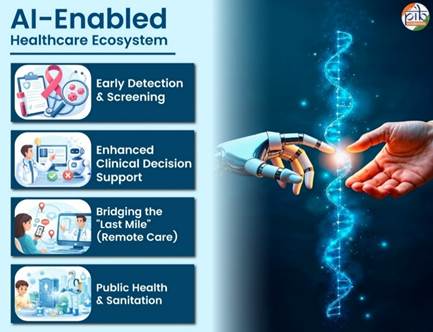
AI-enabled initiatives by the Government of India (2022-2025) to improve public health delivery are:
|
Health Focus
|
AI Solution / Initiative
|
Process, Technology "Treatment" Experience
|
Clinical / Operational Impact
|
|
TB Management
|
Adverse Outcome Prediction
|
Predictive Analytics: AI flags patients at high risk of treatment failure now treatment is initiated.
|
Reported 27% decline in adverse outcomes after nationwide deployment.[6]
|
|
TB Triage
|
DeepCXR (Chest X-ray)
|
Radiology AI: Automated reading of digital X-rays to identify nodules/cavities for presumptive TB cases.
|
Deployed in 8 State/UTs; available free of cost to the Govt to bypass specialist shortages.[7]
|
|
Diabetes (DR)
|
MadhuNetrAI
|
Retinal Triage: Non-specialists take retinal photos; AI grades them to prioritise urgent specialist referrals.[8]
|
7,100 patients benefited across 38 facilities; India's first AI community screening program launched Dec 2025.[9]
|
|
Telemedicine
|
eSanjeevani CDSS
|
Differential Diagnosis: Streamlines patient complaints and provides AI-based differential diagnosis recommendations
|
282 million consultations benefitedfrom April 2023 to November 2025; 12 million aided specifically by AI-recommended diagnoses.[10]
|
|
Traditional Medicine
|
Ayurgenomics& Ayush Grid
|
Genomic-Ayurveda Hybrid: Uses AI to identify disease markers based on Prakriti (constitution types) and ancient texts.
|
Recognised by WHO (July 2025) as a global model for integrating AI with traditional knowledge.[11]
|
|
Cancer Care
|
Imaging Biobank
|
Database R&D: NITI Aayog is building a database of 20,000+ cancer patient profiles (radiology/pathology images).[12]
|
Enables researchers to develop high-accuracy AI tools for early cancer detection and management.
|
|
Health Fraud
|
AB-PMJAY Anti-Fraud
|
Integrity Management: AI/ML detects suspicious transactions and helps deterfraud in real-time within the PM-JAY scheme.
|
Shifts health scheme monitoring from reactive detection to proactive integrity management.[13]
|
|
Surveillance
|
Media Disease Surveillance (MDS)
|
Early Warning: AI scans national digital news sources for symptom clusters (e.g., mystery fevers).
|
Published 4,500+ event alerts since April 2022 to prevent regional outbreaks.[14]
|
The government has established a foundational layer to ensure these tools are safe and standardised:
- Centres of Excellence for Artificial Intelligence: Designated in March 2025, AIIMS Delhi, PGIMER Chandigarh, and AIIMS Rishikesh lead the development of indigenous AI solutions.[15] In addition, NHA has also inked an MoU with TANUH, Ministry of Education’s CoE in Healthcare at IISc Bengaluru to lead AI related developments in healthcare.
- National Federated Learning Platform: An MoU signed on October 14, 2024 between the National Health Authority (NHA) and IIT Kanpur to create an open benchmarking platform for validating AI health models using data from the ecosystem partners under the Ayushman Bharat Digital Mission.[16]
- Ethical Oversight: All AI deployment follows the ICMR Ethical Guidelines (2023)[17] and MeitY AI Governance Guidelines to ensure privacy-by-design and secure data exchange.[18]
- Strategy for AI in Healthcare for India (SAHI): MoHFW is working on a health sector specific AI strategy. This strategy has been prepared after consultation with various public and private stakeholders.
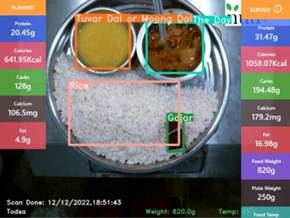
An Indian Administrative Service official was overseeing the Integrated Tribal Development Programme in Maharashtra's Etapalli district. He noticed clear signs of undernourishment in students despite government-funded meals. An audit of the Todsa Ashram School revealed that 27% of its students were malnourished. Gupta's solution was to modify the food fed to the children. An AI-enabled machine to evaluate food served against government-prescribed menus was introduced. It was equipped with advanced image recognition to analyse over 2,100 data points, including temperature and appearance.
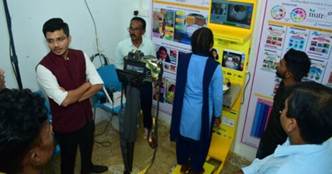
After the machine was deployed, the analysis revealed that many meals did not match prescribed menus. The analysis showed that students often missed out on items like fruits or protein-rich components. Nutritional deficiencies were also exacerbated by inadequate preparation, overcooked vegetables, and spoiled ingredients. This AI-enabled machine helped the authorities enforce stricter compliance protocols and vendor accountability. It led to visible improvements in the children's nutrition. This successful model was replicated across multiple schools in the district.
Regional Open Digital Health Summit 2025
The Regional Open Digital Health Summit 2025 was held in New Delhi on November 19-20. The summit was organised by the National Health Authority (NHA), Ministry of Health & Family Welfare, in collaboration with the National e-Governance Division (NeGD), Ministry of Electronics and Information Technology, WHO South-East Asia Regional Office (SEARO), and UNICEF. The summit convened policymakers, technologists, public health leaders, and global experts from across the WHO South-East Asia Region (SEAR). The discussions highlighted India’s journey in strengthening its digital health architecture through robust governance, open standards, and emerging technologies. The use of GenAI in healthcare, including AI-enabled surveillance and diagnosis, faster disease identification, early outbreak prediction, and support for frontline workers, was a key focus, alongside the integration of AI across other health programmes. The summit also saw representatives from Sri Lanka, Nepal, Bhutan, Bangladesh, and Timor-Leste; and senior officials from WHO-SEARO, UNICEF, and digital health leaders from SEAR Member States.[19]
IndiaAI Mission’s Healthcare Initiatives
In March 2024, the Union Cabinet, chaired by the Prime Minister Narendra Modi, approved the comprehensive national-level IndiaAI mission with a budget outlay of Rs 10,371.92 crorefor promoting India’s socio-economic development using AI.[20]
The IndiaAI Mission initiatives are supporting innovation in AI-enabled healthcare applications.[21][22]One of the pillars of the mission is the IndiaAI Application Development Initiative. This scheme aims to develop, scale, and promote the adoption of impactful AI solutions designed to tackle significant national challenges.[23] Advanced and efficient AI-enabled healthcare delivery is one of the many outcomes of this initiative.
As on March 2025, healthcare-related AI solutions shortlisted under the IndiaAI Application Development Initiative are as follows:
|
Name of the
Solution
|
Solution
Description
|
Stage
|
|
NIDAAN
(iNtegrated lung
health screening& tuberculosIs Detection through AI At National
scale)
|
qXR, an advanced AI tool for interpreting chest X rays (CXR), detects & localizes 30+ findings.
|
Solution
|
|
End to End AI
Cloud Platform for Radiology
Diagnosis
|
AI cloud platform for radiology diagnosis, integrating innovative technologies such as Computer Vision (CV), Generative Artificial Intelligence, Natural Language Processing, Dicom, mobile, and cloud computing
|
Solution
|
|
Impactful AI
solution, preventing preventable
blindness, for socio economic
transformation.
|
Early detection of vision threatening retinal abnormalities
|
Solution
|
|
AI Powered
Wearable
Technology for
Detection &
Diagnosis of
Musculoskeletal
Joint Health Pain.
|
AI Enabled Hardware Platform for Joint Pain Diagnostics and Rehabilitation Segments of Healthcare
|
Solution
|
|
VoxelBox
|
Neuro-informatics platform that allows to map the functional maps/connectomics of the human brain
|
Prototype
|
|
Development of
Ocellux: An AI
Based Solution for Enhanced Early
Diabetic Eye
Screening
|
Portable, affordable and highly accessible retina imaging device powered by AI for early detection of eye diseases like Diabetic Retinopathy, Age-related Macular Degeneration & Glaucoma
|
Prototype
|
|
Revolutionising
healthcare using
doctor-led AI
|
AI-powered personal doctor available 24x7 and free of cost, designed to assist people when they are sick, monitor their health through wearables, and act as a health coach to prevent diseases.
|
Prototype
|
|
AI/ML enabled
MafPro device
platform for cancer staging, localisation, and margins.
|
MafPro handheld detector provides a radiation-free, noninvasive, safe and cost-effective solution that can reliably detect and adequately evaluate metastases in lymphnodes using AI/ML based algorithms
|
Prototype
|
Private sector contributions to AI-assisted healthcare delivery
The Government’s main public policy think tank, Niti Aayog, has recognised significant innovative contributions by the private sector. Some of these AI-driven initiatives are as follows:
|
Health Focus
|
AI Solution / Initiative
|
Technology & "Treatment" Experience
|
Clinical / Operational Impact
|
|
Personal Health Records
|
MyDigiRecords (MDR)
|
Patient-Owned Platform: Secure mobile app for managing lifelong health history, including vaccinations and medication reminders. Includes SmartVitals, which uses facial video analysis to estimate heart rate, respiratory rate, and blood pressure.
|
40,000+ users; 20+ hospitals/clinics recommend the platform for faster clinical context. Links with ABDM/ABHA ID to strengthen care continuity.[24]
|
|
Maternal Care
|
CareNX
|
Integrated Ecosystem: Portable antenatal care kits and wireless fetal monitoring (Fetosense) used by frontline workers for household-level screenings (BP, hemoglobin, fetal heart rate) of pregnant women.
|
Supported 500,000+ mothers across 20+ states. Lowered out-of-pocked expenditure and reduced operational costs.[25]
|
|
Neonatal Monitoring
|
NemoCare Raksha
|
Wearable IoT/AI: A wireless sock-like wearable for newborns and it continuously tracks heart rate, respiratory rate, blood oxygen saturation, and body temperature. Wireless data transmission allows one nurse to monitor 40–50 babies simultaneously.
|
Supported 20,000+ newborns since 2022[26]
|
|
Critical Care
|
Cloudphysician
|
Smart ICU-in-a-Box: Command center connecting remote ICUs for 24/7 monitoring. Uses AIRA (ML-powered note assistant) and NETRA (computer vision tool) to streamline workflows.
|
Impacted 130,000+ patients across 280 hospitals. Reduces documentation time by 40%.[27]
|
|
Vision Care
|
3Nethra
|
Portable AI Screening: Low-cost, non-mydriatic imaging device that captures the front and back of the eye for automated screening for disorders such as diabetic retinopathy, cataracts, and glaucoma.
|
Adopted in 75+ countries, it has screened 3M+ people, reduces unnecessary specialist referrals by 70%.[28]
|
|
Cardiac & Respiratory
|
AiSteth
|
AI-Powered Stethoscope: Captures and digitises body sounds, using AI to visualize heart and lung waveforms on a smartphone.
|
Assists non-specialists in identifying heart murmurs and respiratory issues; useful for remote diagnostics and tele-consultations.[29]
|
|
Advanced Radiology
|
Qure.ai
|
Smart Scans: Deep learning algorithms analyse chest X-rays and CT scans to detect 35+ findings like TB, lung cancer, and heart failures in seconds.
|
Used in 1,000+ sites and serving 15M patients yearly, Qure.ai has improved TB detection by 30%, cut costs globally, secured $125M funding, and partners with WHO and AstraZeneca to make healthcare faster and more accessible.[30]
|
|
Breast Cancer
|
Thermalytix
|
AI-Thermal Imaging: Uses high-resolution thermal sensors and machine learning to detect breast cancer early based on temperature variations.
|
It has screened 75,000+ women across 29 Indian cities and abroad. Non-contact, radiation-free, and privacy-friendly.[31]
|
|
Urban Water Health
|
Boson Whitewater
|
AI/IoT-monitored 11-stage filtration system converting sewage-treated water into potable quality.
|
65+ crore litres recovered; removes E. coli, coliforms, pesticides, herbicides, heavy metals, and viruses.[32]
|
|
Sanitation & Hygiene
|
AI Waste Management
|
Video Analytics & Smart Bins: AI models detect overflowing bins and littering in public spaces using existing city CCTV feeds.
|
20–30% improvement in cleanup efficiency in cities like Varanasi and Vishakhapatnam; reduces disease vectors like dengue.[33]
|
India’s AI healthcare transformation has also been made possible due to the existing digital infrastructure in place – the Ayushman Bharat Digital Mission (ABDM). There are 799 million digital health IDs already in place (as of August 2025)[34]. Over 410,000 registered healthcare facilities and over 670,000 healthcare professionals are registered on the digital repositories. And over 671 million health records have been linked with Ayushman Bharat Health Account.[35]
Under the ABDM, the private sector is being encouraged to use innovative methods to transform healthcare delivery. Some of these AI-driven initiatives by ABDM-enabled applications developed by the private sector are as follows:
|
Health Focus
|
AI Solution / Initiative
|
Technology & "Treatment" Experience
|
Clinical / Operational Impact
|
|
Triaging &
Summarising patient records
|
Eka Doc
|
Clinic Management System: Secure app for managing health records of patients, including triaging, protocol searching, summarising the patient records for doctors etc.
|
ABDM enabled application to strengthen care continuity, supported in triaging of more than 10 lakh patients and summarising more than 17 lakh records,
|
|
Clinical Documentation
|
Sunoh.Ai by eClinicalWorks
|
AI powered scribing tool which enables doctors to create ePrescription with voice technology.
|
Supports doctors in creation of lakhs of ePrescriptions using AI
|
|
Clinical Documentation
|
Eka Scribe
|
AI powered scribing tool which enables doctors to create ePrescription with voice technology.
|
Supported in creation of more than 5 lakh ePrescriptions using AI
|
|
AI powered HMIS
|
eClinicalWorks
|
AI and ML embedded HMIS system, to increase operational efficiency through AI automation in Image reading, assistance in clinical and diagnostic workflows.
|
Created 34 lakh ABHA linked health records across 219 hospitals.
|
|
Smart Reports
|
EkaCare
|
ABDM enabled Personal Health Record applications with AI/NLP capabilities for structuring health records and generating summaries while managing lifelong health history
|
Provided smart reports for more than 1.3 crores
ABDM linked health records
|
|
AI enabled HMIS
|
Plus91
|
AI and ML embedded HMIS system, to increase operational efficiency through report structuring, structured doctor patient notes and specialised clinical support
|
Created 4.24 crores ABHA linked health records across 6613 hospitals.
|
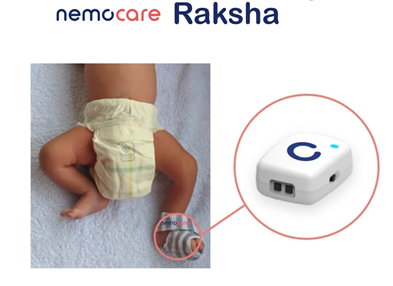
Figure 1 - NemoCare Raksha
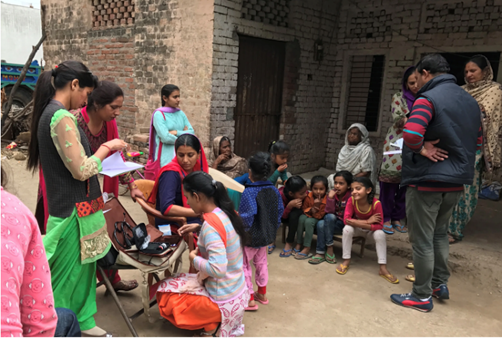
Figure 2 - CareNX is an India-origin digital health technology platform that leverages artificial intelligence (AI), mobile diagnostics, and cloud-based decision support systems to improve access to quality maternal and women’s healthcare.
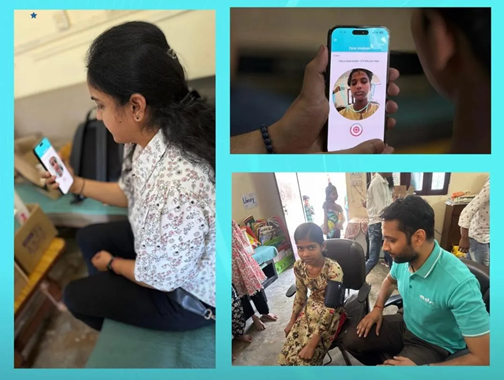
Figure 3 - MyDigiRecords (MDR) is a patient-centric digital health records and care management platform.
Conclusion
From diagnosing various diseases and improving the health outcomes of marginalised communities to enabling access to clean water, the innovative use of AI in healthcare reflects the principle of AI for Humanity: leveraging technology to address critical human challenges, promote inclusive socio-economic development, and advance the vision of a Viksit Bharat@2047.
References
Transforming Healthcare Delivery Through Artificial Intelligence
*******
PIB Research Unit
(Release ID: 2227410)
Visitor Counter : 10335