Ministry of Finance
Minister of State, Shri Harsh Malhotra hails Union Budget 2026-27 as a Roadmap for Viksit Bharat 2047
MoS emphasises infrastructure expansion, high-speed rail, and expressways as key growth drivers
A “Budget for 140 crore Indians”—one that balances growth with welfare, ambition with prudence and innovation with inclusivity: MoS
Delhi–Mumbai Expressway, scheduled for completion by 2027 to reduce travel time from 33 hours to just 12 hours enhancing logistics efficiency and economic integration
Posted On:
06 FEB 2026 6:31PM by PIB Delhi
Addressing media on the Union Budget 2026-27, the Minister of State for Ministry of Corporate Affairs and the Ministry of Road, Transport and Highways, Shri Harsh Malhotra cited the first budget presented from the newly inaugurated Kartavya Bhawan, to be a historic milestone in India’s journey towards becoming a fully developed nation by 2047.
The Minister stated that the budget is rooted firmly in the Prime Minister, Shri Narendra Modi’s visionary roadmap for Viksit Bharat and lays the foundation for a resilient, inclusive and future-ready economy. Shri Malhotra further lauded the Finance Minister Smt. Nirmala Sitharaman, to be the first finance Minister to present the ninth consecutive budget of the nation reflecting continuity, stability and bold reforms to ensure that the aspirations of 140 crore Indians translate into meaningful growth and prosperity.
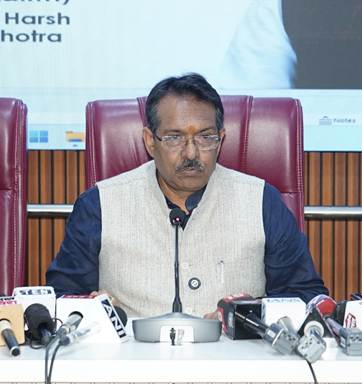
The Minister highlighted the three core duties (Kartavya) to be the guiding lights of the Budget. The duties entail enhancing productivity with competitiveness, accelerating skill development, and ensuring equitable participation across communities and sectors.
Shri Malhotra stated that the Union Budget 2026 is progressive, citizen-centric, and trust-based, emphasizing transparency and ease of living. He underscored the fact that over the past decade, the government has tripled the overall budget size while maintaining a lower fiscal deficit, demonstrating prudent financial management alongside ambitious development goals. Further, he cited a sixfold increase in capital expenditure and increased budget size by three times since 2014, fuelling infrastructure expansion, employment generation, and long-term economic productivity.
Shri Malhotra further stated that India’s export performance has reached an impressive USD 825 billion, highlighting the steadily advancing defense production under the Aatmanirbhar Bharat initiative. Significantly declining Gross NPAs in the banking sector, and continued rising Foreign Direct Investment, were cited by him, reflecting strong global confidence in India’s economic fundamentals. The streamlined approvals with establishment of single-window systems across 32 central departments and majority of states, improved ease of doing business, over 300 mobile manufacturing units further reinforce the success of the Make in India initiative and position India as a global manufacturing hub, the Minister said.
Shri Malhotra stated that education and skilling remain central pillars of this budget, with the government’s announcement of the development of Five University townships along industrial corridors and the creation of ecosystems that integrate academia with industry. Recognizing the power of women-led development, the government has presented its ninth consecutive gender-focused budget, with provisions for hostels in every district to enhance access to education and employment opportunities for women, Shri Malhotra said.
The Minister stated that focus would be on Artificial Intelligence to equip India’s youth with future-ready capabilities. Short-term modular courses will support professionals, small traders and underemployed individuals, keeping the workforce skilled and globally competitive. Highlighting a major boost that the Healthcare has received with a record allocation of approximately ₹1 lakh crore, the Minster said that the ₹10,000 crore earmarked for the Biopharma Shakti initiative shall strengthen innovation and self-reliance in medical technologies. Additionally, 1,00,000 allied health professionals to be trained and three AIIMS-Ayurveda institutions and five integrated medical hubs announced, reflects a holistic approach. Flagship schemes like Ayushman Bharat continue to expand, benefitting lakhs of families in Delhi, while PM Vaya Vandana Yojna underscores the government’s commitment to senior citizens.
The Minister highlighted Infrastructure as the backbone of this budget. With approx. ₹3 lakh crore allocated for road infrastructure and seven high-speed rail corridors planned, India is set to witness unprecedented connectivity. He cited the ambitious Delhi–Varanasi rail corridor and the redevelopment of 1,000 stations under the Amrit Bharat initiative to transform rail travel. Further, Defense with allocation of a robust ₹7.5 lakh crore, reinforces India’s commitment to national security while strengthening indigenous manufacturing capabilities.
Shri Malhotra stated that a landmark project, the Delhi–Mumbai Expressway, scheduled for completion by 2027 will reduce travel time from 33 hours to just 12 hours—dramatically enhancing logistics efficiency and economic integration.
Shri Malhotra highlighted the initiatives for Delhi and stated that the Government, previously, has announced an outlay of approximately ₹24,000 crore for a comprehensive Delhi Decongestion Plan aimed at easing traffic, reducing vehicular pollution, and improving urban mobility. Further, Key road stretches—including Ashram to Badarpur, Punjabi Bagh to Tikri Border, and the Mehrauli-Gurugram stretch— which have been taken over by NHAI will significantly enhance traffic flow. The three stretches -Mathura Road from Ashram to Badarpur Border, Old Delhi- Rohtak Road -- Punjabi Bagh to Tikri Border, and Mehrauli-Gurugram Road -- Mehrauli to Gurugram city, totalling a total 33 km serve are the critical links between Delhi and neighbouring areas, the Minister said.
Shri Malhotra stated that the Delhi Decongestion Plan primarily focusses on Extension of Delhi-Amritsar-Katra Expressway (NE-5) from KMPE till UER-II (NH-344M) in Delhi and Haryana would provide Direct Connectivity link to Delhi and Gurugram with Katra through UER-II & Dwarka Expressway, Extension of UER-II (NH-344M) near Alipur till Delhi-Dehradun Expressway (NH-709B) near Tronica City in Delhi and Uttar Pradesh. This will also act as bypass to NH-44/Delhi Outer/Inner Ring Road as the traffic destined to move to North/North-West/West/South-West Delhi & Gurugram may travel through UER-II & Dwarka Expressway to reach the destination, construction of a Road Tunnel starting from Dwarka Expressway (near Shiv Murti Mahipalpur) to Nelson Mandela Marg, Vasant Kunj in the State of Delhi which will facilitate easy flow of traffic from Dwarka Expressway to Nelson Mandela Marg.
Shri Malhotra stressed that Environmental sustainability for Delhi is another priority. He cited the government commitment towards eliminating the three major landfills at Bhalswa, Ghazipur, and Okhla. Legacy and current waste will be segregated for commercial use under the Prime Minister’s Waste to Wealth vision. Inert waste has already been utilized in road construction projects such as UER-II and the Dwarka Expressway, demonstrating innovative resource management. Further, a new water treatment plant in Chandrawal for which approx 380 crores have been allocated will ensure that the vision of “Nal Se Jal” reaches every household in Delhi. The budget allocates ₹2,700 crore for railway infrastructure in the capital, ₹15 crore natural calamities and approx. ₹1000 crore for pollution control and ₹2 crore to support victims of the Anti-Sikh riots—reflecting a compassionate and inclusive governance approach, the Minister highlighted.
Shri Malhotra said that the government’s focus on affordable education, affordable healthcare, and an affordable ease of living reinforces its commitment to improving the quality of life for every citizen.
The Minister said that this is truly a “Budget for 140 crore Indians”—one that balances growth with welfare, ambition with prudence and innovation with inclusivity. By strengthening aspirational sectors, boosting infrastructure and empowering citizens, the Union Budget 2026 accelerates India’s journey from Local to Global leadership.
Shri Malhotra concludingly remarked that under the dynamic leadership of Prime Minister, Shri Narendra Modi and the steady, reform-oriented guidance of Finance Minister, Smt Nirmala Sitharaman, India is moving ahead at an unprecedented pace. Further he said that this budget is not merely an annual financial statement—it is the architectural blueprint of a developed India. With sustained reforms, strategic investments, and unwavering commitment to national progress, the dream of Viksit Bharat 2047 is no longer distant—it is decisively within reach.
*****
NB/PK
(Release ID: 2224587)
Visitor Counter : 1669