PIB Backgrounder
Counting What Counts: Strengthening India’s National Accounts and Core Economic Statistics
Posted On:
28 JAN 2026 1:55PM by PIB Delhi
Key Takeaways
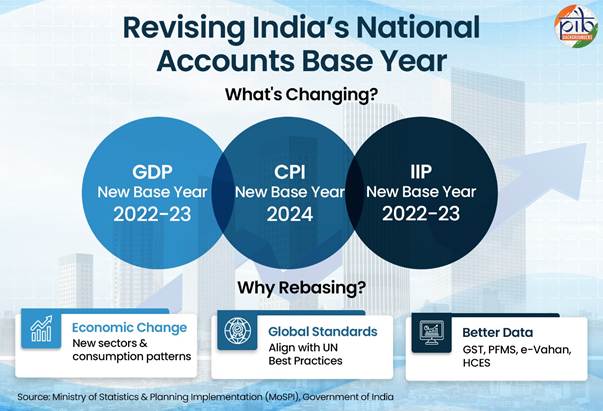
- Base year for GDP estimates being revised to 2022-23 to reflect new economic structures.
- CPI base year is revised to 2024, updating the consumption basket and weights for both rural and urban households.
- IIP is being revised to 2022-23, aligned with the new national accounts series.
- Informal sector measurement has improved with quarterly QBUSE bulletins.
- District-level estimation has become a core design feature across PLFS, ASUSE, and NSS surveys.
- Public access to official data has been expanded through GoIStats, e-Sankhyiki, and the revamped Microdata Portal, supporting transparency and data reuse.
|
Introduction
India’s statistical system is undergoing a comprehensive modernization to better capture the realities of a fast-changing economy. Over the decade since the last base year (2011-12), the country has seen significant structural shifts, the services sector has expanded rapidly, formalization has increased under the Goods and Services Tax (GST), and digital platforms have transformed business models. These changes created demand for more timely indicators, finer geographic detail, and improved coverage of the informal and services sectors. In response, the Government has initiated coordinated reforms as part of a broader modernization of the national statistical system aimed at strengthening data quality, credibility and policy relevance.
Major reforms under this include the upcoming revision of GDP and price indices base years, improvements in measuring the informal and services economy, enhancements to labour market statistics, cross-cutting innovations in survey methods and technology, and steps to boost transparency through stakeholder engagement.
Together, these reforms are poised to improve the timeliness, granularity and trustworthiness of India’s official statistics for evidence-based policymaking.
National Accounts Base Year Revision
Periodic base year updates ensure that GDP and other indices reflect the current economic structure and relative prices, which tend to evolve over time. The base year is revised periodically to better capture the structural changes happening in the economy by updating the methodology of compilation and incorporation of new data sources.
Moreover, rebasing allows adoption of international best practices in methodology as recommended by bodies like the UN Statistical Commission. Aligning with updated global standards ensures that India’s statistics remain comparable and methodologically sound in light of new guidance on measuring the digital economy, supply-use tables, etc.
Base Year Revision in Compilation of GDP Series
One of the major reforms has been the revision of the base year for Gross Domestic Product (GDP) estimates, from 2011-12 to 2022-23. In the decade since 2011-12, India’s economy has transformed drastically, with new industries emerging (e.g. renewable energy, digital services) and changes in consumption patterns and investment behaviour. Such structural changes necessitate rebasing so that metrics like GDP capture true contribution of growing sectors and changes in technology and productivity.
Over the years extensive digitization has also opened up new data sources and incorporating these data into national accounts will improve accuracy and detail. For instance, real-time administrative databases like e-Vahan (vehicle registrations), the Public Financial Management System (PFMS), and the GST system now provide granular economic data.
|
Rationale for Selecting 2022-23
The year 2022-23 was chosen as the new base because it is the most recent “normal” year after the disruptions of 2019-2021. The years 2019-20 and 2020-21 were significantly affected by the COVID-19 pandemic, which temporarily altered consumption patterns and industrial output.
|
GDP will continue to be compiled using the expenditure and production/ income approaches. While the overall framework remains unchanged, methodological refinements are being introduced in the compilation of economic aggregates under the production/ income approaches, in both nominal and real terms, as well as under the expenditure approach.
Revision of the Consumer Price Index (CPI) Base Year
The Consumer Price Index (CPI) provides a comprehensive and timely measure of inflation reflecting the consumption patterns of different population groups. The CPI series will also be revised with a new base year of 2024. This update will use data from the Household Consumption Expenditure Survey (HCES) 2023-24 to revise the item basket and expenditure weights so that they reflect current consumption patterns in both rural and urban India. The revision is intended to improve the accuracy and relevance of CPI estimates, strengthen methodological transparency, and support better-informed economic policymaking.
|
Process of Base Year Revision
The base revision of the Consumer Price Index (CPI) began in early 2023 under the guidance of an Expert Group comprising representatives from RBI, key ministries, academia, and senior government officials.
The revision has followed a structured, multi-stage process, using the HCES 2023-24 sample, including verification of samples, identification of markets and dwellings, and collection of base prices.
Multiple meetings of the Expert Group have been held to review progress and methodology. Extensive consultations were also conducted with international organisations, including IMF, World Bank, financial institutions, and government bodies, along with the release of discussion papers to invite stakeholder feedback.
|
Revision of Index of Industrial Production (IIP) Base Year
The Index of Industrial Production (IIP) is a key indicator that measures how industrial production is changing over time. It is a monthly indicator which reflect the monthly changes in the volume of production of a representative basket of industrial products, with reference to a specified base year. IIP is widely used for economic policy formulation and serves as an important input for estimating the Gross Value Added (GVA) of the manufacturing sector in GDP.
As industries evolve due to technology changes, new products, and structural shifts, the IIP base year needs periodic revision to reflect current industrial realities and landscape. The Government is currently in the process of revising the IIP base year to 2022-23 to incorporate the latest data and improve accuracy. This revision seeks to strengthen the IIP by updating sectoral coverage, revising item weights, improving factory representation, and adopting enhanced methodologies. The update is being aligned with the base year revision of the National Accounts to ensure consistency across major macroeconomic indicators.
|
Timeline for New Series
- The Ministry of Statistics and Program Implementation (MoSPI) has announced a clear schedule for releasing the rebased series.
- The new series of GDP (base year 2022-23) will be released on 27 February 2026.
- The new series of CPI (base year 2024) to be released on 12 February 2026.
- The new series of IIP (base year 2022-23) is slated for release on 28 May 2026.
|
These updates are expected to enhance confidence in official statistics and facilitate better-informed decisions in economic policy, monetary management, and business planning.
Improving Informal and Services Sector Measurement
The Government places special emphasis on strengthening the measurement of the informal economy and services sector output, given their substantial contribution to economic output and employment. To enhance the robustness and reliability of estimates, new survey frameworks, pilot studies, and experts consultations have been undertaken.
Strengthening Data on India’s Services Sector
|
Annual Survey of Unincorporated Sector Enterprises
It is conducted to measure the unincorporated non-agricultural sector, which is a major contributor to GDP, a significant source of employment, and a key driver of local entrepreneurship and supply chains.
|
The services sector is a major pillar of India’s economy, contributing 50% of GDP and generating millions of jobs. While the unincorporated segment is covered under the Annual Survey of Unincorporated Sector Enterprises (ASUSE), there is a lack of granular data on the economic and operational characteristics, employment, and other related aspects of the incorporated service sector.
This gap in data is primarily due to the absence of a regular national-level survey covering the various sub-sectors of the incorporated non-agricultural non-manufacturing sectors. To address this gap, the National Statistical Office (NSO) undertook a pilot study for the Annual Survey of Service Sector Enterprises (ASSSE). The objective of the pilot study was to assess key operational aspects, including enterprise response, clarity of survey instructions, effectiveness of the questionnaire, and the availability of key data from official records such as books of accounts, profit and loss statements, and labour registers.
Based on the experience and discussions, the ASSSE questionnaire has been developed under the overall guidance of the Technical Advisory Group (TAG) for Enterprise Surveys. The survey aims to capture key indicators such as gross value added (GVA), fixed capital, capital formation, number of persons employed and other important features pertaining to the units belonging to service sector.
Introduction of Quarterly Bulletins on Unincorporated Sector Enterprises (QBUSE)
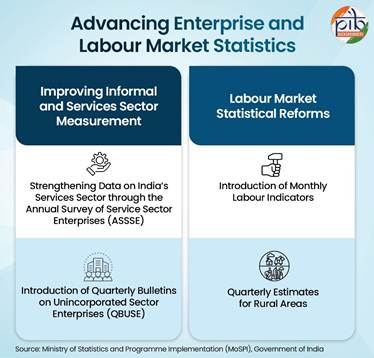
The Annual Survey of Unincorporated Sector Enterprises has been revamped by enhancing it to incorporate more frequent estimate releases. Starting 2025, Quarterly Bulletins on Unincorporated Sector Enterprises (QBUSE) have been introduced, providing interim results every quarter instead of waiting for an annual report. The quarterly data are intended to capture short-term movements in the sector.
- While ASUSE continues to publish detailed annual estimates covering a wider set of financial and non-financial indicators, QBUSE provides quarterly estimates on the scale, composition, and employment profile of unincorporated non-agricultural enterprises using the same framework.
- Its introduction reflects NSO’s effort to deliver timely and actionable data for policymakers, researchers, and stakeholders on one of India’s most dynamic economic segments.
Labour Market Statistics Reform (PLFS)
Considering the importance of availability of labour force data at more frequent time intervals, National Statistical Office (NSO) launched Periodic Labour Force Survey (PLFS) in April 2017.
The Periodic Labour Force Survey (PLFS) is the primary source of official data on labour force participation and employment and unemployment conditions of the population in the country. The survey provides estimates of the key employment and unemployment indicators (viz. Worker Population Ratio, Labour Force Participation Rate, Unemployment Rate). Major reforms were introduced to the PLFS in 2025, marking a shift towards higher-frequency, more granular labour statistics.
- Introduction of Monthly Labour Indicators: With effect from January 2025, the PLFS methodology has been revised to generate monthly estimates of key labour market indicators at the national level.
- Quarterly Estimates for Rural Areas: Until December 2024, PLFS Quarterly Bulletins presented labour market indicators only for urban areas. With the revision in the PLFS survey methodology, its coverage has been extended to rural areas as well. In addition, state-level estimates are also provided for selected States.
The changes have enhanced the capability to track employment and unemployment trends in near-real time and across both urban and rural areas, supporting evidence-based interventions for inclusive growth.
Cross-Cutting Data Reforms: Granularity and Digitalization
Beyond specific surveys or indices, MoSPI implemented several cross-cutting reforms in 2025 aimed at strengthening the overall statistical infrastructure. These initiatives address the need for more fine-grained data at local levels and leverage technology to improve survey efficiency, accuracy, and agility.
District as a Statistical Unit
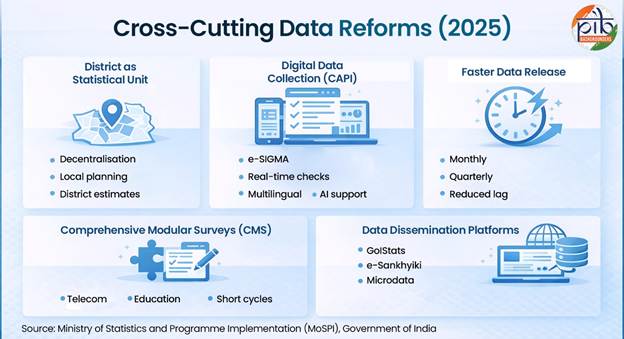
From January 2025, sampling design in National Sample Surveys (NSS) has been modified with a provision for generating district level estimates with district as a basic stratum with an aim to enable data-driven planning at more granular levels. This shift marks a major step towards supporting evidence-based planning and policy formulation at the district and sub-district levels.
|
The National Sample Survey (NSS) conducts large-scale socio-economic surveys to generate key indicators traditionally available at the national and State/ UT levels.
|
- District, adopted as the basic stratum within each State, enabling generation of quarterly estimates from ASUSE 2025, in addition to the annual results.
- District, made the primary geographical unit (basic stratum) in PLFS sample design within each State/ UT, separately for rural and urban sectors.
- States are actively participating in PLFS, ASUSE, Domestic Tourism Expenditure Survey (DTES) and Health survey and 27 States have expressed willingness to participate in flagship NSO surveys for 2026-27.
Digital Data Collection and Real-Time Validation
NSS surveys are now conducted using Computer Assisted Personal Interviewing (CAPI) through the e-SIGMA platform, which includes in-built validation checks, real-time data submission, multilingual interfaces, and AI-enabled chatbot support. These features have significantly improved data quality and field efficiency.
- Stronger survey design: Sampling designs have been strengthened to generate monthly, quarterly, and district-level estimates, increasing the usefulness of NSS data for both local and national planning.
· Faster data release: These initiatives have substantially reduced publication delays.
- Annual survey results are now released within 90-120 days
- Quarterly results are released within 45-60 days, and;
- Monthly results are released within 15-30 days of survey completion.
Comprehensive Modular Surveys (CMS)
To meet evolving data requirements and immediate policy needs, MoSPI has undertaken Comprehensive Modular Surveys (CMS) to collect focused information on specific themes within shorter time frames.
- CMS on Telecom was conducted during January-March 2025, to generate national-level estimates of telecom and ICT skills related indicators.
- CMS on Education was carried out during April-June 2025, to generate national and state level estimates of average expenditure on school education and private coaching during the academic year.
- The Forward-Looking Survey on Private Sector Capital Expenditure (CAPEX) was conducted between November 2024 and January 2025, to assess investment intentions of private sector enterprises. This was MoSPI’s first survey to engage the corporate sector through a self-administered, web-based platform, using digital tools such as chatbot support to collect structured information on planned capital expenditure.
Data Dissemination Platforms
Complementing improvements in data collection, data dissemination has also been modernized to make official statistics more accessible to the public.
- GoIStats Mobile App: Launched in June 2025, the GoIStats mobile application reflects the vision of building an integrated and accessible data ecosystem that enables stakeholders to access official statistics anytime, anywhere.
- The app presents major socio-economic indicators through dynamic visualisations, covering metrics such as GDP, inflation, and employment.
- Users can directly access NSO datasets, supported by advanced search and filtering tools, comprehensive metadata, and mobile-optimised tables for easy viewing.
- e-Sankhyiki Portal: Launched in June 2024, the e-Sankhyiki portal is a comprehensive data platform hosting over 136 million records, 772 indicators, and 18 statistical products across nine thematic areas.
- At present, datasets from three Ministries/ Departments, Department for Promotion of Industry and Internal Trade (DPIIT), Ministry of Labour and Employment, and Ministry of Health and Family Welfare, have been onboarded, along with data from the Reserve Bank of India.
- Designed in line with global best practices, e-Sankhyiki provides data dissemination through Application Programming Interfaces (APIs), enabling integration with other platforms such as the National Data and Analytics Platform (NDAP).
- Microdata Access and Other Tools: A revamped Microdata Portal was launched in 2025 serving as a central repository for unit-level data from national surveys and economic censuses and addresses the technological limitations of the earlier system.
- Developed in collaboration with the World Bank technology team, the upgraded portal uses a modern and scalable technology framework, ensuring compliance with current security standards while offering a more user-friendly, responsive design and improved data access mechanisms.
- 88 lakh hits have been recorded on microdata portal since January 2025.
- New websites of National Statistical Commission (NSC) and National Statistical Systems Training Academy (NSSTA), Data Innovation Lab Portal, Internship Portal, Metadata Portal have also been launched.
Conclusion
The recent statistical reforms mark a decisive shift in India’s statistical system towards greater relevance, responsiveness, and credibility. By updating base years for GDP, CPI, and IIP, strengthening measurement of the informal and services sectors, and transforming labour statistics, the Government has aligned official data more closely with the structure and dynamics of today’s economy.
At the same time, various measures have been undertaken to significantly improve data quality, timeliness, and public access. The coordinated rollout of new series and systems reflects a commitment not only to methodological rigor and international best practices, but also to transparency and stakeholder engagement.
These initiatives lay a stronger statistical foundation for evidence-based policymaking, effective decentralised planning, and informed public discourse, ensuring that India’s official statistics remain fit for purpose in a rapidly evolving economic landscape.
PIB Research
References:
Ministry of Statistics & Programme Implementation (MoSPI):
https://www.mospi.gov.in/uploads/announcements/announcements_1766247401195_8eb491fa-2542-46fe-b99c-39affe421dda_Booklet_on_proposed_changes_in_GDP,_CPI_and_IIP_20122025.pdf
https://new.mospi.gov.in/uploads/announcements/announcements_1763725600839_38257510-c97c-4d03-993e-ccbbf873bc83_Discussion_Paper_NAD.pdf
https://mospi.gov.in/sites/default/files/press_release/Press%20Note_%20ASSSE_30.04.2025.pdf
https://mospi.gov.in/sites/default/files/publication_reports/ASSSE_english.pdf
https://www.pib.gov.in/PressReleasePage.aspx?PRID=2119641
https://www.pib.gov.in/PressReleasePage.aspx?PRID=2208162
https://www.pib.gov.in/PressReleasePage.aspx?PRID=2132330®=3&lang=2
https://www.pib.gov.in/PressReleasePage.aspx?PRID=2160863®=3&lang=2
https://www.pib.gov.in/PressReleasePage.aspx?PRID=2125175
https://www.pib.gov.in/PressReleasePage.aspx?PRID=2140618
https://www.pib.gov.in/PressReleasePage.aspx?PRID=2205157
https://www.pib.gov.in/PressReleasePage.aspx?PRID=2163337®=3&lang=2
https://www.pib.gov.in/PressReleasePage.aspx?PRID=2128662®=3&lang=2
https://www.pib.gov.in/PressReleasePage.aspx?PRID=2194100
https://www.pib.gov.in/PressReleasePage.aspx?PRID=2188343®=3&lang=2
https://static.pib.gov.in/WriteReadData/specificdocs/documents/2025/sep/doc2025915637101.pdf
Click here to see pdf
****
PIB Research
(Release ID: 2219549)
Visitor Counter : 20675