Ministry of Science & Technology
Novel supercapacitors with dual-functional porous graphene can provide EV with faster acceleration
Posted On:
28 JAN 2026 11:46AM by PIB Delhi
A high-voltage supercapacitor based on a dual-functional porous graphene carbon nanocomposite (PGCN) electrode has been developed which could facilitate stabler supercapacitors for applications like solar panels and also provide electric vehicles with increased range and faster acceleration.
Conventional electrolytes used in commercial supercapacitors can operate between 2.5–3.0 V and begin to decompose or face safety issues (such as flammability) at higher voltages.
Researchers at the International Advanced Research Centre for Powder Metallurgy and New Materials (ARCI), an autonomous institute of the Department of Science and Technology (DST) used dual-functional PGCN electrodes to reach an unprecedented 3.4 V overcoming the 3.0 V limitation of conventional supercapacitors along with significantly improved energy storage.
This innovation addresses electrolyte instability, doubling energy density to provide electric vehicles with increased range and faster acceleration while simplifying module design through reduced cell stacking.
The enhanced performance originates from the engineered surface of the PGCN material, which is both water-repellent and highly compatible with organic electrolytes. This dual functionality suppresses water-induced degradation and enables rapid electrolyte penetration into the porous structure, improving ion transport and electrochemical efficiency. As a result, the supercapacitor delivers 33% higher energy storage, high power output, and excellent long-term stability, making it suitable for electric vehicles, grid-scale storage, and portable electronics.
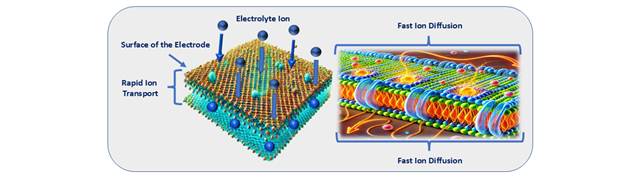
Fig 1: Schematic representation for facilitating rapid electrolyte infiltration and diffusion within the porous structure of PGCN.
The PGCN electrodes are produced through an eco-friendly hydrothermal carbonization process using 1,2-propanediol as the precursor. Conducted at 300°C for 25 hours in a sealed vessel, the process eliminates the use of harsh chemicals and external gases, minimizes environmental impact, achieves yields exceeding 20%, and is scalable from laboratory to industrial production.
The resulting material exhibits a micro- and mesoporous architecture that supports rapid ion transport and high energy storage, delivering a power density of up to 17,000 W/kg. Consistent performance is ensured through precise control of synthesis parameters. Compared with commercial carbon-based electrodes, the PGCN electrode simultaneously enhances operating voltage and power output.
PGCN-based supercapacitor stores 33% more energy than conventional devices and retains 96% of its performance after 15,000 charge–discharge cycles, demonstrating exceptional durability, as shown below.
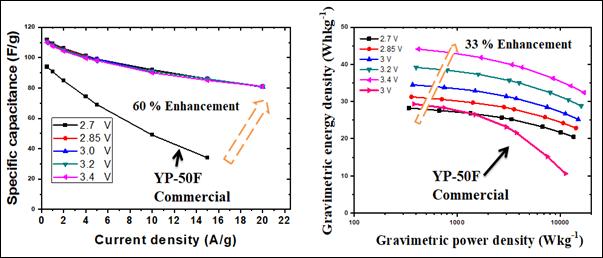
Fig 2: Comparison of specific capacitance and energy density of the PGCN with the commercial YP-50F electrode.
This work supports India’s clean energy goals and the Aatma Nirbhar Bharat initiative by strengthening indigenous capabilities in advanced energy-storage technologies. The higher operating voltage reduces the need for stacking multiple low-voltage cells, enabling more compact and efficient energy-storage modules.
The study published in the Chemical Engineering Journal (Elsevier) has been supported by the Department of Science and Technology (DST), Government of India, under the Technical Research Centre (TRC) initiative.
*****
NKR/FK/NM
(Release ID: 2219463)
Visitor Counter : 1615