|
Ministry of Education
Shri Dharmendra Pradhan addresses 56th anniversary of Thuglak magazine in Chennai today
प्रविष्टि तिथि:
14 JAN 2026 6:30PM by PIB Delhi
Union Minister for Education Shri Dharmendra Pradhan addressed the 56th anniversary of Thuglak magazine in Chennai today.
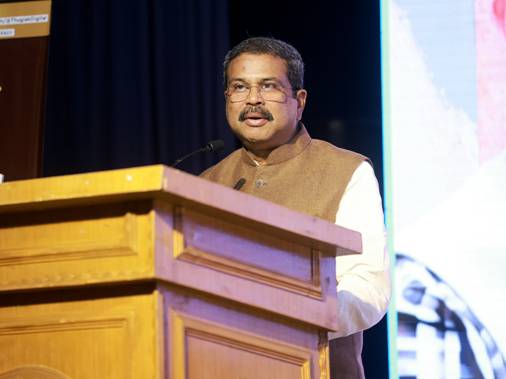
Addressing the gathering, Shri Pradhan described Thuglak as a forum that has contributed significantly to public discourse. He spoke on a range of contemporary themes including ethics, accountability, the National Education Policy 2020, Tamil Nadu’s cultural heritage, the link between education and national development, and the shared responsibility of building a Viksit Bharat.
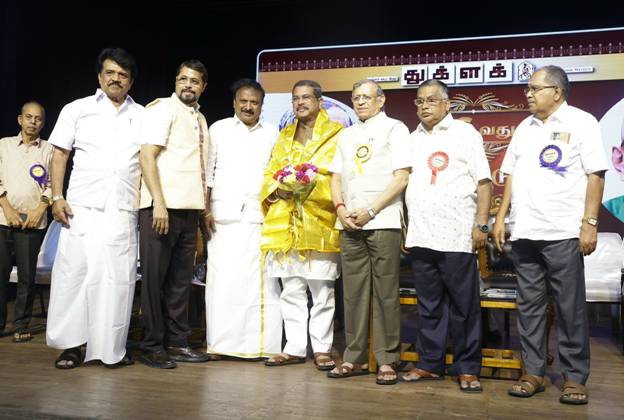
Excerpts from the speech are as follows:
எல்லோருக்கும் வணக்கம்!
Greetings to everyone.
என் இனிய தமிழ்ச் சொந்தங்களுக்கு, இனிப்பான பொங்கல் வாழ்த்துகள்!
Sweet Pongal greetings to my dear Tamil brothers and sisters.
உங்களை இந்த தைத் திருவிழாவில் சந்திப்பதில் மிக்க மகிழ்ச்சி.
I am very happy to meet you at this festival.
நீங்கள் எல்லோரும் தமிழ்க் கலாசாரத்தின் சொந்தங்கள்.
All of you are inheritors of Tamil culture.
இந்தியச் சொந்தத்துடன் நானும் சேர்வது எனக்கு மிக்க மகிழ்ச்சி!
I am very happy to join you as part of the Indian family.
- I am very happy to be here today, on a platform that has been shaped, over the years, by people who believed in speaking plainly and questioning honestly.
- Thughlak has never been a space for easy applause.
- It has been a space where speakers are expected to think, and to be questioned. That expectation itself, is a sign of a healthy working democracy.
- It is befitting that we gather around Pongal. Pongal is a festival, grounded in realism.
- It celebrates effort, continuity, and responsibility.
- Societies, like harvests, mature over time.
- Pongal also reminds us of something deeper about India.
- Across the country, the same astronomical transition is celebrated in different forms. Pongal in the South, Bihu in the East, and Makar Sankranti across many regions. The names differ. The customs vary. This is the beauty of Bharatiya Civilization.
- But the spirit is the same; thankfulness, renewal, and harmony with Mother Nature.
- This is the idea of Ek Bharat, Shreshtha Bharat.
- Unity in Bharat was never imposed; it has always been practised and experienced. Diversity did not weaken this nation; it has enriched it.
- Regional languages, traditions, and practices became different expressions of a common civilisational rhythm.
- Long before unity was written into policy, it lived through The Indian culture.
- And that anchoring is tested through questioning, which is exactly the reason why Thuglak matters today.
- In an age where opinions travel faster than thought, where volume is mistaken for conviction and outrage for engagement, Thuglak reminds us that democracy needs depth not noise.
- It insists that ideas carry responsibility. That disagreement must be anchored in reason. That public life cannot be sustained by performance alone.
- Over decades, this forum has reflected that seriousness.
- This stage has heard voices from across India’s public life, Prime Minister Shri Narendra Modi ji, senior leaders such as the late Shri Arun Jaitley ji and Shri L. K. Advani ji, and public thinkers like Shri Cho Ramaswamy ji and Shri S. Gurumurthy ji each contributing in their own way to India’s intellectual journey.
- Their presence here was never ceremonial. It reflected the importance of Thuglak as a forum where ideas are tested, not curated for comfort.
- Thuglak is not merely a magazine. It is a mosaic of thoughts, ideas and diverse perspectives.
- It is a public institution of democracy, one that belongs neither to power nor to opposition, but to readers of Thughlak.
- And that institutional character was envisioned by one man - Shri Srinivasa Raghavan Ramaswamy ji, our very own - Cho Ramaswamy ji.
- If Thuglak represented a method of disciplined dissent, Cho represented its conscience. He was a Rajaguru.
- Cho was fearless, but never careless.
- He questioned every government of his time; criticism was not accidental; it was deliberate.
- Cho believed that democracy weakens, not when leaders are criticised, but when they stop being questioned seriously.
- What distinguished him from others was not what he said, but how he said it.
- For Cho, satire was not about making fun it was a craft. It was a moral instrument.
- He used humour to expose contradiction, exaggeration to reveal truth, and irony to puncture self-importance.
- He criticised friends openly and acknowledged merit in opponents honestly.
- Cho understood journalism as public responsibility, not personal performance.
- Thuglak under him carried views and positions that forced readers to think rather than choose sides. That reflected deep democratic confidence.
- He believed those in government must be the most comfortable with questions because power without questioning weakens judgement.
- Even in his final days, Cho did not withdraw into detachment. He remained alert, engaged, and accountable to public life.
- After Cho, Thuglak has been carried forward by Shri S. Gurumurthy ji, who has preserved its core ethos independence, critique, and national interest while applying it to contemporary challenges of economy, culture, and sovereignty.
- Tamil Nadu understands this moment naturally, because this land has never viewed power as inheritance. It has viewed power as responsibility.
- Long before democracy became a constitutional language, Tamil literature spoke of virtue, justice, restraint, ethical duty. Authority was measured not by lineage, but by conduct.
- The Sengol symbolised this idea. It represented moral authority, the transfer of power bound by dharma.
- From Sirukadambur near Gingee, where the presence of the twenty-four Tirthankaras reflects an ancient Jain heritage, to the great Hindu temples that anchor Tamil sacred geography, this land has sustained spiritual plurality for centuries.
- Powerful kingdoms, most notably the Cholas, nurtured faith, philosophy, learning, and cultural harmony.
- They did not see spirituality and statecraft as opposites, but as complementary forces that strengthen society.
- Tamil Nadu has been a custodian of India’s deepest spiritual traditions, Vedantic sampradayas, Yoga, Ayurveda, Jyotish, Vastu, Sanskrit learning, classical music, and classical dance.
- The Cholas and the Pandyas carried this shared Indian civilisation from Kedarnath to Kanyakumari, and even beyond the seas, through temples, art, and cultural exchange.
- And yet, despite this vast inheritance, we hear voices today that speak casually of erasing Sanatana Dharma, reducing it to caricature, even comparing it to disease.
- It is strange that a civilisation which absorbed debate for centuries is now declared intolerant by those who cannot tolerate its very existence.
- At this point, one can only hope Mahaprabhu is kinder to them, than their understanding of civilisation has been.
- Tamil civilisation has never confined itself to geography. It has travelled through scholarship, devotion, trade, and ideas.
- The Thirukkural is the finest example. It is a Tamil text, but not a regional text.
- Its teachings on ethics, governance, restraint, and human conduct belong to humanity. That is why under the vision of Prime Minister Shri Narendra Modi Ji, the Thirukkural has been consciously taken beyond language and region.
- Initiatives such as Kashi Tamil Sangamam reaffirm this civilisational continuum connecting Kashi, Kanchi, Madurai, and Rameshwaram as living nodes of one cultural map.
- When the Prime Minister spoke in Tamil at the United Nations, it was not symbolism. It was a statement that India’s modern voice carries the depth of its ancient languages.
- Taking Tamil and Tamil heritage to the global stage is not only a cultural act.
- It is a statement of confidence, about who we are, and how we prepare the next generation.
- Because civilisations do not sustain themselves through memory alone.
- They do so through education, by widening access, deepening opportunity, and building capability.
- This is a confidence in Tamil language and not dilution.
NEP 2020
- NEP 2020 reflects the vision articulated by Dr. K. Kasturirangan to restore confidence, coherence, and trust in India’s civilisational intelligence while preparing learners for a modern world.
- It begins with a simple truth: children learn best in the language they understand first i.e. their mother tongue.
- That is why NEP places the mother tongue at the centre of early education, not as ideology, but as pedagogy.
- Let me re-emphasize this platform today. Language is not a barrier. Language is a force multiplier.
- The three-language formula of NEP 2020 does not weaken the mother tongue or our language.
- It protects it and then expands opportunity.
- Tamil is not threatened by learning another language.
- Tamil is strengthened when its children are multilingual, confident, and globally competitive.
- Global research speaks for itself: multilingual learners demonstrate stronger cognitive flexibility, better learning outcomes, and greater economic mobility. NEP reflects this evidence, not petty politics.
- That is the spirit of NEP, not compulsion; empowerment, not imposition. This approach is already delivering results.
- India’s higher education enrolment has crossed 4.46 crore students, a growth of over 30 per cent since 2014.
- Women’s enrolment has increased from 1.57 crore to 2.18 crore, a rise of 38.4 per cent.
- Most significantly, the female Gross Enrolment Ratio has risen from about 23 per cent in 2014–15 to nearly 29 per cent today, remaining higher than the male Gross Enrolment Ratio for six consecutive years.
- Among Scheduled Castes, enrolment has grown by over 50 per cent, and among Scheduled Tribes by 75 per cent.
- The transformation is even sharper for young women: SC female enrolment has increased by over 61 per cent, and ST female enrolment by over 96 per cent.
- This is not symbolism.
- This is structural inclusion. And inclusion, for us, also means accessibility.
- That is why, under the vision of Modi ji, Indian languages are finding place in classrooms, competitive examinations, digital platforms and on global stages.
- Over one hundred scholarly publications on India’s classical languages have been produced and supported covering works such as the Tirukkural, Tholkappiyam, Silappathikaram, and Manimekalai with translations across Indian and foreign languages, as well as into Indian Sign Language.
- The objective is clear: knowledge must travel across regions, generations, and abilities without linguistic or physical barriers.
- NEP 2020 did not ask us to choose between identity and aspiration. India can and must have both.
- Cho Ramaswamy would probably have concluded my speech to these thought provoking questions today
- Are we building institutions strong enough to survive our own success?
- Are we adding to clarity or to confusion?
- These are not academic questions. They are questions of responsibility.
- India’s future is demanding. But it is also deeply promising.
- That is why the call of Viksit Bharat is not a slogan.
- It is a shared responsibility. To build without bitterness. To reform without resentment. To lead without arrogance.
- This responsibility does not belong to Delhi alone.
- It begins with institutions, with thinkers, with teachers, with citizens of every nook and corner of this nation.
- It begins with the magnificent state of Tamil Nadu.
- It begins with us. It begins at Thuglak.
- This is Bharatiyata continuity with confidence, rootedness with openness.
- And if we remain true to that spirit, then the path ahead is clear.
In the end I would say:
May Tamil flourish
May Tamil Nadu prosper
May India progress
Jai Hind! Jai Tamil Nadu! Jai Bharat
*****
AK
(रिलीज़ आईडी: 2215302)
|