Ministry of Jal Shakti
DDWS holds 4th District Collectors’ Peyjal Samvad
Jal Arpan, Jal Bandhan and Jal Sankalp Reinforce the Spirit of Jan Bhagidari and Community Ownership
Districts share field innovations in 24×7 water supply, water quality, community engagement and O&M systems
Posted On:
11 DEC 2025 6:05PM by PIB Delhi
The Department of Drinking Water & Sanitation (DDWS), Ministry of Jal Shakti, organised the 4th edition of the District Collectors’ Peyjal Samvad today, bringing together senior officials, district administrations, and sector experts to deliberate on strengthening the implementation of Har Ghar Jal under the Jal Jeevan Mission (JJM).
The virtual event was chaired by Shri Ashok K. K. Meena, Secretary, DDWS, and witnessed participation from District Collector/Deputy Commissioner/ District Officials across the country.
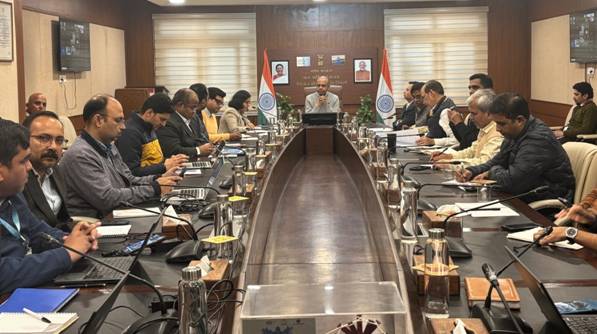
In his address, Secretary, DDWS, Shri Ashok K.K. Meena appreciated the district teams’ efforts and encouraged them to continue strengthening service delivery with diligence and community partnership.
He outlined three key priorities for all District Collectors and Mission Directors. First, he stressed the importance of conducting regular DWSM review meetings, with minutes uploaded promptly, to take stock of rural drinking water supply, sanitation progress, Har Ghar Jal declarations, Model Village development, operational sustainability and grievance redressal, etc. Second, referring to the launch of the Sujalam Bharat App by the Union Minister of Jal Shakti, he highlighted the creation of Sujalam Bharat – Sujal Gaon ID, under the Sujalam Bharat Database, noting that these unique identifiers are a major enabler for clear scheme mapping, transparent asset management and improved monitoring. Third, he urged districts to go through and adopt the handbook - ‘Community Managed Piped Water Systems in Rural India - Jan-Bhagidari se Har Ghar Jal’, particularly its guidance on readiness protocols, commissioning-to-handover processes and VWSC empowerment.
Smt. Ankita Chakraborty, Deputy Secretary – NJJM, welcomed the Secretary, the Additional Secretary and Mission Director – NJJM, Mission Directors from States and all participating District Collectors/ District Magistrates to the 4th District Collectors’ Peyjal Samvad. She highlighted that the focus of today’s deliberations would be on Jal Arpan Diwas, and emphasised the need to re-affirm the spirit of Jan Bhagidari and community ownership in rural water governance. Jal Arpan, she noted, is meant to connect communities with their water assets, and stands as a declaration from the Government of India that these assets belong to the village and are to be managed and cared for by them.
DDWS Presentation on Jal Arpan Diwas
A detailed presentation on Jal Arpan, focusing on community ownership and the formal handover of rural water supply schemes to Gram Panchayats and Village Water & Sanitation Committees (VWSCs), was made by Shri Y.K. Singh, Director-NJJM.
He explained that Jal Arpan Diwas is celebrated as a moment where responsibility for managing, operating, and maintaining the village water supply system formally shifts from government-led construction to community-led ownership.
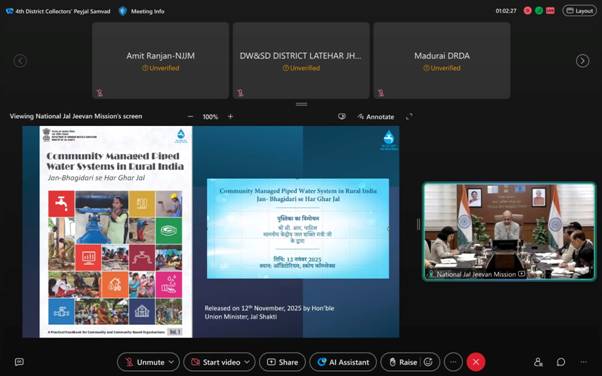
Jal Arpan brings together Gram Panchayats, VWSCs, SHGs, youth groups, and villagers, reinforcing the Jan Bhagidari framework. Celebrations typically include cultural rituals, Jal Chaupal, and recognition of community volunteers – strengthening social ownership.
The ceremony will be held at the village water assets, pump house, OHT, or distribution points, followed by symbolic handover, signing of records, and reading of community commitments. Suggested activities include cleanliness drives, water-quality awareness, system demonstrations, Gram Sabha discussions, and showcasing O&M preparedness.
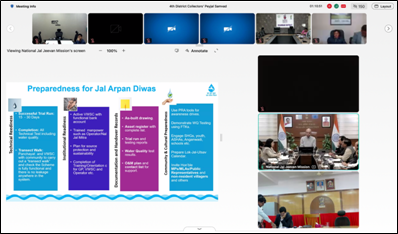
The presentation highlighted:
- The significance of Jal Arpan Diwas as a festival of community ownership where villages take charge of operating, maintaining and safeguarding their water supply systems.
- The transition from infrastructure creation to O&M and sustainability, emphasising Jan Bhagidari as the core philosophy.
- Preparedness requirements including trial runs, O&M plans, asset registers, as-built drawings, water-quality testing, and community mobilisation.
- Suggested celebration formats such as Jal Walk, Jal Bandhan, Jal Vandana, Jal Sankalp, and recognition of VWSC members and volunteers.
- Post-handover responsibilities of VWSCs and continued technical support from district teams.
District Presentations
The following districts presented their progress and field practices. Each presentation was delivered by the respective District Collector/Deputy Commissioner/ District Officials.
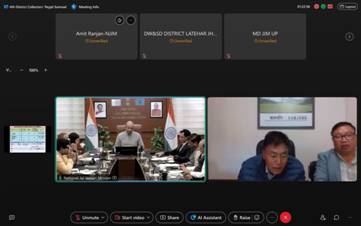
- Kamjong, Manipur: The District Official highlighted field-level activities under JJM including FTK water testing by VWSCs, regular IEC/awareness programmes, provision of Functional Household Tap Connections (FHTCs), declaration of Har Ghar Jal villages, and instances of public participation in restoration of damaged pipelines.
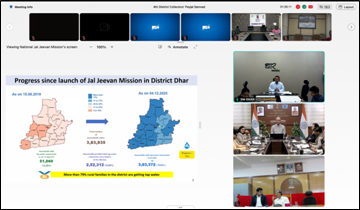
- Dhar, Madhya Pradesh: Shri Priyank Mishra, Collector & District Magistrate, Dhar presented the district’s progress and provided an overview of major multi-village schemes (Rajond, Mann Dam, Bagh, Rignod, Upper Narmada, Mahi and Lower Narmada), including sanctioned costs, contractors and physical progress. He highlighted the district’s use of the Panchayat Darpan Portal for bulk-water billing and collections, and showcased how Dhar has already mapped executed pipeline network and assets on GIS layer in PM Gati Shakti portal. The district has also introduced GIS-based grievance redressal, strengthening service responsiveness. He further noted a positive social impact – improved attendance of girls in schools, attributed to better access to reliable drinking water at the household and institution level.
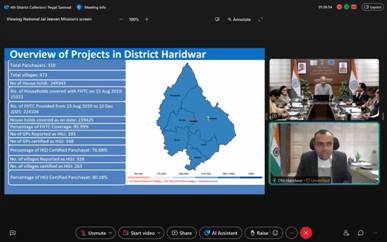
- Haridwar, Uttarakhand: Shri Mayur Dixit, District Magistrate, presented detailed project data: 375 total projects, 299 physically completed, population and household figures, and 239,425 FHTCs provided. He described monitoring and implementation arrangements (regular site inspection, third-party inspection), quality assurance processes (TUV SUD/QACA engagement), O&M arrangements (handled by Uttarakhand Jal Nigam/Jal Sansthan pending State O&M policy), SHG engagement for FTK testing, rainwater recharge interventions and case studies on user charge collection at village level. Importantly, he noted that these interventions have contributed to a reduction in water-borne diseases in several areas. The presentation also detailed grievance-redressal and monitoring mechanisms.
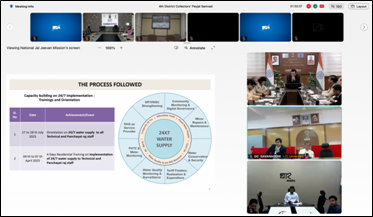
- Davanagere, Karnataka: Shri Gangadhara Swamy G.M., Deputy Commissioner, presented the district’s 24×7 rural water supply initiative, showcased as a model for the State. The district reported 57 villages (45 revenue villages and 12 habitations) already declared as 24×7 supply villages and outlined the Mission-100 approach, including feasibility assessments, baseline surveys and consumption analysis. He highlighted key outcomes from pilot villages, such as reduction in non-revenue water, lower water consumption, reduced pumping hours, and decreased electricity expenditure, alongside strengthened O&M practices.The presentation also noted broader community benefits, including a 50% reduction in dengue cases, significant reduction in leakages, and lower instances of water contamination, supported by continuous, pressurised supply and improved system maintenance. Village declaration ceremonies with public representatives and community participation have further reinforced ownership and sustainability.
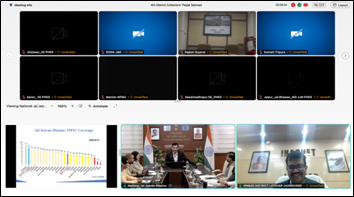
- Latehar, Jharkhand: Shri Utkarsh Gupta, Deputy Commissioner, presented the district’s focused efforts on handoverof completed schemes to Village Water & Sanitation Committees (VWSCs) through the Gram Sabha process, including preparation of asset registers, completion certificates, clarification of O&M responsibilities, tariff awareness and strengthening community ownership. He highlighted the crucial role of Jal Sahiyas, who support VWSCs in the O&Mof the schemes and are equipped with the technical skills required for water quality testing, with 4,800 tests conducted this year. He described the district’s long-standing water-scarcity challenges prior to JJM interventions and the steps taken to ensure strong community participation and sustainability. The district also reported a robust grievance-redressal mechanism, with 280 grievances received and only 8 pending resolution, reflecting improved service delivery responsiveness.
These presentations showcased both achievements and ongoing challenges, underlining the diversity of approaches adopted to accelerate progress under Har Ghar Jal.
In his concluding remarks, Shri K.K. Soan, AS&MD - NJJM, noted that the Department is documenting the efforts and presentations shared in every District Collectors’ Peyjal Samvad in the monthly newsletter, Jal Jeevan Samvad, so that districts can continually learn from each other’s experiences. He highlighted the importance of Jal Arpan, explaining that unlike Har Ghar Jal certification, it marks the formal handover of the entire system to the community after a minimum 15-day trial run so that villagers can see the system functioning, understand where to report shortcomings and ensure issues are addressed transparently. Strengthening village-level transparency, he said, is key to ensuring true Jan Bhagidari and enabling communities to participate meaningfully in managing their water systems. He expressed confidence that, with sustained district leadership and community ownership, the objectives of the Mission will be accomplished.
The session concluded with a vote of thanks by Shri Umesh Bhardwaj, Deputy Secretary-NJJM, who acknowledged the proactive participation of district officials and reiterated DDWS’s commitment to supporting states in ensuring safe drinking water for every rural household.
The 4th edition of District Collectors’ Peyjal Samvad was attended by the Additional Secretary & Mission Director, National Jal Jeevan Mission, Shri Kamal Kishore Soan, along with senior officials from the Department, District Collector/Deputy Commissioner/ District Officials, Mission Directors and State Mission Teams, from across the country.
***
ND
(Release ID: 2202476)
Visitor Counter : 851