PIB Backgrounder
Labour Reforms Elevating Audio-Visual Workers
Posted On:
10 DEC 2025 2:41PM by PIB Delhi
Key Takeaways
- Expanded definition of Cine Workers - Digital workers, Journalist (in electronic media), Dubbing artists & Stunt persons.
- Universal Minimum Wages, Floor Wage, and double-paid overtime strengthen income security.
- Producers liable for unpaid dues and workers to get long three-year claim window.
- Improved Health, Safety & Welfare with mandatory check-ups and regulated work hours
- Greater transparency through appointment letters, wage slips, and gender-equal treatment.
|
A Modern Labour Framework Powering India’s Audio-Visual Workforce
India’s Audio-Visual sector spanning film, television, digital media, dubbing, stunts, and more, has rapidly evolved into a high-growth engine of the Media and Entertainment (M&E) industry. The Government’s consolidation of 29 labour laws into 4 unified Labour Codes marks a transformational shift in strengthening this workforce ecosystem. The Codes aim to balance the protection of Audio-Visual workers’ rights and workplace safety through a framework that advances worker welfare and supports employment. This will enable the sector’s labour ecosystem to become more efficient, equitable, and future ready.
Enhancing Security for “People behind the Screen”
By mandating formal employment contracts, minimum wages, wage slip transparency, social security benefits, and ensuring liability for wage payment, the labour reforms aim to formalize the Audio-Visual workspace, strengthen worker welfare, and bring stability to Audio-Visual workers across India.
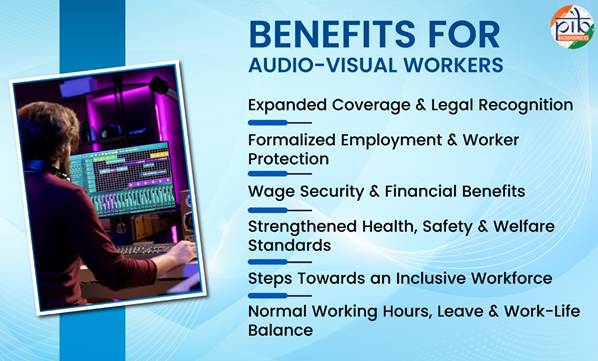
Expanded Coverage & Legal Recognition
- The definition of cine workers has been replaced by a broader definition of Audio-Visual workers, which now includes digital/Audio-Visual workers, journalists working in electronic media, dubbing artists, and stunt persons. All of these professionals will receive the benefits of social security, health, safety, formal recognition and access to legal protections that ensure safer and fairer working conditions.
- Limitation period: The period of limitation for filing of claims by an employee before the claim authority has been enhanced to three years, as against the existing time varying from six months to two years.
Employment Terms, Contracts & Worker Protection
- Formalization through appointment letters: Every employee will get appointment letters in the prescribed format specifying the details of the employee, designation, category, details of the wages, information around social security etc.
- Issuance of Wage Slips: Employers shall issue wage slips electronically or in physical form to the employee on or before payment of wages, ensuring complete transparency and accountability of the employer.
- The Occupational Safety, Health and Working Conditions Code, 2020 (OSH & WC Code, 2020)- The new provisions bring several advantages to Audio-Visual workers and casts responsibility on the producer of the audio- visual programme to provide additional facilities as:
|
Legal Protection
|
The requirement for a written agreement ensures that workers have documented evidence of their employment terms, providing legal recourse in case of disputes.
|
|
Clarity of Terms
|
Detailed agreements help in setting clear expectations regarding job roles, compensation, and working conditions, reducing misunderstandings.
|
|
Wages and other benefits
|
Wages and other benefits (including Provident Fund, if covered under the Employees Provident Fund and Miscellaneous Provisions Act, 1952) will be specified in the agreement, ensuring nature of assignment, wage and other benefits, health and working conditions, safety, hours of work and welfare facilities.
|
|
Safety and Health Assurance
|
Including safety and health provisions in the agreement ensure that workers' well-being is prioritized during production activities.
|
|
Dispute Resolution
|
The inclusion of dispute resolution mechanism in the agreement provides a structured approach to address any conflicts that may arise during employment.
|
Wage Security & Financial Benefits
- Universalization of minimum wages: Under the new provisions, no employer shall pay any employee less than the minimum wage notified by the Government. Previously, minimum wages applied only to scheduled employments, but the coverage has now been expanded to include all employees. The Government shall review or revise the minimum rates of wages at intervals not exceeding five years, strengthening wage adequacy over time. Further, the Government shall fix minimum rates of wages for time work and piece work across different wage periods, whether hourly, daily, or monthly while taking into account both the skill level of the employee and the arduousness of the work.
- Floor Wage: The floor wage will be fixed by the Government after taking into account the minimum living standards of an employee, including essentials such as food, clothing, and other basic needs. The Government will revise the floor wage at regular intervals, and this uniformity is expected to reduce the migration of labour from one state to another, as workers will receive broadly similar wage levels across regions.
- Time Limit for Payment of Wages: The provisions also strengthen wage protection by mandating a strict time limit for payment of wages. The employer shall pay or cause to be paid wages to all the employees, under the following timelines.
|
SI.
|
Type of Employment
|
Time Limit for Payment of Wages
|
|
1.
|
Daily wage
|
End of shift
|
|
2.
|
Weekly
|
Before weekly holiday
|
|
3.
|
Fortnightly
|
Within 2 days of end of fortnight
|
|
4.
|
Monthly irrespective of strength
|
Within 7 days of next month
|
|
5.
|
On termination or resignation
|
Within 2 working days
|
- Overtime Wages: Employers must pay employee at least twice the normal wage rate for any work beyond normal working hours. Any overtime will only be with the consent of the worker and worker representatives/ unions.
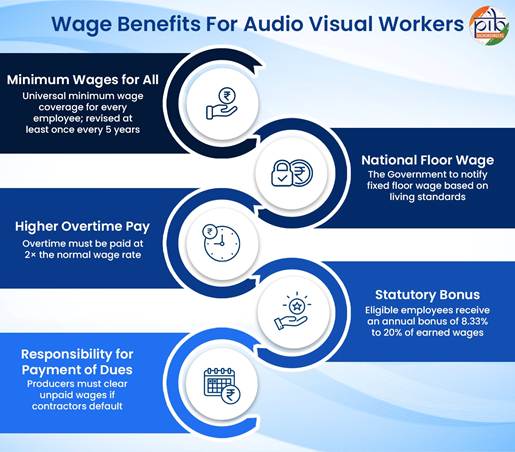
- Bonus: Bonus shall be paid to every employee drawing wages not exceeding the amount fixed by the appropriate government and who has worked for at least 30 days in an accounting year. The annual bonus will be payable at a minimum rate of eight and one-third percent and up to a maximum of 20 percent of the wages earned by the employee.
- Responsibility for Payment of Dues: In cases where the contractor employing Audio-Visual workers fails to clear wage payments, the producer shall be liable to make the payment, irrespective of any wage ceiling, which at present is ₹8,000 under the Cine-Workers and Cinema Theatre Workers (Regulation of Employment) Act, 1981. The new framework extends protection to a much larger pool of workers, ensuring their dues are safeguarded without limitation.
Health, Safety & Welfare Standards
- Free annual health check-ups: Employees who have crossed the age of 40 are entitled to free annual health check-ups, promoting overall well-being.
- Universal coverage of all establishments for health & safety of workers: The OSH & WC Code now ensures the health and safety of workers, extending coverage universally to every sector.
Towards an Inclusive Workforce
- Prohibition of Gender Discrimination: Employers shall not discriminate on ground of gender in matters relating to recruitment, wages, or conditions of employment in respect of the same work or work of a similar nature done by employees.
Working Hours, Leave & Work-Life Balance
- Annual Leave with wages: Workers employed in an establishment for 180 days or more in a calendar year are now entitled to annual paid leave, with the threshold for eligibility reduced from 240 days to 180 days, ensuring that all eligible employees receive leave with wages.
- Fixing Hours of Work for a Normal Working Day: No employee shall be required to work more than 8 hours a day or 48 hours a week. Any work beyond this will have to be only with the consent of the worker and the worker will have to be paid overtime. Normal working hours are limited to protect employees from being overworked without adequate compensation and to promote a healthy work-life balance.
Advancing a Safer, Fairer, and More Resilient Audio-Visual Workforce
The new Labour Codes usher in a transformational shift for India’s Audio-Visual sector by establishing a unified, transparent, and future ready labour framework. They guarantee stronger wage protection, written contracts, time-bound payments, social security coverage, gender equal treatment, and enforceable dispute resolution rights. By aligning growth with dignity and protection, the new framework positions the Audio-Visual sector to contribute more robustly to India’s creative economy.
Click here to see in PDF
PIB Research
(Release ID: 2201405)
Visitor Counter : 1100