Ministry of Science & Technology
IIA Celebrates 10 Years of Operation of the UltraViolet Imaging Telescope on board AstroSat
Posted On:
04 DEC 2025 3:37PM by PIB Delhi
In a landmark moment, the Indian Institute of Astrophysics celebrated 10 years of operation of the highly successful UltraViolet Imaging Telescope (UVIT) on board AstroSat.
UIVT is the primary payload on board AstroSat, India’s first dedicated space observatory, launched on September, 28, 2015 by ISRO. AstroSat carries five payloads capable of observing simultaneously from the ultraviolet to soft X-rays and hard X-rays.
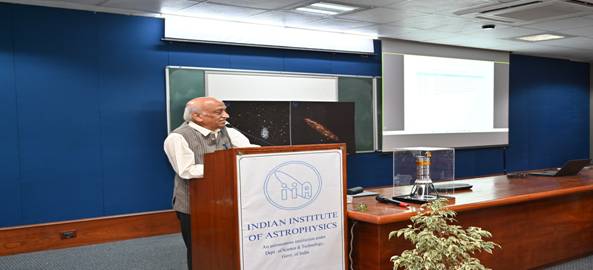
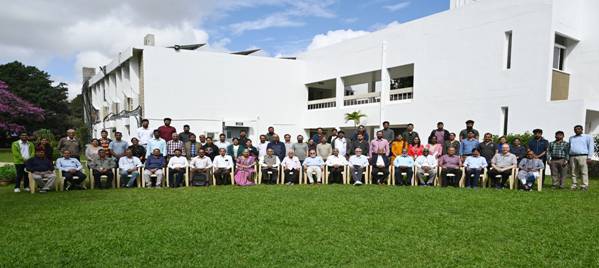
UIVT was designed, assembled, tested, and delivered by the Indian Institute of Astrophysics (IIA), an autonomous institute of the Department of Science and Technology (DST), from its campus in Hosakote. To commemorate this achievement and to plan for future space UV telescopes, IIA organised a one-day academic workshop on 4 December 2025, to mark 10 years since the opening of the doors of UVIT on 30 November 2015.
“Since UV rays are absorbed by our atmosphere, it can only be observed using space telescopes. The UVIT is India’s first UV space telescope, and is the only operational telescope capable of observing in the far-UV apart from the Hubble Space Telescope”, Explained Annapurni Subramaniam, Director of IIA and Calibration Scientist of UVIT.
UVIT has led to a number of important discoveries, and is being used by astronomers in India and abroad to this day. It is unique in the world in combining a large field of view and a superior spatial resolution of the sky.
Recalling the contribution of Prof. K. Kasturirangan, former Chairman ISRO Shri A.S. Kiran Kumar, former Chairman, ISRO said “Our ability to understand the Universe improves whenever we discover new ways of observing and measuring the cosmos, and I complement IIA in bring us all together today to tell the story of how AstroSat and UVIT was designed, fabricated, and successfully flown in space”.
“The UVIT is a twin telescope system. One of them observes the Universe in the near-ultraviolet (NUV; 200-300 nanometres) and visual bands (vis: 320–550 nanometres), and the other observes in the far-ultraviolet (FUV; 130-180 nanometres)”, explains C.S. Stalin, the in-charge of UVIT Payloads Operation Centre.
Its combination of a large field of view and high spatial resolution better than 1.5 arcseconds (better than GALEX/NASA) makes it a unique instrument for astronomy related discoveries.
UVIT’s design and fabrication involved several institutions, and the entire project was led by the IIA, with a national consortium including support from IUCAA in Pune, TIFR in Mumbai, many centres of ISRO playing crucial roles, including ISAC/URSC, LEOS, IISU, and SAC and the Canadian Space Agency.
“We had to set up a special laboratory with ‘Clean Rooms’ for handling sensitive components to prevent any contamination that will degrade them. This MGK Menon Laboratory was installed at our CREST campus in Hosakote, which has since been used for other space missions as well”, Subramaniam pointed out. An international collaboration was set up with Canada to utilise their experience with UV astronomy as well, she added. Following the launch, the UVIT Payload Operation Centre (POC) was set up at IIA, which is responsible for the production of science-ready data for astronomers, regular monitoring of UVIT, technical evaluation of proposals, and upgrading software on the telescope.
The workshop also highlighted some of the key discoveries and science highlights from the UVIT observations, which include discovery of hot compact companion stars of Be stars and Blue Straggler Stars in clusters, feedback effects in active galactic nuclei traced by star formation, novae in the Andromeda galaxy, discovery of extended UV disks in dwarf galaxies and planetary nebulae, detection of emission from distant galaxies at redshift of 1.42, correlations between UV and X-ray emission from active galactic nuclei, and characteristics of young star formation in galaxies.
It was also highlighted that UVIT has observed a total of 1451 targets in the sky and in the last 10 years of operation, it has led to about 300 research articles and 19 Ph.D. thesis. Many more students both in India and outside the country are using data from UVIT for their thesis work as well.
The improved version of the final science ready images is being uploaded by the UVIT POC to the PRADAN archive of ISRO’s ISSDC for archiving and dissemination, for the use of all astronomers in the years to come for their research.
Finally, the assembled astronomers also discussed how, by building on more than two decades of experience in UVIT, a larger next generation space facility, viz., INSIST (Indian Spectroscopic and Imaging Space Telescope), can be made possible.
*****
NKR/AK
(Release ID: 2198713)
Visitor Counter : 1179