Ministry of Health and Family Welfare
Union Health Secretary Smt. Punya Salila Srivastava highlights Prime Minister Shri Narendra Modi’s emphasis on greater investment and public-private partnerships in the health sector
Addresses National Level Orientation Workshop on National Health Mission and Pradhan Mantri Ayushman Bharat Health Infrastructure Mission in Bengaluru
PM-ABHIM has approved 19,983 infrastructure units across the country, including 2,151 Block Public Health Units, 744 Integrated Public Health Laboratories and 631 Critical Care Blocks
Emphasises strengthening public health infrastructure, disease surveillance and emergency preparedness through coordinated Centre-State efforts
Calls upon States and UTs to accelerate implementation of PM-ABHIM and ensure timely operationalisation of approved infrastructure
प्रविष्टि तिथि:
26 NOV 2026 4:28PM by PIB Delhi
Union Health Secretary Smt. Punya Salila Srivastava addressed the National Level Orientation Workshop on the National Health Mission (NHM) and the Pradhan Mantri Ayushman Bharat Health Infrastructure Mission (PM-ABHIM) in Bengaluru, Karnataka. The two-day workshop, which commenced on 25 November 2026, brought together representatives from States and Union Territories and senior officials of the Ministry of Health and Family Welfare to review the progress of the two national missions, deliberate on implementation priorities and strengthen coordination for improved public health outcomes.
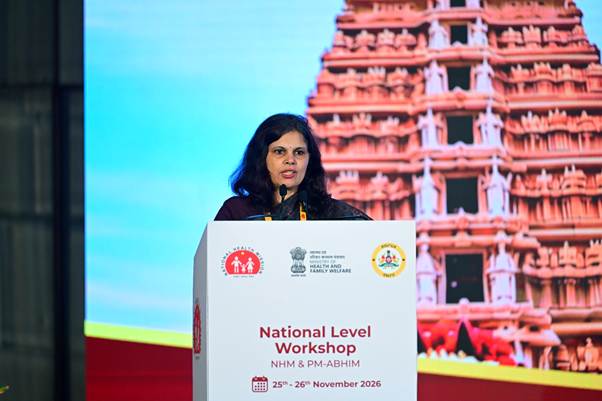
Addressing the workshop on the first day, Smt. Srivastava emphasised the need for a mission-mode approach to accelerate progress towards the Sustainable Development Goals (SDGs), supported by robust situational awareness and effective inter-departmental coordination. She highlighted the importance of leveraging digital health initiatives, particularly by strengthening linkages with the Ayushman Bharat Digital Mission (ABDM) and Aarogya Setu, to facilitate integrated, coordinated and efficient healthcare delivery.
Addressing the participants on the second day, Smt. Srivastava highlighted the importance of strengthening the country's public health infrastructure, drawing upon the experiences and lessons of the COVID-19 pandemic. Recalling the need for rapid augmentation of healthcare facilities, research capabilities, genomic sequencing and vaccine development during the pandemic, she underlined that PM-ABHIM was conceived to enhance the country's preparedness to effectively respond to future pandemics and disease outbreaks.
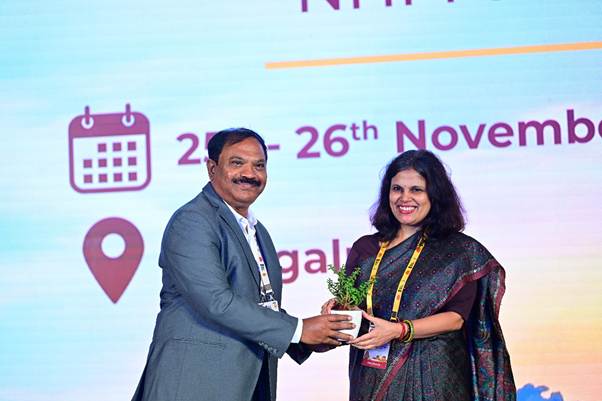
She observed that while NHM contributes towards achieving key health-related Sustainable Development Goals through improved healthcare delivery, PM-ABHIM complements these efforts by strengthening the infrastructure, institutional capacities and systems required for public health resilience, emergency preparedness and pandemic response.
Smt. Srivastava highlighted that the Government, under the leadership of Hon’ble Prime Minister Shri Narendra Modi, has accorded emphasis to greater capital investment in the health sector and the promotion of public-private partnerships to strengthen healthcare infrastructure and service delivery.

Launched on 25 October 2021 with a financial outlay of ₹64,180 crore, PM-ABHIM aims to strengthen public health infrastructure, enhance disease surveillance and outbreak response capabilities, promote pandemic-related research and improve emergency preparedness and biosecurity. The Mission has approved 19,983 infrastructure units across the country, marking significant progress in the expansion of healthcare facilities, diagnostic capabilities and critical care infrastructure.
Under the Mission, grassroots healthcare infrastructure is being strengthened through the establishment of 11,001 Ayushman Arogya Mandir–Sub Health Centres at previously building-less locations and 5,456 Urban Ayushman Arogya Mandirs. The Free Drugs and Diagnostics Initiative further supports the availability of essential medicines and diagnostic services at these facilities, contributing to improved access to primary healthcare.
The diagnostic and disease surveillance network has also been strengthened through 2,151 Block Public Health Units and 744 district-level Integrated Public Health Laboratories. In addition, 631 Critical Care Blocks and 48 Virus Research and Diagnostic Laboratories have been supported under the Mission, enhancing capacities for timely diagnosis, disease management, critical care and research.
Highlighting the central sector interventions under PM-ABHIM, Smt. Srivastava referred to the establishment of branches of the National Centre for Disease Control (NCDC) in different parts of the country to strengthen disease surveillance, outbreak investigation and response. Other important interventions include the development of quarantine facilities at major airports, strengthening of points of entry at airports and ports, and the establishment of metropolitan surveillance units in 20 cities.
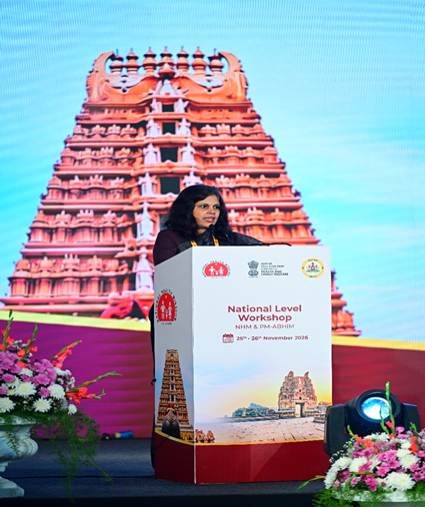
She also highlighted the Bharat Health Initiative for Sahyog Hita & Maitri (BHISHM) Cubes, which enable the rapid deployment of mini-hospital facilities during emergencies and are available through HLL for institutions requiring them. She further noted the support provided to the Department of Health Research for genomic sequencing research, which is important for strengthening the country's capacity to investigate and respond to emerging public health threats.
Emphasising the importance of robust disease surveillance systems, Smt. Srivastava highlighted the role of the Integrated Disease Surveillance Programme (IDSP) and the Integrated Health Information Platform (IHIP) in enabling timely identification and response to public health events. Information received through these platforms facilitates the Ministry's coordination and provision of support through the National Joint Outbreak Response Team.
IHIP is operational across all States and Union Territories, covering 50 health conditions and 12 national health programmes through more than 2.5 lakh public and private health facilities.
Smt. Srivastava underscored the importance of prioritisation, regular monitoring and close coordination between the Union Government and States and Union Territories to ensure the timely achievement of PM-ABHIM targets. She encouraged States and UTs to identify their infrastructure and capital investment requirements and share proposals that could be considered by the Union Government for further strengthening healthcare facilities across the country.
Calling for collective efforts towards effective implementation of the Mission, she urged States and UTs to work in close coordination with the Ministry to ensure that approved infrastructure is translated into functional facilities with the necessary equipment, human resources and operational arrangements. She emphasised that sustained Centre-State collaboration would be essential to strengthen the country's capacity to effectively respond to emerging public health challenges and future health emergencies.
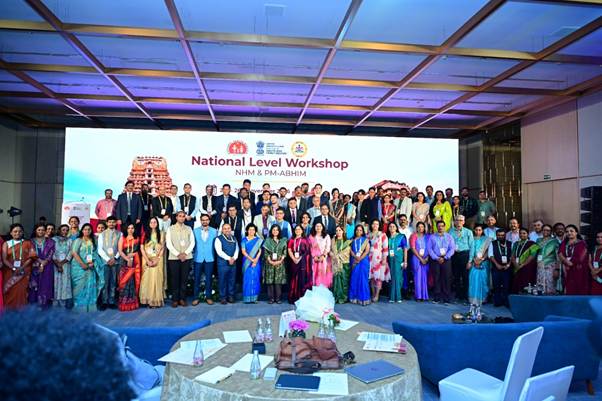
The workshop featured technical sessions on the physical and financial progress of PM-ABHIM, along with presentations by States and Union Territories on implementation status, achievements and priorities. The discussions highlighted the importance of coordinated Centre-State efforts, regular monitoring and convergence of investments to ensure the timely operationalisation of infrastructure, improve healthcare service delivery and build a resilient public health system.
The workshop was attended by Shri Ritvik Ranjanam Pandey, Principal Secretary, Department of Health and Family Welfare, Government of Karnataka; Smt. Aradhana Patnaik, Additional Secretary and Mission Director, National Health Mission, Union Ministry of Health and Family Welfare; Shri S. Akram Pasha, Mission Director, National Health Mission, Karnataka; senior officers and officials of the Ministry and representatives from States and Union Territories.
***
SR
HFW/ Union Health Secretary addresses PM ABHIM national workshop/26 November 2026/2
(रिलीज़ आईडी: 2341965)
आगंतुक पटल : 71
इस विज्ञप्ति को इन भाषाओं में पढ़ें:
Urdu