Ministry of Social Justice & Empowerment
A Rulebook Alone Cannot Guarantee Dignity; Every Hand in Aviation Must Ensure It: Manmeet Kaur Nanda
प्रविष्टि तिथि:
04 NOV 2026 4:44PM by PIB Delhi
“Merely framing rules, enforcing them or having a handbook will make no difference unless the last person dealing with a passenger with a disability understands and implements what is written in it.” Emphasizing the need to translate accessibility commitments into ground-level action, Ms. Manmeet Kaur Nanda, Additional Secretary, Department of Empowerment of Persons with Disabilities (DEPwD), called for making continuous sensitization and training an integral part of India's aviation ecosystem to ensure safe, dignified and independent air travel for persons with disabilities.
Highlighting the human cost of inaccessible air travel, Ms. Nanda recounted the experience of a para-athlete who had to travel to Egypt and compete in an international sporting event using a broken wheelchair after her original wheelchair was damaged by an airline. Despite this ordeal, the athlete went on to win a medal. Describing such experiences as barriers that the entire aviation ecosystem must collectively eliminate, she stressed that airlines, airport operators, ground-handling personnel, security agencies, customs and immigration officials must undergo regular induction and refresher training. She underlined that the Handbook's coverage of all 21 specified disabilities, including invisible disabilities, would help build greater sensitivity and preparedness among frontline personnel. Calling for measurable accountability, she advocated accessibility performance indicators, time-bound grievance redressal mechanisms and dedicated dashboards to monitor the performance of airlines and airports. Reiterating the principle of “Nothing About Us Without Us”, she emphasized the active involvement of persons with disabilities as trainers and partners in shaping and evaluating aviation services.
Ms. Stuti Kacker, Former Secretary, DEPwD and Advisor, Asia-Pacific Network for Accessibility (APNA), highlighted the significant contribution of civil society organizations, disability rights activists, the media and the judiciary in advancing India's accessibility movement. Acknowledging the pioneering efforts of disability rights advocates, she observed that accessibility is a fundamental right, not an act of charity. She emphasized that Universal Design, inclusive mobility and sustained collaboration are essential to ensuring dignity, independence and equal opportunities.
Shri S. Govindraj, Commissioner, Office of the Chief Commissioner for Persons with Disabilities, highlighted the need to extend priority assistance to passengers with disabilities during deplaning, just as it is provided during boarding, to ensure a seamless and dignified travel experience. Mr. Prateek Sen of IndiGo emphasized that accessible physical infrastructure must be complemented by adequately trained personnel equipped with the right knowledge, attitude and soft skills. Reiterating the airline's philosophy of “Customers are the Core”, he stressed the importance of comprehensive sensitization and training across aviation services.
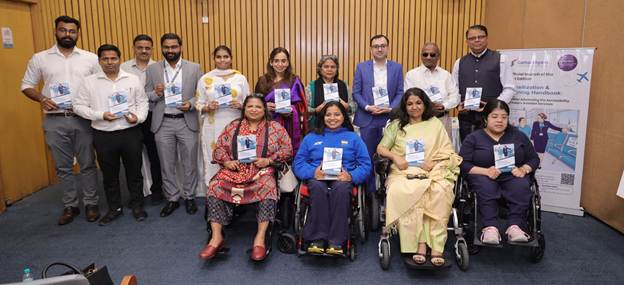
The “Sensitization and Training Handbook: Further Advancing the Accessibility of India’s Aviation Services” was officially launched on 4 November 2026 at the India International Centre, New Delhi. Developed by Samarthyam Centre for Universal Accessibility under the aegis of the Department of Empowerment of Persons with Disabilities (DEPwD), Ministry of Social Justice and Empowerment, in collaboration with the Ministry of Civil Aviation, the Handbook aims to strengthen institutional capacity and promote an inclusive, safe and passenger-friendly aviation ecosystem.
The Handbook provides practical guidance to airline personnel, airport operators, security staff and other aviation stakeholders on the rights and requirements of persons with 21 specified disabilities under the Rights of Persons with Disabilities (RPwD) Act, 2016, relevant Civil Aviation Requirements (CAR), end-to-end passenger assistance, safety protocols, accessible communication and identification of barriers throughout the air travel journey. The launch was accompanied by a panel discussion featuring representatives from the Ministry of Civil Aviation, Airports Authority of India, Indian Aviation Academy, Office of the Chief Commissioner for Persons with Disabilities and IndiGo Airlines. Passengers with diverse disabilities also shared their lived experiences and perspectives, bringing the voice of the traveler to the center of the deliberations.
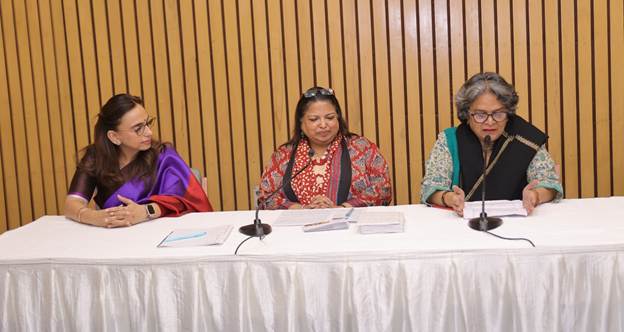
In her welcome address, Dr. Anjlee Agarwal, Founder Trustee, Samarthyam Centre for Universal Accessibility and Co-founder, Asia-Pacific Network for Accessibility (APNA), highlighted the pivotal role played by civil society in shaping India's journey towards accessibility and disability inclusion. She emphasized the importance of translating advocacy into institutional action through awareness, capacity building and sustained stakeholder engagement. Samarthyam, a not-for-profit organization working for the past 36 years to advance universal accessibility, inclusive mobility and disability rights through advocacy, capacity building and accessibility audits, has been instrumental in advancing this agenda. The initiative marks an important step towards transforming accessibility commitments into everyday practices, ensuring that every passenger can travel with confidence, dignity, independence and equal opportunity.
*****
KV/HK
(रिलीज़ आईडी: 2332557)
आगंतुक पटल : 119