PIB Backgrounder
Carbon Capture, Utilisation and Storage
Powering India's Industries Towards a Net Zero Future
प्रविष्टि तिथि:
27 OCT 2026 11:42AM by PIB Delhi
|
CCUS is an important pathway for reducing emissions from hard-to-abate sectors. Carbon dioxide is increasingly being viewed not only as an emission, but also as a potential resource. CCUS can support India’s Net Zero by 2070 vision while strengthening industrial competitiveness and resource efficiency. The Government is fostering an ecosystem that brings together research institutions, public sector enterprises and private industry. This growing ecosystem spans operational projects, projects under execution and proposed initiatives across multiple States. These efforts are laying the foundation for indigenous CCUS capabilities, carbon utilisation and secure carbon storage.
|
CCUS Bridging the Gap in India’s Net Zero Journey

India’s journey towards Net Zero by 2070 requires reducing emissions across its energy and industrial sectors. Renewable energy can significantly lower emissions, but some industrial processes cannot be easily electrified. These include processes requiring very high temperatures or carbon-based inputs. Carbon Capture, Utilisation and Storage (CCUS) offers an additional pathway for addressing such emissions. It involves capturing carbon dioxide from industrial sources before its release into the atmosphere. The captured carbon dioxide can then be utilised in productive applications or stored securely underground. CCUS can therefore complement renewable energy and support India’s transition towards a lower-carbon industrial economy.
NITI Aayog identifies CCUS as critical for decarbonising hard-to-abate sectors, including steel, cement, oil and gas, petrochemicals, chemicals and fertilisers. These industries contribute significantly to industrial emissions and face technological challenges in achieving deep decarbonisation. CCUS can help reduce emissions from existing facilities while supporting the continued production of essential goods. It can also create opportunities for developing new technologies, infrastructure and industrial capabilities in India. By connecting carbon capture with utilisation and secure storage, the approach can address emissions across multiple stages. CCUS can thus support India’s climate goals while maintaining industrial growth and economic development.
|
Creative Minds, Catalyzing Science, Empowering Technologies
ESTIC-2026, the second edition of India’s Emerging Science, Technology and Innovation Conclave, is being held from 27–29 October 2026 at Bharat Mandapam, New Delhi. Organised by the Council of Scientific & Industrial Research (CSIR), the conclave follows the theme “Creative Minds, Catalyzing Science, Empowering Technologies.” It advances emerging frontiers in science and technology, including energy technologies such as Carbon Capture, Utilisation and Storage (CCUS). Spanning 12 thematic areas, ESTIC-2026 features plenary sessions, technical discussions and exhibitions. The conclave also promotes strategic collaborations in support of India’s vision of Viksit Bharat 2047. Read More on the agenda: ESTIC 2026
|
CCUS Process: From Capture to Storage
Step 1: Capturing Carbon Dioxide at the Source
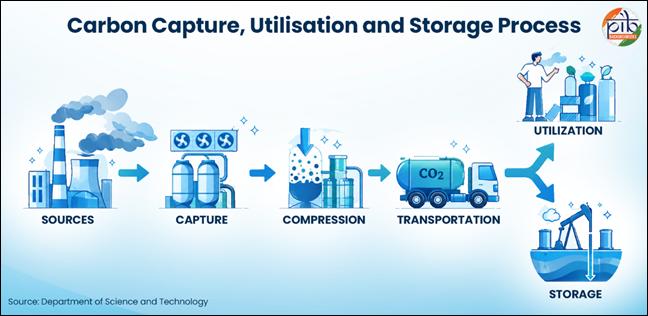
The process begins at an industrial facility where carbon dioxide is generated. Capture systems separate carbon dioxide from gases released during fuel combustion or industrial processes. The captured gas is then purified, dried and compressed into a dense form before being transported or used.
Step 2: From Capture to Transport
Pipelines are commonly used to transport carbon dioxide over suitable distances. Ships and other transport modes can provide flexibility, especially for longer distances. The choice of transport depends on distance, volume, infrastructure and the destination. The carbon dioxide can then be sent to a utilisation facility or geological storage site.
|
Did You Know? A geological storage site is a secure, deep underground location used to permanently isolate captured CO₂. CO₂ geological storage (geo-storage) is a promising approach that can help to reduce greenhouse gas emissions.
|
Step 3: Carbon Utilisation and Permanent Storage
At the final stage, captured carbon dioxide can either be put to productive use or stored permanently underground. It can be used in applications such as enhanced oil recovery, food and beverages, urea, green methanol and concrete. For permanent storage, carbon dioxide is injected deep underground into suitable geological formations, including depleted oil and gas reservoirs, deep saline aquifers and basaltic rock formations.
|
CCUS Hubs and Clusters Model
India’s CCUS framework envisages regional clusters and hubs connecting multiple carbon dioxide emitters with shared infrastructure. This model can integrate common systems for carbon dioxide transport, utilisation and storage. Captured carbon dioxide can be collected from multiple sources and transported through shared networks. It can then be directed to suitable utilisation facilities or geological storage sites. NITI Aayog identifies the hub and cluster approach as suitable for India. The model can create economies of scale, reduce infrastructure risks and connect carbon dioxide supply with potential demand.
The Department of Science and Technology’s CCUS Roadmap 2025 identifies potential industrial and geological regions for such clusters. These include the Gujarat coast, with its concentration of refineries and chemical industries. The Odisha–Jharkhand belt offers potential for clusters linked to steel and cement industries. Northeast India also presents opportunities linked to its oil and gas resources. Such regional clusters can bring together emitters, transport infrastructure, utilisation facilities and storage sites. This approach can help develop a coordinated CCUS ecosystem suited to India’s industrial landscape.
|
CCUS Advancing the Low Carbon Transition
India’s low-carbon transition requires solutions that combine economic growth with deeper emission reductions. CCUS addresses this gap by managing carbon dioxide at source and creating opportunities for its reuse. It complements renewable energy expansion while opening applications across industry, hydrogen and carbon dioxide removal.
Decarbonising Hard-to-Abate Sectors
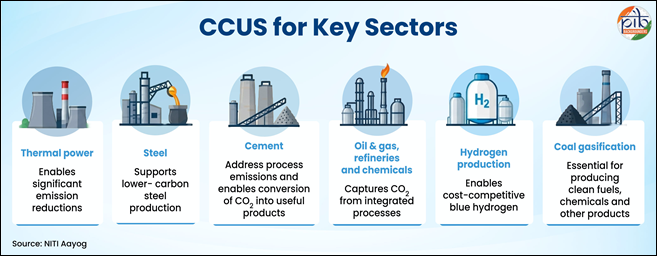
Hard-to-Abate Sectors (steel, cement, refineries/chemicals, fertilisers) release carbon dioxide directly from their processes. Their emissions can be difficult to eliminate through electrification (transition to renewables) alone. Emissions from these sectors and thermal power generation are expected to reach nearly 2,300 million tonnes per annum by 2030, making their capture and abatement critical. CCUS technology provides a means of addressing these emissions from ongoing industrial activity.
|
Did you know? Green Hydrogen is produced by electrolysis of water using power generated from renewable energy sources. Blue Hydrogen is produced using natural gas or coal as the primary feedstock.
|
Enabling the Low Carbon Hydrogen Economy
CCUS is expected to play an important part in India’s shift towards hydrogen, through blue hydrogen production using coal gasification coupled with carbon capture. This complements India’s efforts to develop a low-carbon hydrogen economy.
|
Coal Gasification
Coal gasification converts solid coal into a clean, useful gas using controlled heat. This gas is called synthesis gas, or syngas. The process of producing it from coal is known as coal gasification. There are two established methods of doing this. Surface coal gasification processes mined coal in above-ground gasifiers. Underground coal gasification converts coal directly within the underground layer. In both cases, coal is not fully burned, unlike conventional combustion. Instead, it reacts with a limited supply of oxygen and steam. This takes place at high temperatures, typically between 800°C and 1,600°C. These conditions break coal's complex structure into simpler gases.
|
Sustaining Existing Energy Infrastructure
As of August 2026, fossil-fuel-based sources accounted for 45.12% of India’s total installed power capacity. This existing infrastructure will remain part of India’s energy system during the transition to cleaner sources. Managing emissions from these assets will therefore be important for achieving long-term climate goals. CCUS can support this effort by enabling existing thermal power plants and industries to reduce emissions. Steel and cement facilities can also potentially be retrofitted with CCUS systems. This can reduce carbon dioxide emissions while allowing essential energy and industrial infrastructure to continue operating.
Carbon Utilisation
Within the Carbon Capture, Utilisation and Storage framework, captured carbon dioxide can serve as a feedstock for materials, fuels, chemicals and biological products, creating pathways for both carbon management and industrial value. Applications include building materials such as concrete and aggregates, synthetic fuels and chemicals, polymers, enhanced oil recovery with underground carbon storage, and algae-based products including biofuels. These applications extend carbon dioxide utilisation across materials, fuels, chemicals and biological products, while improving resource efficiency.
|
India’s First of Its Kind CCU Test Beds In Coal- Gasification Facilities
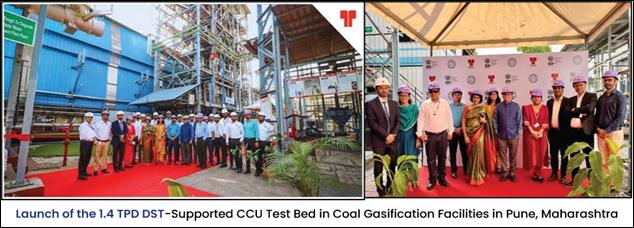
Through one of its recent interventions, DST has supported two Technology Deployment Testbeds to be implemented by Industry-Research Consortia between IIT Delhi – Thermax Ltd and CSIR-IICT Hyderabad – BHEL for setting up pilot-scale demonstrations in Coal Gasification plants for Methanol and DME production, with Industry partnering as a solution provider along with a Technology designer (knowledge partner) to deploy CCU in hard-to-abate sectors like Thermal power.
|
|
India’s First Integrated CCUS Field Laboratory
India’s first integrated CCUS Field Laboratory at IIT Bombay, inaugurated in May 2026, brings carbon capture, utilisation and permanent geological storage together on a single pilot-scale platform. The indigenous facility can capture up to 3 tonnes of carbon dioxide per day from industrial emissions and ambient air, using non-potable water, and convert it into advantageous carbonate and bicarbonate products. Scientific drilling in Deccan Traps basalt formations will further assess India’s potential for safe and permanent carbon dioxide storage. The facility provides a national testbed for developing and scaling indigenous carbon management technologies, supporting Net Zero 2070 and solutions for hard-to-abate industries. Read more: India’s First Integrated CCUS Field Laboratory Facility
|
Strengthening India’s CCUS Ecosystem
The Government of India has undertaken initiatives spanning research, policy and industry to advance CCUS development and reduce emissions. These measures strengthen the foundation for India’s Net Zero target by 2070.
- Union Budget 2026–27, CCUS Scheme: Announced in February 2026, the Ministry of Finance allocated ₹20,000 crore over five years to promote carbon capture, utilisation and storage in five major industrial sectors: Power, Steel, Cement, Refineries, and Chemicals.
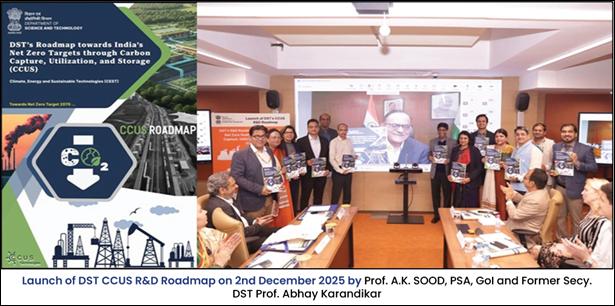
- Department of Science & Technology- CCUS R&D Roadmap: Launched in December 2025, the roadmap provides strategic direction for CCUS research, funding, technology development and deployment, with a focus on commercial readiness, breakthrough technologies and enabling frameworks. Click to Access the DST Roadmap
- NITI Aayog CCUS Policy Framework & Mechanism: Released in November 2022, the report examines CCUS as an emissions reduction strategy for deep decarbonisation of hard-to-abate sectors and outlines sector-specific policy interventions for its deployment. Click to Access NITI Aayog Report
- National CCUS Centres: Established in 2022 at IIT Bombay and JNCASR, Bengaluru, with backing from the Department of Science and Technology, these centres focus on CCUS research, technology development, pilot-scale demonstration and industry collaboration.
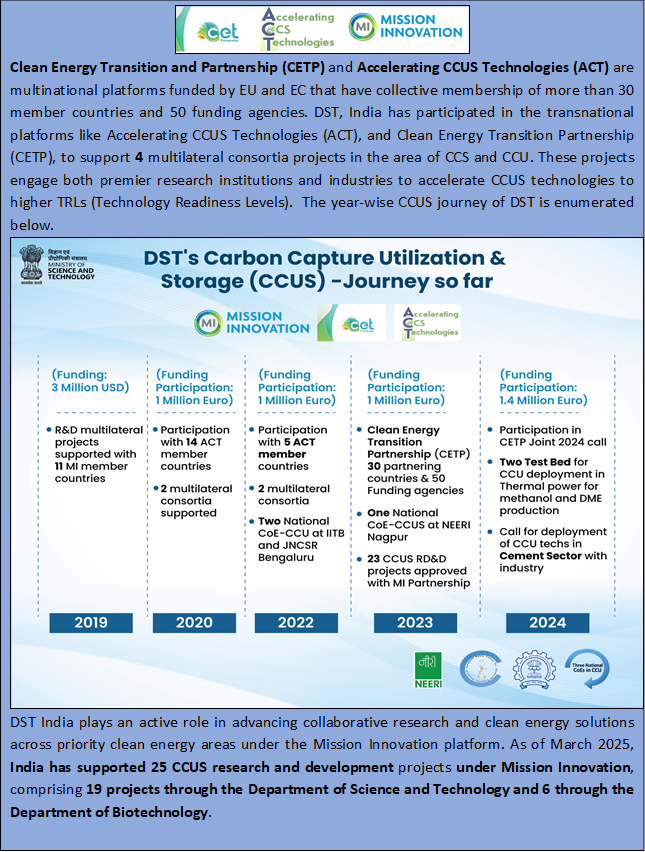
- India’s CCUS Initiative: Spearheaded jointly by the Department of Science and Technology (DST) and the Department of Biotechnology (DBT), India launched a major research drive on CCUS. As part of Mission Innovation, a global clean energy platform, India collaborated with 13 partner countries to advance technologies to capture, separate, safely store, and convert CO2 into useful value-added materials.
|
India Launches First Ever CCU Testbed Cluster for Cement Industry
India launched its first cluster of five Carbon Capture and Utilisation testbeds for the cement industry on 11th May 2025. Led by the Department of Science and Technology (DST), the initiative brings leading cement companies and premier research institutions together under a Public-Private Partnership model to develop and deploy industrial CCU technologies. The testbeds cover applications ranging from carbon dioxide capture and mineralisation to its conversion into concrete products, advancing practical CCU applications for cement sector decarbonisation.
|

India Accelerates on CCU
India has several CCU projects as of April 2026, spanning operational, under execution and proposed stages. The portfolio includes public sector enterprises, private industry, and academic institutions across multiple States. Projects focus on reducing carbon emissions, productive carbon utilisation and circular economy applications.
- Operational: Three projects are operational, with one each in Madhya Pradesh, Tamil Nadu and Maharashtra.
- Under Construction/Execution: Six projects are under construction or execution. Andhra Pradesh leads with three projects, followed by Telangana with two and Maharashtra with one.
- Proposed: Sixteen projects are at the proposed stage. Assam and Odisha lead with four projects each, followed by Gujarat and Rajasthan with two each. Andhra Pradesh, Madhya Pradesh, Haryana and Tamil Nadu have one project each.
The project pipeline reflects growing momentum towards carbon management solutions across India. It also provides a foundation for scaling indigenous Carbon Capture and Utilisation applications.
Shaping India’s Low Carbon Industrial Future
India’s Panchamrit commitments provide the broader context for advancing low-carbon growth and achieving Net Zero by 2070. CCUS adds an important technology dimension by addressing emissions from sectors where complete elimination remains challenging. Government initiatives spanning research, technology development, financing and demonstration are creating the foundations for wider deployment. As these efforts progress, CCUS could improve resource efficiency, support industrial decarbonisation, and help develop a more circular carbon economy.
References:
Department of Science and Technology
Ministry of Chemicals and Fertilisers
NITI Aayog
Ministry of Power
National Power Portal
Press Information Bureau
Mission Innovation
Carbon Capture, Utilisation and Storage
*****
PIB Research
(रिलीज़ आईडी: 2328830)
आगंतुक पटल : 565