Ministry of Science & Technology
A decade of cosmic flickering reveals new clues about a rare giant binary black hole system
प्रविष्टि तिथि:
06 OCT 2026 2:32PM by PIB Delhi
A new study has tracked the changing brightness and colour of the peculiar blazar OJ 287 over 10 years, offering fresh insights into its powerful emission and the behaviour of its central black holes.
OJ 287 is a rare astronomical object about 4 billion light years away from the Earth, that contains two supermassive black holes (SMBHs) at its center, orbiting around each other in a twelve-year orbit, forming a binary system. SMBHs can have masses ranging from millions to billions of times that of the Sun. OJ 287 is a blazar, which produces powerful jets of plasma moving at nearly the speed of light and directed toward Earth. Blazars show strong and rapidly changing emission across the electromagnetic spectrum, from radio waves to gamma-rays.
The blazar produces a distinctive double-peaked pattern in its brightness over time. This periodic behaviour was discovered in 1988 by a team of scientists from Finland using nearly 100 years of optical observations dating back to 1880. Since then, astronomers around the world have continued to observe OJ 287 to track its 12-year cycle of double-peaked outbursts to get a complete picture of its orbital motion.
A multi-institutional study was carried out, co-ordinated by scientists from Aryabhatta Research Institute of Observational Sciences (ARIES), Nainital, an autonomous institution of the Department of Science and Technology (DST), to capture the most recent 12-year optical outbursts (periodic/quasi-periodic pattern) between 2015 and 2019.
The study led by Dr. Alok C. Gupta, from ARIES included a team of 106 scientists from 18 countries (India, Bulgaria, Chile, China, Crimea, Finland, Georgia, Germany, Italy, Japan, Russia, Serbia, Spain, Sweden, Tajikistan, the UK, the USA, and the West Indies) and 48 research institutions/universities carried out optical observation of the source using two dozen telescopes from 2015 to 2025.
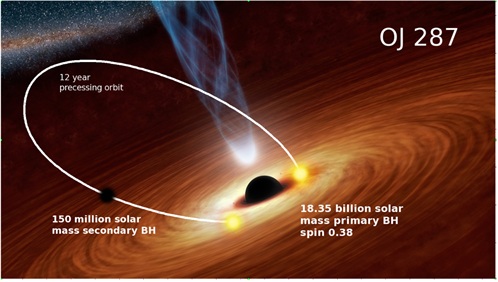
Fig 1: Artistic illustration of the binary black hole system in OJ 287.
Credit: Lankeshwar Dey et al. 2018
The decade-long optical observation campaign supported by observations in other parts of the electromagnetic (EM) spectrum using several ground- and space-based telescopes produced the most extensive and densely sampled optical time-series data of OJ 287 obtained over the past 150 years.
The data tracked how OJ 287 has evolved across different timescales—from long-term changes spanning years to rapid variations occurring over much shorter periods. The study provides one of the most extensive multiband optical datasets available for this peculiar object.
The data obtained from the in the complete EM spectrum helped solve key problems like determine the positions of the two black holes relative to each other at different times, understand how the brightness, spectrum, and polarization of OJ 287 changed over different timescales, search for evidence of emission from the smaller black hole and explore the nature and behaviour of this unique binary black hole system.
The study was preceded by a series of research papers led by Dr. A. C. Gupta and Prof. Mauri J. Valtonen, University of Turku, Finland Since 2017.
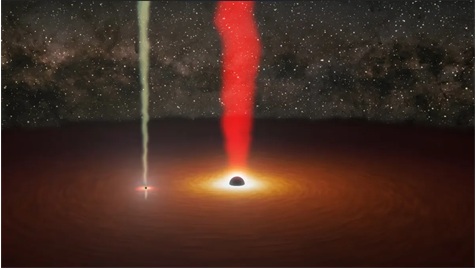
Fig 2: The black holes in orbit around each other. Both black holes have jets associated with them: the larger one with reddish colour, and the smaller one with a yellowish colour jet.
Credit: NASA/JPL–Caltech/R. Hurt (IPAC) and M. Mugrauer (AIU Jena)
Using eight optical spectra in the low-flux states of OJ 287 taken from 2017 October 21 to 2017 November 22, from Steward Observatory, USA the central black hole mass was estimated to be at least 3.89 billion solar mass from the [O III] emission line width. The study also provided insights into the emission mechanism of this binary black hole system and its importance for multimessenger astronomy (coordinated simultaneous observations in different electromagnetic bands from various ground and space based observing facilities) which entails combining different signals—like light, gravitational waves, neutrinos, and cosmic rays from the same source. These findings have expanded the scientific scope of OJ 287 beyond the study of its binary nature.
By bringing together a decade of optical observations, the study strengthens the picture of OJ 287 as a dynamic and extreme cosmic laboratory. Continued monitoring of the object across different wavelengths could help scientists better understand the physics of relativistic jets, the behaviour of supermassive binary black holes, and the possible connections between electromagnetic and gravitational-wave signals.
Publication link: DOI: 10.3847/1538-4365/ae8795
*****
NKR/FT/AA
(रिलीज़ आईडी: 2319522)
आगंतुक पटल : 371