PIB Backgrounder
India’s Rising Supercomputing Ecosystem
प्रविष्टि तिथि:
04 OCT 2026 5:58PM by PIB Delhi
India’s supercomputing journey has evolved from PARAM 8000 in the early 1990s to a national ecosystem under the National Supercomputing Mission (NSM), launched in 2015. With 40 supercomputers delivering 68 PF as of September 2026, NSM is expanding access to high-performance computing (HPC). The Mission has also developed indigenous servers, software, cooling and networking technologies, while supporting applications in Computational Biology, Weather Prediction and Climate Modelling, Disaster Management, Big Data Analytics, and Astrophysics.
Building India’s Supercomputing Capabilities
From predicting crop yields and tracking disease outbreaks to accelerating drug discovery and predicting affected areas due to river floods, high-performance computing supports societal applications that affect everyday life. They help process massive datasets and support complex simulations across climate, space, healthcare and engineering. They also enable faster analysis and help researchers address increasingly complex scientific challenges. It is becoming essential for accelerating scientific discovery and technological innovation.
Supercomputers are high-performance computing systems designed to process complex calculations at exceptional speeds. They combine large numbers of processors to perform multiple calculations simultaneously. This enables researchers to analyse massive datasets and run sophisticated simulations efficiently. Supercomputers therefore provide critical infrastructure for advanced scientific research and strategic applications.
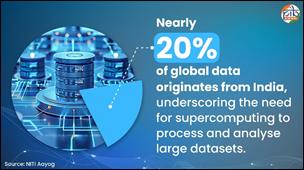
India’s growing digital ecosystem is driving demand for advanced computing infrastructure. India generates nearly 20% of the world’s data. Applications such as Artificial Intelligence, weather forecasting and space research require significant computing capabilities. The Government is therefore expanding access to supercomputing across research institutions. This effort strengthens indigenous capabilities and supports India’s vision of Aatmanirbhar Bharat.
|
Creative Minds, Catalyzing Science, Empowering Technologies
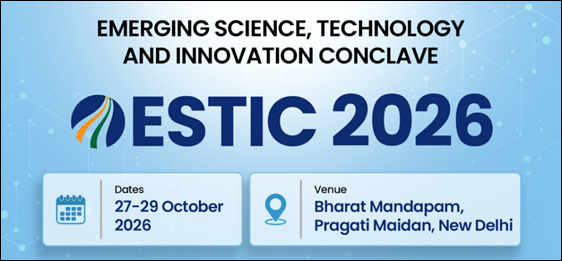
ESTIC-2026, the second edition of India’s Emerging Science, Technology and Innovation Conclave, will be held from 27–29 October 2026. The event will be held at Bharat Mandapam, New Delhi, under the theme “Creative Minds, Catalyzing Science, Empowering Technologies.” Organised by the Council of Scientific & Industrial Research (CSIR), ESTIC-2026 will advance emerging science and technology frontiers. These include Supercomputing and other emerging technologies. The conclave will catalyse strategic collaborations and support India’s vision of Viksit Bharat 2047. Spanning 12 thematic areas, the event will feature plenary sessions, technical discussions and exhibitions.Read More on Agenda: ESTIC 2026
|
The Strategy Behind National Supercomputing Mission
India launched the National Supercomputing Mission (NSM) in April 2015 to strengthen the country’s computing capabilities. The Mission was launched with an outlay of about ₹4,500 crore. It is jointly steered by the Department of Science and Technology (DST) and the Ministry of Electronics and Information Technology (MeitY).
The Mission aims to build self-reliance in supercomputing and strengthen India’s high-performance computing capabilities. It promotes the use of supercomputing for research, development and problem-solving across scientific and technological domains. It also supports the development of solutions for societal applications. The Mission seeks to establish a globally competitive supercomputing ecosystem in India.
The Centre for Development of Advanced Computing (C-DAC), Pune, and the Indian Institute of Science (IISc), Bengaluru, implement the Mission. NSM follows a 'Build approach' consisting of three concurrent phases to create indigenous supercomputing infrastructure: assembly, manufacturing, and design and manufacturing support. This approach combines the expansion of computing infrastructure with the development of indigenous capabilities.
|
Interesting Facts About the Supercomputers
- Unlike regular computers, supercomputers are designed to process large amounts of data at very high speeds. They use multiple processors or computing nodes that work together simultaneously. This allows them to solve complex problems much faster than conventional computers. High-speed connections between these nodes enable them to exchange data efficiently during large-scale computations.
- Supercomputers are sometimes called parallel computers because supercomputing can use parallel processing. Parallel processing is when multiple CPUs work on solving a single calculation at a given time.
- A supercomputer's power is measured in FLOPS (Floating Point Operations Per Second). This tells us how many calculations it can perform in one second. One teraFLOPS (TF) means one trillion calculations per second, while one petaFLOPS (PF) means one quadrillion calculations per second.
- The world’s fastest supercomputer achieves around 2.19 exaflops in 2026. It can perform about 2.19 quintillion calculations per second.
|
Current Status of the Mission
Under NSM, India has established an ecosystem focused on achieving self-reliance in supercomputing. It covers supercomputer design, development, manufacturing, system software and specialised applications. This growing indigenous capability can reduce dependence on imported technologies. It also strengthens India’s domestic high-performance computing ecosystem.
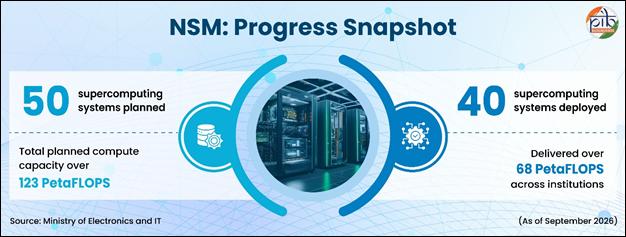
NSM plans to establish a total of 50 supercomputers with a cumulative capacity exceeding 123 PF across various academic/research institutions across India. These systems cater to diverse computational requirements based on their processing capacities.
Evolution of PARAM Series
PARAM 8000, developed by C-DAC and unveiled in 1991, marked India’s entry into indigenous supercomputing with a speed of 1 gigaflop. It laid the foundation for the PARAM series, which evolved through increasingly powerful systems such as PARAM Yuva at 54 teraflops, supporting computationally intensive applications. This supported applications such as weather forecasting, which predicts atmospheric conditions, and computational fluid dynamics, which studies fluid flow, etc. The series later expanded India’s supercomputing capabilities for both domestic research and international deployments.
Expanding Computing Capacity
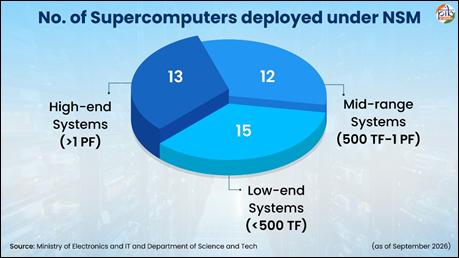
As of September 2026, India had deployed 40 supercomputers with a combined capacity of 68 PF. This includes 13 high-end systems exceeding 1 PF. Additionally, 12 mid-range systems have capacities between 500 TF and 1 PF. Another 15 systems have capacities below 500 TF. These machines have been built locally and commissioned across the country. The Mission continues to advance infrastructure, applications, research and development, and human resource development.
|
Supercomputing for Sustainable Development
NSM contributes to 11 United Nations Sustainable Development Goals (SDGs) by applying advanced computing to areas of national development. Its applications support climate action through flood prediction, forest-fire management and climate modelling, while strengthening education and skill development through HPC training. The Mission also promotes innovation, indigenous technology, economic growth and collaboration among academia, industry and research institutions.

|
National Applications of Supercomputing under NSM
Supercomputers deployed under NSM support large-scale simulations and fast data processing, enabling national applications across various sectors.
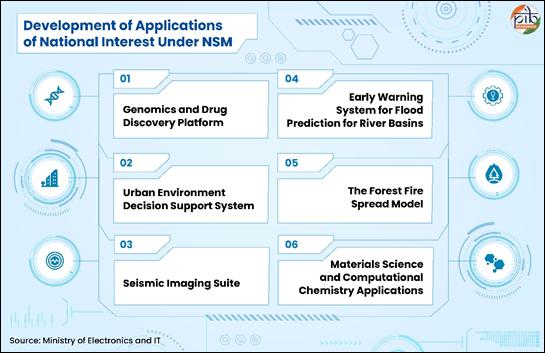
- Genomics and Drug Discovery Platform: It studies large sets of molecules to help find and test drugs. It was used during COVID-19 to screen existing drugs and also predict side effects like heart risk.
- Urban Environment Decision Support System: It uses detailed models to track weather and air pollution. It predicts heavy rain and pollution so cities can prepare and mitigate damage.
- Seismic Imaging Suite: It aims to improve oil and gas exploration by using advanced algorithms to map subsurface structures. Its performance matches commercial seismic imaging tools.
- Early Warning System for Flood Prediction for River Basins: It leverages data analysis and predictive models to forecast floods up to 2 days in advance. It is being used for the Mahanadi River basin to protect communities and infrastructure.
- The Forest Fire Spread Model: It combines satellite remote sensing with computational models to predict how forest fires will spread. It has been tested in regions like the Sikkim Himalayas using a HPC system.
- Materials Science and Computational Chemistry Applications: It provides a suite that allows simulations of atoms, molecules, and alloys. These facilitate the study of their behaviour.
These applications demonstrate how India’s growing HPC infrastructure is strengthening research, supporting evidence-based decision-making and addressing complex challenges across health, environment, energy and advanced science.
Achievements: Indigenous Components Developed Under NSM
Under the NSM, a complete ecosystem has been established with the focused goal of achieving self-reliance in supercomputing. It includes, inter alia, the design, development, and manufacturing of critical supercomputing sub-components, as follows:
- Rudra Series of Servers: It is a key supercomputing component. It provides the processing power needed to run complex calculations, simulations and AI workloads. It has been indigenously designed and developed by C-DAC, with its technology transferred to Indian Electronics Manufacturing Services (EMS) partners for manufacturing.
PARAM Rudra Series: Advancing Indigenous Supercomputing
A major milestone of NSM has been the development of the PARAM Rudra supercomputers, built using indigenously designed and manufactured Rudra servers and an indigenous system software stack. They support a wide range of applications like advanced research in astronomy, material science, atomic physics, and earth sciences. As of September 2026, 6,000 Rudra servers had been deployed in PARAM Rudra supercomputers, with another 1,500 servers under manufacturing.
- High-Speed Interconnect Network: A high-speed inter-communication network between computer nodes has been developed and tested with speeds of 100 Gbps and 200 Gbps. It enhances data transfer and communication between computing nodes, strengthening India’s supercomputing capabilities.
- Indigenous Cooling Technology: Cooling technology has been indigenously developed and demonstrated and is now in the deployment stage. It is important for maintaining the operating temperature of high-performance computing systems and have better power efficiency.
- High Performance Computing (HPC) System Software: A complete HPC system software stack has been developed and integrated with supercomputing systems to support their efficient operation and management.
- PARAM Shavak: It is a supercomputing-in-a-box that has been designed, developed and manufactured in India to meet the HPC and AI computing needs of students and researchers in engineering colleges and universities.
- HPC Applications for National Needs: HPC applications have been developed and deployed across areas such as genomics and drug discovery. These applications support organisations including the India Meteorological Department (IMD), Central Water Commission (CWC), Central Pollution Control Board (CPCB), and the Ministry of AYUSH.
From core computing infrastructure to applications addressing national needs, NSM is expanding India’s capacity to develop and use advanced computing technologies within the country.
Building a Skilled Workforce for High-Performance Computing in India
As access to supercomputing infrastructure expands, NSM is also building the skills needed to use these resources effectively. NSM infrastructure has supported over 16,000 researchers, including more than 2,900 PhD scholars, across over 400 institutions. These systems have executed more than 1.5 crore compute jobs (a complex task or simulation assigned to a supercomputer) and contributed to over 1,990 research publications, as of September 2026.
To further expand the skilled user base, the Mission has developed a range of training and learning initiatives:
- HPC and Deep Learning Awareness Programmes: Workshops are conducted across India with NSM institutions to introduce students, researchers and faculty to High-Performance Computing (HPC) and Deep Learning (DL).
- Hackathons and Bootcamps: HPC and DL hackathons and bootcamps provide hands-on experience and encourage problem-solving in HPC, Artificial Intelligence (AI) and Generative AI.
- Faculty Development and Quality Improvement Programmes: Faculty, including teachers from non-computer science disciplines, are trained in HPC, AI, Machine Learning (ML) and DL in collaboration with the All-India Council for Technical Education (AICTE).
- EduHPC Workshop: An annual workshop provides comprehensive training in HPC to faculty from institutions across India.
- High-Performance Scientific Computing Course: A structured course on the SWAYAM platform, under the National Programme on Technology Enhanced Learning (NPTEL), helps learners build a strong foundation in HPC.
- HPC Shiksha Portal: The portal provides access to HPC resources, recorded lectures and learning materials, enabling students and teachers to gain practical experience.
- NSM Users Forum: The forum provides a platform for users across NSM sites to discuss technical issues, resolve queries and share knowledge and best practices.
National Knowledge Network (NKN)
The NKN serves as the backbone of India’s supercomputing ecosystem under the National Supercomputing Mission. It connects supercomputing facilities across academic and research institutions through a high-speed national network. This enables researchers and institutions to access advanced computing resources and collaborate across geographical boundaries. The network strengthens the sharing of computational resources, research capabilities and scientific knowledge. Through this connected infrastructure, the Mission is expanding access to High-Performance Computing across India.
These initiatives are expanding HPC skills beyond specialised computing institutions and building a broader workforce equipped to use advanced computing.
Way Forward
India’s supercomputing ecosystem is set to grow significantly by expanding computing capacity, developing more advanced technologies within the country, and making high-performance computing (HPC) more accessible to researchers, academia and industry. The focus of the mission will be on building faster, energy-efficient and reliable systems, strengthening Indian hardware and software capabilities, and developing skilled professionals. Greater integration of Artificial Intelligence (AI) and HPC will help address important challenges in areas such as weather and climate, healthcare, agriculture, energy, drug discovery, engineering and scientific research. By bringing together government, academia, industry, startups and research institutions, India can turn advanced computing into practical solutions, drive innovation and economic growth, and build a secure, sustainable and self-reliant supercomputing ecosystem.
References
Department of Science and Technology
Ministry of Electronics & IT
Centre for Development of Advanced Computing
Click here to see pdf
PIB Research
(रिलीज़ आईडी: 2318908)
आगंतुक पटल : 442