PIB Backgrounder
Pradhan Mantri Anusuchit Jaati Abhyuday Yojna (PM-AJAY)
Building Pathways to Progress
प्रविष्टि तिथि:
28 SEP 2026 11:57AM by PIB Delhi
|
Scheduled Castes (SCs), constituting 16.6% of India's population, have historically faced barriers to socio-economic advancement and inclusion. Addressing these disparities is vital to ensuring social justice, equal opportunity, and broader participation in India's development journey. Recognising these development gaps, the Government of India launched Pradhan Mantri Anusuchit Jaati Abhyuday Yojana (PM-AJAY) to foster the overall development of Scheduled Castes.
|
A Vision for Inclusive Empowerment
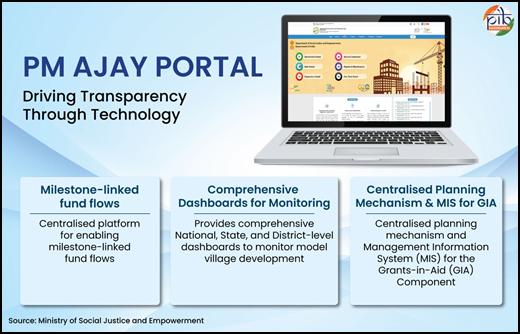
The Pradhan Mantri Anusuchit Jaati Abhyuday Yojna (PM-AJAY) is a 100% centrally sponsored scheme launched in FY 2021-22. It envisions achieving socio-economic and educational empowerment of Scheduled Caste communities through a comprehensive and integrated approach. The Government has launched ‘PM-AJAY’ Mobile App and ‘PM-AJAY’ Portal for expedited and quality implementation of the PM-AJAY Scheme.
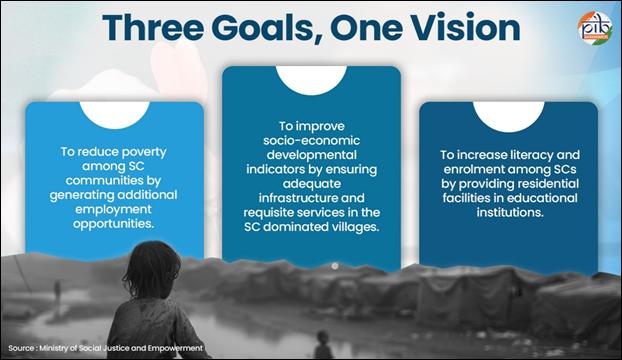
PM-AJAY is a merger scheme of three erstwhile centrally sponsored schemes, namely, Pradhan Mantri Adarsh Gram Yojana (PMAGY), Special Central Assistance to Scheduled Castes Sub Plan (SCA to SCSP) and Babu Jagjivan Ram Chhatrawas Yojana (BJRCY). Implemented by the Ministry of Social Justice & Empowerment, PM-AJAY turns its broader goal of ensuring development for everyone into practical action through the following three main objectives:
- To reduce poverty of the SC communities by generation of additional employment opportunities. It can be done through skill development, income generating schemes and other initiatives. These interventions seek to enhance livelihood opportunities and enable beneficiaries to engage in sustainable income-generating activities.
- To improve socio-economic developmental indicators by ensuring adequate infrastructure and requisite services in SC dominated areas. The scheme seeks to bridge critical developmental gaps and improve access to essential facilities that contribute to a better quality of life.
- To increase literacy and encourage enrolment of SCs in schools and higher educational institutions. It is achieved by providing adequate residential facilities in quality institutions and residential schools, especially in aspirational districts/SC-dominated blocks and elsewhere in India.
Who Can Benefit from PM-AJAY?
At the heart of PM-AJAY lies a carefully defined framework of eligibility, ensuring that the benefits of the scheme reach the individuals and communities for whom they are intended. Accordingly, access to the scheme is determined on the basis of the following criteria:
- While selecting beneficiaries under GIA component, priority is given to the families/persons having annual income not more than Rs. 2.50 lakh per annum. SC members of SC majority group are also be eligible.
- In case of Infrastructure Development, villages having 40% or more SC population and total population more than or equal to 500 are eligible for grants under the Scheme.
PM-AJAY in Action
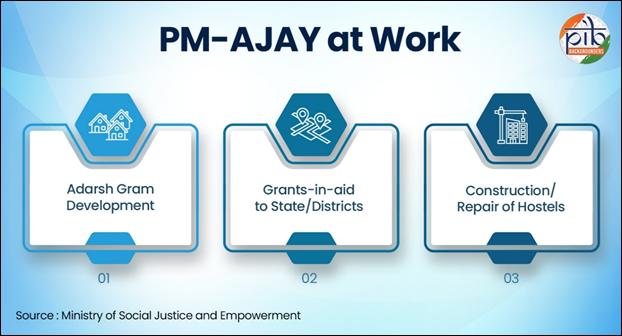
The architecture of PM-AJAY rests on three distinct components to address various aspects of development:
Development of SC dominated villages into “Adarsh Gram”
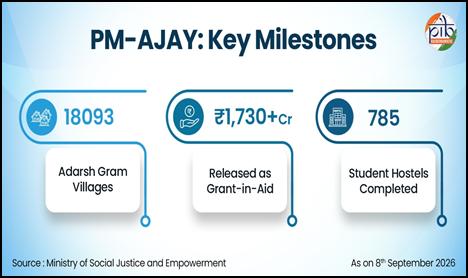
Transforming SC-majority villages into ‘Adarsh Grams’ (model villages) by filling critical gaps in infrastructure and services. The Adarsh Gram component has covered 47,243 villages, benefiting more than 47.79 lakh citizens across the country. A total of 46,944 development works have been completed, while 27,032 Village Development Plans (VDPs) have been prepared. As on 8th September 2026, 18,093 villages have been declared as Adarsh Grams, reflecting significant progress in improving infrastructure, basic services and quality of life in Scheduled Caste-majority villages.
|
An ‘Adarsh Gram’ is one wherein people have access to various basic services. The minimum needs of all the sections of the society are fully met and disparities are reduced to a minimum. These villages are envisioned to have all essential infrastructure and universal access to basic services required for dignified living. This creates an enabling environment for every resident to realise their full potential.
|
Grants-in-aid for Socio-Economic Projects to State/Districts
Providing financial assistance for district/state-level projects aimed at the socio-economic betterment of SCs. This includes:
- Increasing the income of the target population by way of comprehensive livelihood projects, including skill development and related infrastructure.
- Improving socio-economic developmental indicators by creating adequate infrastructure in SC dominated villages.
- Increasing literacy and encouraging enrolment of SCs in schools by providing residential schools where required.
More than ₹1,730 crore has been released directly to States under the Grants-in-Aid component from FY 2021-22 to FY 2025-26. It extends skilling and livelihood support to over 2.5 lakh individual and group beneficiaries.
Construction/Repair of Hostels
- The construction and repair of hostels is one of the means to enable and encourage students belonging to Scheduled Castes (SC) to attain quality education. Such hostels are immensely beneficial to the students hailing from rural and remote areas of the country. As of September 2026, a total of 785 student hostels have been completed. The Government has allocated central assistance of ₹61.46 crore for FY 2026-27 for construction of two hostel projects (one for girls and one for boys) to provide accommodation for 264 students.
Investing in Empowerment
Effective implementation of any welfare initiative requires sustained financial support. An overview of the funding framework under PM-AJAY is presented below.
|
Funding at a Glance
|
Funding Pattern
|
100% Centrally Funded Scheme
|
|
State/UT Contribution
|
States/UTs may supplement the scheme with additional resources, if required
|
|
Component-wise Allocation
|
- Up to 50% - Gap-filling activities in selected Adarsh Gram villages.
- Up to 5% - For setting up and operation of the TSG (Technical Support Group) and PIU (Project Implementation Units) at the Central level as well as PIU at the State and District level.
- Up to 2% – Construction and repair of hostels- to be utilized for Central Institutions and released directly to the implementing agencies by the Ministry.
- Remaining funds - Grants-in-aids for the Projects at District/State, allocated based on Scheduled Caste population and ratio of State SCSP to the Annual Plan as compared to the SC population in the States/UTs.
|
|
Maintenance
|
Post completion of the infrastructure projects under the scheme, their upkeep and operations shall be taken care of by the State Governments/implementing agencies, as the case may be.
|
|
A Digital Leap Towards Effective Governance
The recent launch of the ‘PM-AJAY’ Mobile App and ‘PM-AJAY’ Portal aims to transition from paper-based workflow and processing to an end-to-end digital workflow and processing on a real-time basis.
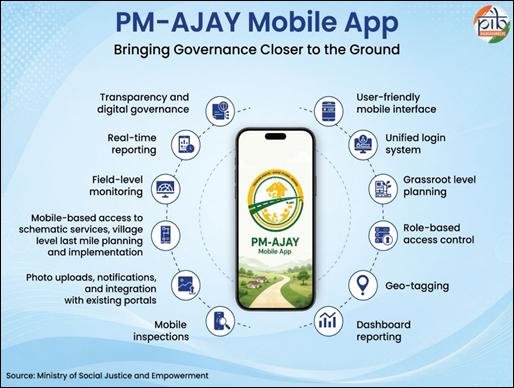
Good governance is built on the principles of transparency, accountability and efficiency.
Digital technologies have transformed the planning, delivery and monitoring of public programmes. Technology-enabled governance improves information access, strengthens monitoring and supports data-driven decision-making. It also enhances coordination, transparency and the overall effectiveness of programme implementation.
The Next Chapter in India’s Growth Story
The journey towards Viksit Bharat @2047 is founded on the principle that the benefits of development must reach every section of society and create opportunities for all to progress. In this endeavour, PM-AJAY plays a significant role in advancing the socio-economic and educational empowerment of Scheduled Caste communities through targeted interventions that promote sustainable livelihoods, quality education and improved infrastructure. As the scheme continues to expand, greater use of technology, stronger monitoring mechanisms, and focused last-mile delivery are enhancing its effectiveness and outreach. By empowering individuals and communities to realise their full potential and actively participate in India's development journey, PM-AJAY will continue to foster a more inclusive, equitable, and empowered nation.
References
Ministry of Social Justice and Empowerment:
https://socialjustice.gov.in/
https://socialjustice.gov.in/schemes/104
https://socialjustice.gov.in/writereaddata/UploadFile/71441776233188.pdf
https://pmajay.dosje.gov.in/
https://pmajay.dosje.gov.in/Writereaddata/Guidelines.pdf
https://www.pib.gov.in/PressReleasePage.aspx?PRID=2265530®=3&lang=1
https://www.pib.gov.in/PressReleasePage.aspx?PRID=2285859®=48&lang=1
https://www.pib.gov.in/PressReleasePage.aspx?PRID=2268689®=48&lang=1
https://www.indiabudget.gov.in/doc/eb/sbe93.pdf
Ministry of Finance:
https://www.indiabudget.gov.in/doc/OutcomeBudgetE2026_2027.pdf
myScheme:
https://www.myscheme.gov.in/schemes/pmajay-ag
Click here to see pdf
*****
PIB Research
(रिलीज़ आईडी: 2315840)
आगंतुक पटल : 320